‘I very nearly threw the whole project out’: Żejtune film director
How a retired għana singer inspired director’s second feature film Żejtune
Film director Alex Camilleri almost abandoned his second feature film, Żejtune.
But it was saved by a chance encounter with a silver-haired man sitting on a bench in Birkirkara who would go on to become one of the film’s central figures.
Camilleri is the writer and director of Żejtune, a film that follows the story of Mar, a young Maltese woman determined to leave the country. After the death of her estranged mother, Mar inherits plots of land which she plans to sell to pay her way out of Malta.
During this process, however, she meets Nenu, an għannej (traditional Maltese folk singer), who helps her see the island through his eyes.
But Camilleri and his casting director Edward Said had a problem: they struggled to find their folk singer.
In his debut feature, Luzzu, which tells the story of a struggling fisherman, Camilleri chose as his star Jesmark Scicluna, who was cast despite having no prior acting experience.
In Żejtune, Camilleri wanted a similar method through the character of Nenu, an affable għannej. Camilleri said the role could not have been played by a professional actor, citing several factors, including the vocal demands of traditional għana singing.
“Even ethically, who is better to portray the music and experience of a guy like Nenu than someone who has lived it?”
Despite extensive research and conversations with people within the għana scene, Camilleri struggled to find someone who embodied everything he was looking for.
The road to Nenu almost derailed the project entirely.
“I very nearly threw the whole project out,” he said.
But then he heard whispers “about a guy who hadn’t sung in 15 years and that he was from Birkirkara”. With cautious optimism, he and Said arranged to meet retired singer Nenu Borg.
How Camilleri found his Nenu
While searching for parking, the pair repeatedly noticed “an elderly gentleman with an amazing shock of white hair and wearing a very cool camel coloured leather jacket” sitting on a bench.
Camilleri remembered thinking: “If the guy that I’m about to meet has half of the charisma of that guy on the bench, I’ll be happy.” As fate would have it, the man was Nenu Borg himself. Camilleri had found his Nenu.
The film also stars Michela Farrugia, who appeared in Luzzu and whom Camilleri described as “one of the foundations of the project as well as a collaborator in the truest sense”. She is joined by Frida Cauchi, also seen in Luzzu, and musician Michael Azzopardi, who makes his big-screen debut in Żejtune.
Azzopardi’s involvement, Camilleri said, helps inject a more contemporary dimension into Malta’s indigenous music scene.
“I thought that his artistry with language would be a nice connection to għana which I’ve heard described surprisingly more of an oral tradition, than as a musical one,” Camilleri said.
He noted that people were often surprised to learn he was working on a film about għana that was neither a documentary nor a period piece, as though the tradition no longer had relevance.
“I think it really didn’t deserve that reaction because maybe it doesn’t exactly resemble what it once did. It is just something else,” he said. “Ultimately, music is immaterial and it can’t be broken.”
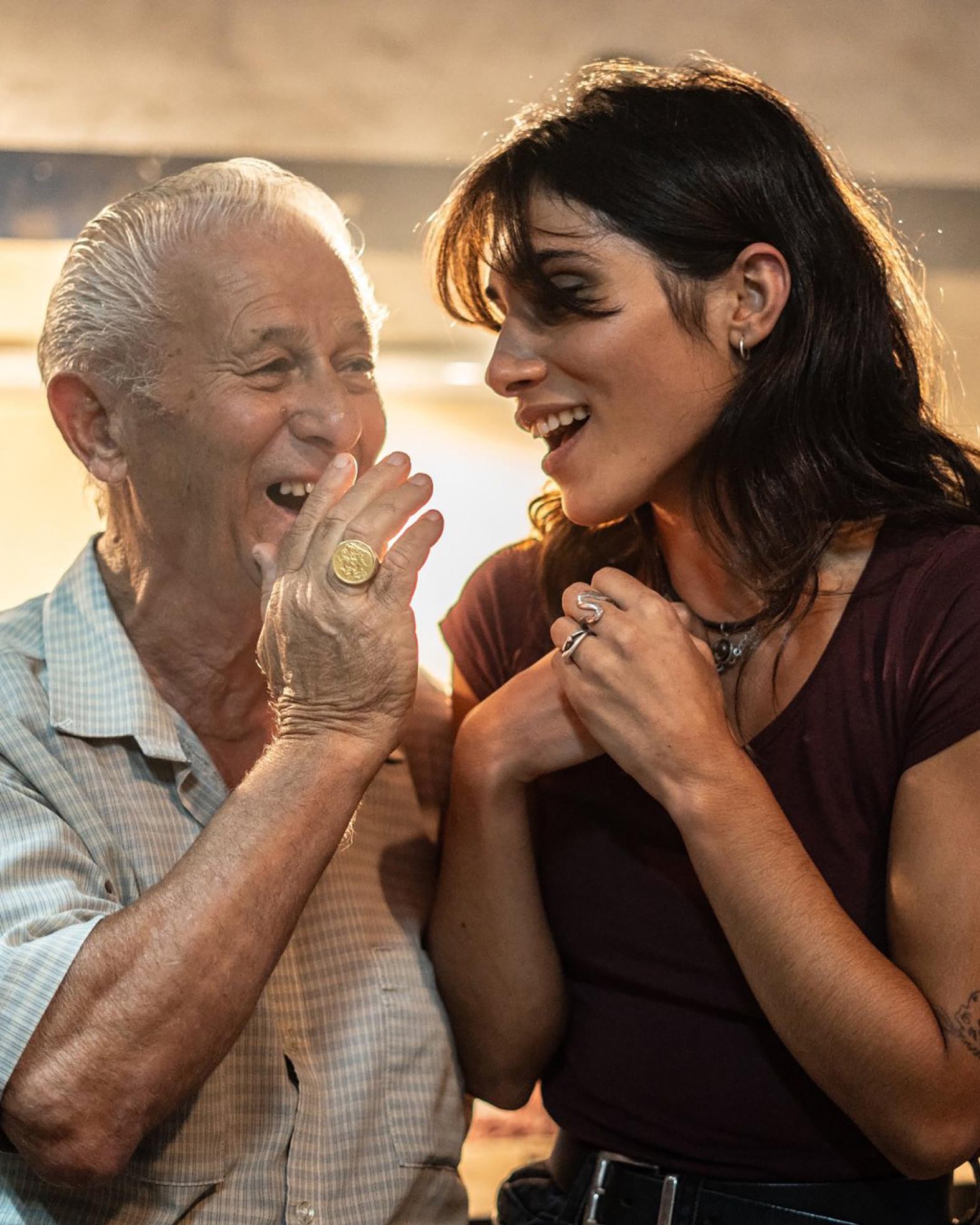 Stars of Żejtune, Nenu Borg and Michela Farrugia.
He describes the film as being about two people whose fates become intertwined “and how they each navigate their own questions of belonging”. The film sees Mar grappling with fundamental questions about identity and home, asking: “Where does she ultimately belong? And what are the costs of leaving the place that she is from?”
While the Maltese-American director stressed that Żejtune is not autobiographical, he acknowledged that the story is personal.
“I didn’t really have a home. I left New York City during the pandemic to launch Luzzu in Malta and pretty much all I had was a carry-on suitcase and a return ticket,” he said.
Camilleri intended to split his time between Malta and New York while developing Żejtune. “I thought I would develop the film, then go back to my real life. Come back to Malta and then go back to my real life. And then I realised that, you know, real life didn’t exist anymore.”
He admitted that choosing Malta over New York as a permanent base was not an easy decision, particularly as a filmmaker. Yet, almost without noticing, he found himself already rooted on the island.
“I’m only interested in gold. I don’t want bronze or silver. I’m just looking for the gold and the gold is here in Malta,” Camilleri said.
Żejtune opens nationwide on April 8 and will be shown at Eden Cinemas in St Julian’s, Embassy Cinemas in Valletta, and Citadel Cinemas in Gozo.