Imagining a national museum of modern art in our country
It should emerge from the island’s own roots, from the dialogue between the sacred and the secular
When I first began thinking about the need for a national museum of modern art in Malta, I found myself returning to a persistent thought: that our modernist heritage has never been given a home worthy of its ambition. Malta’s modern art exists everywhere and nowhere at once – scattered across state, private and foundation-led institutions, often appearing only in temporary exhibitions, yet never consolidated into a coherent national narrative.
If such a museum were ever to materialise, the question would not only be what to exhibit but where. The building itself should carry meaning; it should be a space that speaks. A museum of modern art in Malta cannot be another anonymous contemporary structure. It should emerge from the island’s own roots, from the dialogue between the sacred and the secular, between the weight of tradition and the restlessness of the modern.
Last summer, I visited the Granet Museum in Aix-en-Provence and the experience truly struck a chord within me. The museum had expanded its exhibition space into the 17th-century chapel of the White Penitents under the title Granet XXe – which now houses the Jean Planque Collection – comprising around 300 paintings, drawings and sculptures from Cézanne, Monet, Van Gogh and Degas to Picasso, Braque, Léger, de Staël and Dubuffet.
What struck me most was how naturally the space absorbed the art. The transformation felt less like an intervention than a revelation. The vaulted ceilings and filtered light gave each modern work a kind of spiritual resonance. The juxtaposition was poetic; a conversation between two forms of transcendence, one sacred, one aesthetic.
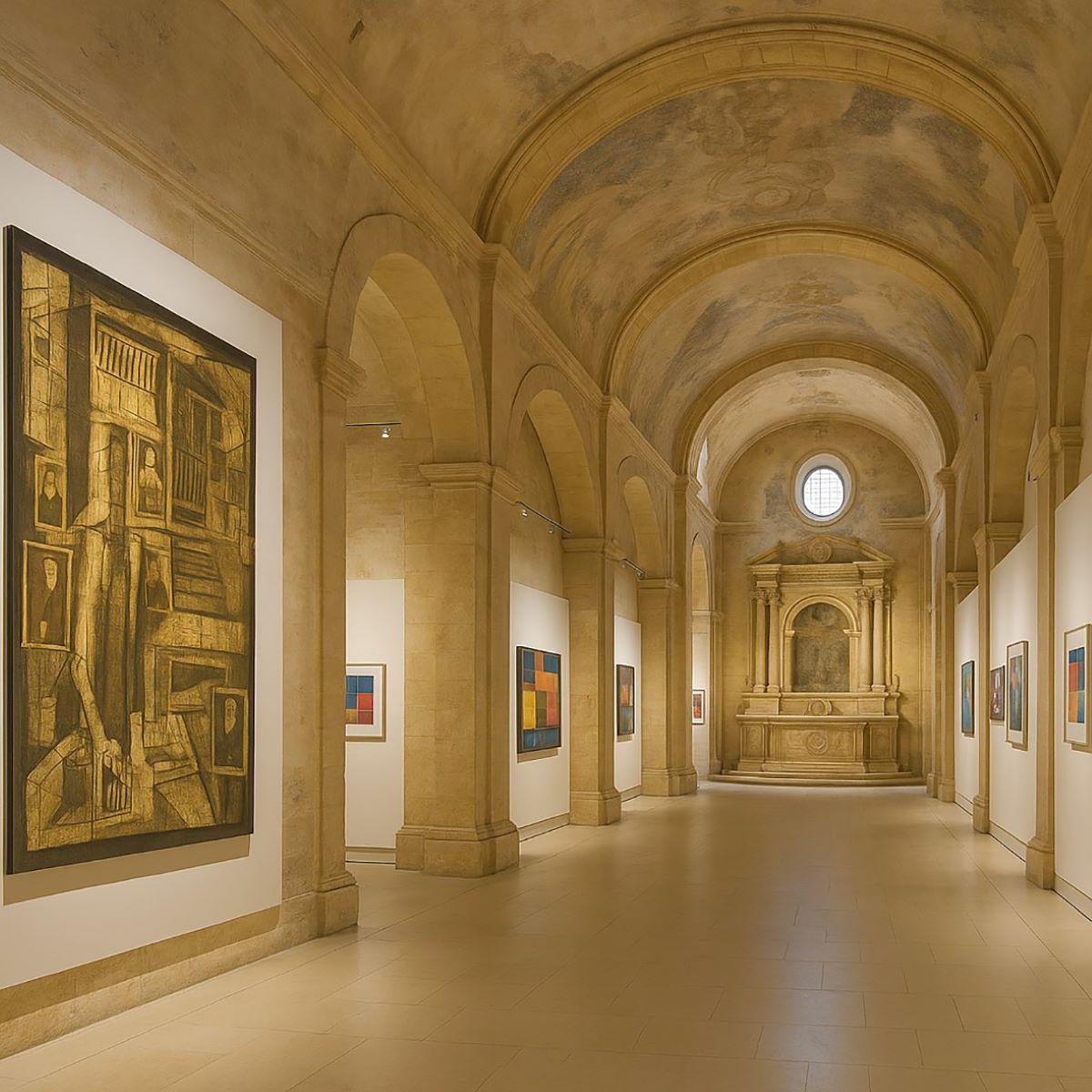 AI-generated image showcasing a work by Antoine Camilleri.
The Granet XXe’s success lies precisely in its ability to merge reverence with reinvention. Its chapel is no longer a place of prayer, yet it retains its aura of contemplation. The modern art displayed within it gains depth from that context. It becomes part of a continuum rather than a rupture.
It made me think of Malta, where chapels and convents stand at every corner, each one an echo of faith and memory. These spaces, still charged with presence, could find renewed life as places of contemplation – not for worship but for art. Like the Granet XXe, they could offer a setting where the old and the new do not compete but complete one another.
I imagine a museum of modern art in Malta as a reanimated historical structure, a space where the island’s past becomes part of the visitor’s experience. The weathered stone, the play of light through apertures, the faint echo of footsteps. All would form part of the aesthetic dialogue.
Such an approach would reflect the very nature of Maltese modernism, which was never about rupture but about negotiation: a negotiation with faith, with insularity, with the colonial legacy and the Catholic ethos. Maltese modern art did not emerge in opposition to tradition but through it. In many ways, the artists themselves were revolutionaries without needing to declare themselves as such.
I imagine a museum of modern art in Malta as a reanimated historical structure, a space where the island’s past becomes part of the visitor’s experience- Rowna Baldacchino
Their modernism, like T.S. Eliot’s ideal of poetic tradition, was not revolutionary in the sense of destruction but of appropriation. They pursued deeply personal idioms, negotiating between sacred and secular, local and universal, each developing a visual language that is both rooted in Malta’s heritage and strikingly modern.
To house such art within a repurposed chapel or historical structure would therefore be symbolically fitting. The building would become a metaphor for the very process of modernisation in Malta, a transformation achieved not by erasure but by reinterpretation.
In Europe, the conversion of religious or historical buildings into museums of modern art has become an established practice. A notable example is the Musée Picasso in Paris housed in the Hôtel Salé, a majestic Parisian mansion of the 17th century. Its baroque architecture, featuring a dramatic central staircase inspired by Michelangelo’s Laurentian Library and rich sculptural ornamentation, forms a striking and resonant setting for Picasso’s modern masterpieces.
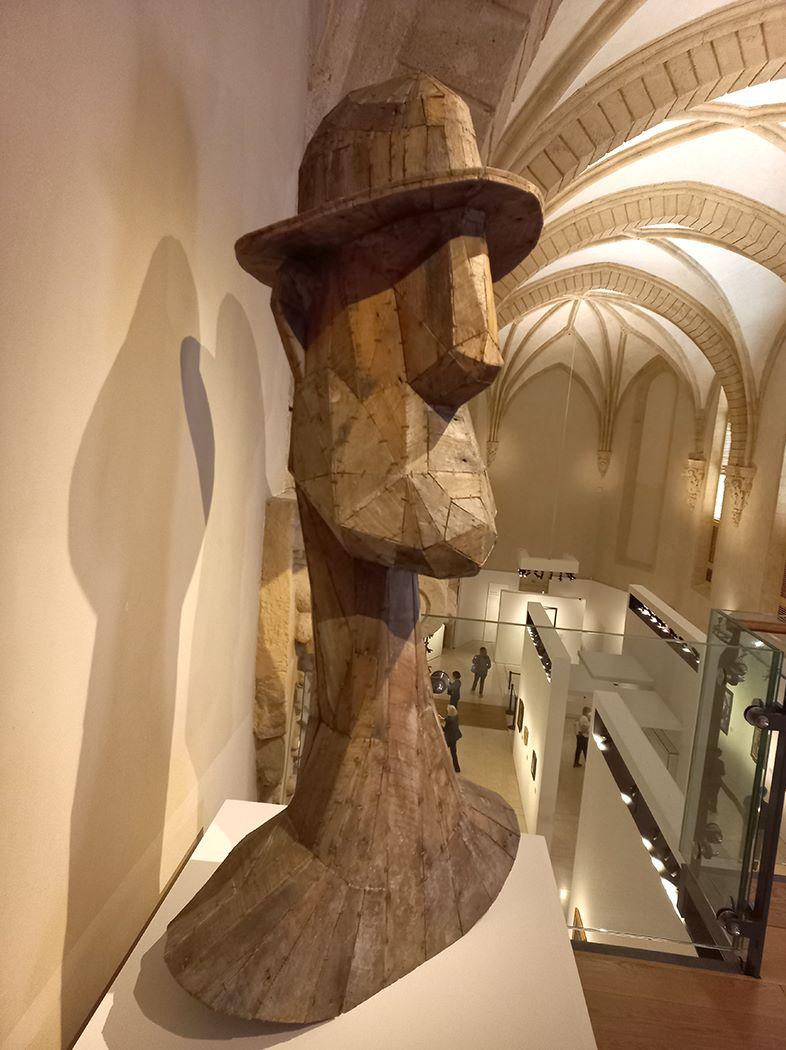 Homme au chapeau no 57 by Kosta Alex at the Granet XXe.
Another example can be found in Treviso at the Museo Luigi Bailo, where the modern art collection of Bailo is housed within a restored Renaissance-era monastery. The museum has undergone extensive redesigns while maintaining the same light and atmosphere of the original Renaissance-era monastery. Its spaces, including the elegant cloisters and original monastery halls, allow visitors to experience the artworks in a dialogue with history.
Malta could thus embrace a similar vision: not the creation of a museum ex nihilo but the transformation of what already exists. In doing so, we would be affirming that our history is a living structure capable of appropriating new meanings.
I sometimes imagine walking into such a space – the air still bearing the reverence of centuries but turned toward another kind of transcendence. Each work would seem to speak to the walls that surround it, to centuries of belief, labour and transformation. It would feel like a conversation across time.
Perhaps it is only a dream within a dream, an idea suspended between memory and possibility. But all cultural renewal begins with such dreaming.
If Malta is ever to give its modern art the home it deserves, it must dare to imagine beyond its inherited hierarchies of value. It must reimagine its own architecture as a vessel for modernity, allowing the old stones to speak in new ways.
Only then will our modern heritage step fully into the light – no longer a footnote to the baroque but its necessary continuation.