Introducing marine biology in early childhood through AI-supported learning
SELBI project: using AI to introduce marine concepts to young children
A research project at the Malta College of Arts, Science and Technology (MCAST) is exploring how artificial intelligence (AI) can support early childhood educators introduce young children to blue skills and marine sustainability in meaningful ways.
The ‘Supporting Early ChiLdhood Education in Blue Skills with Generative Artificial Intelligence’ (SELBI) project gathers expertise in early childhood education and care, marine biology, AI and applied research. Its purpose is not to replace educators, but support them in planning learning experiences connected to the sea, marine life and environmental responsibility.
This work is aligned with Malta Vision 2050 and Malta’s Sustainable Development Strategy for 2050, both of which place environmental responsibility and sustainable economic transition at the centre of national policy. In an island context like Malta, the sea is central to everyday life, culture and identity. Yet, ideas linked to marine environments and sustainability are not always easy to translate into experiences that are suitable for very young children. SELBI responds to this challenge by developing an AI-supported platform designed for educators as part of their professional planning and curriculum-making.
At a time when AI is often discussed in abstract terms, SELBI offers a practical example of how it can be used carefully and purposefully
What makes the project distinctive is its emphasis on responsible and grounded use of AI. Rather than generating generic information, the platform is designed around a curated knowledge base so that responses can be scientifically accurate, educationally meaningful and relevant to Malta’s context. In this way, AI becomes a support mechanism for professional judgement, helping educators turn complex matters into pedagogically appropriate activities and conversations.
The project also reflects a strong interdisciplinary approach. By combining knowledge from education, marine science and AI, SELBI seeks to ensure that what is offered to educators is both pedagogically sound and scientifically reliable. SELBI also offers a wider educational purpose: to nurture curiosity, awareness and care for the marine world from the earliest years of learning.
SELBI has already progressed through several important stages. The project began with a nationwide survey of educators in Kindergarten 1, Kindergarten 2, Year 1 and Year 2 to identify where support was most needed in relation to marine sustainability and blue skills.
In response, the team developed a dedicated knowledge base with early childhood-appropriate, inquiry-based material for Kindergarten 1 up to Year 2 classrooms in Malta, alongside an AI-supported platform designed to provide educators with scientifically accurate and pedagogically suitable guidance. A group of educators contributed to the testing of the platform, and the team is currently evaluating the validity of the project as a whole with a view to scaling it up further.
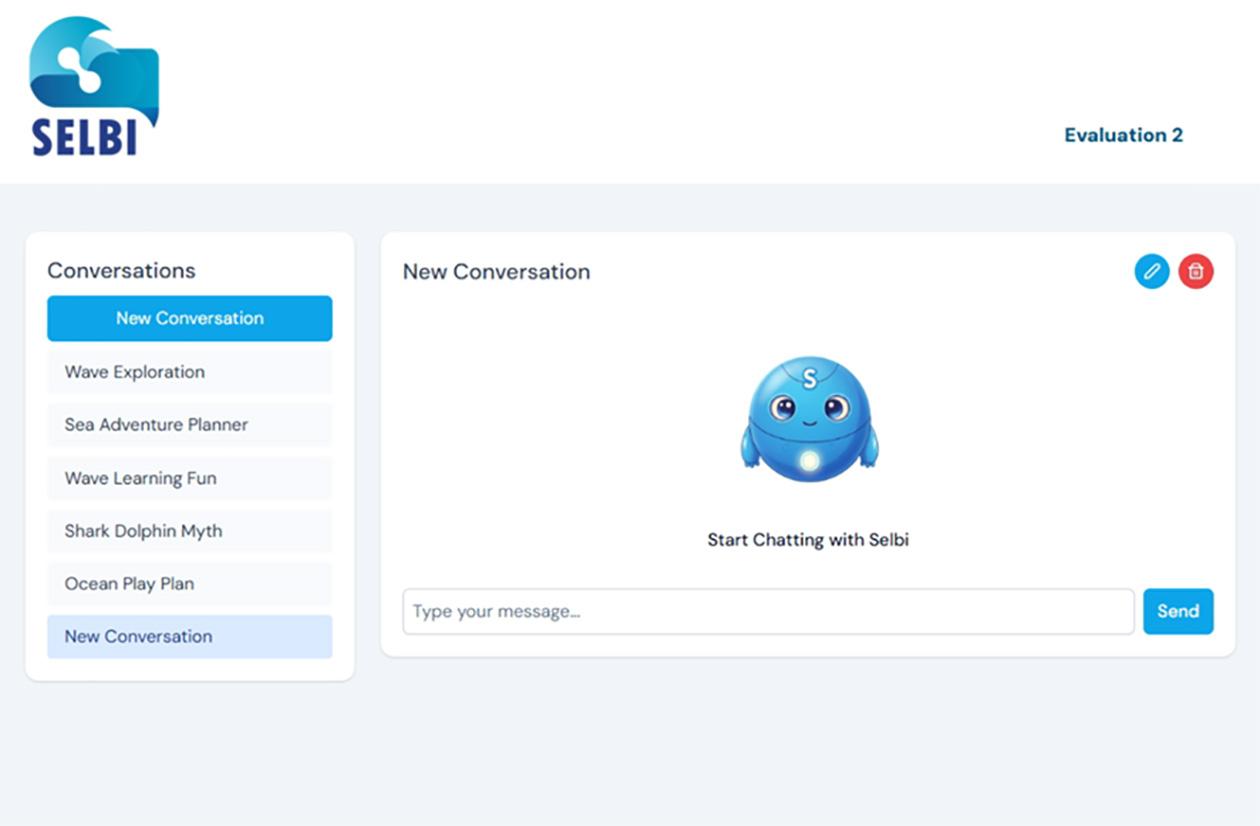 The SELBI educator facing prototype interface.
At a time when AI is often discussed in abstract terms, SELBI offers a practical example of how it can be used carefully and purposefully. By linking innovation with sustainability and early childhood education and care, the project aims to help educators engage children with issues that matter deeply for Malta’s future.To learn more about SELBI and follow its ongoing progress, visit its website selbi.education, and social media pages at www.facebook.com/selbi.education and www.linkedin.com/company/106354084/admin/dashboard.
SELBI is funded by Xjenza Malta under the Research Excellence Programme (Grant Agreement REP-2024-005).
The SELBI team consists of six academics at MCAST: Shirley Ann Gauci and Francis Delicata from the Applied Research and Innovation Centre; Alan Gatt and Frankie Inguanez from the Institute of Information and Communication Technology; Heathcliff Schembri from the Institute of Community Services; and Kimberly Terribile from the Institute of Applied Sciences, with expertise spanning early childhood education and care, artificial intelligence, marine science and research.