Iran announces Mojtaba Khamenei as its new supreme leader
Israeli forces land in eastern Lebanon on 15 helicopters across the Syrian border
Iran's Assembly of Experts has announced Mojtaba Khamenei, 56, the son of the slain Ayatollah Ali Khamenei, as the country's new supreme leader.
In a lengthy statement, the assembly said that "after careful and extensive studies... in today's extraordinary session, Ayatollah Seyyed Mojtaba Hosseini Khamenei (may Allah protect him) is appointed and introduced as the third leader of the sacred system of the Islamic Republic of Iran, based on the decisive vote of the respected representatives of the Assembly of Experts."
Earlier, US President Donald Trump had warned that Iran's new supreme leader would not last long without his approval.
Trump dismissed the younger Khamenei as an unacceptable "lightweight".
Mojtaba Khamenei is regarded as a conservative figure, notably because of his ties to the Revolutionary Guards, the ideological arm of the Islamic republic's military.
Israel's military has warned any successor that "we will not hesitate to target you".
Iran launches missiles as Khamenei's son takes charge
Iran fired missiles at Israel and Gulf nations early Monday after the Islamic republic named Mojtaba Khamenei its new leader, despite threats by the United States and Israel to target him next.
Israel launched a new wave of strikes, this time targeting infrastructure in central Iran, as the expanding war sent stocks plunging and crude prices surging 30 percent on supply disruption fears.
Saudi Arabia intercepted drones headed for an eastern oil field, while the United Arab Emirates and Kuwait reported missile attacks and Bahrain said sirens were activated.
State media showed a projectile to be launched at Israel bearing the slogan, "At Your Command, Sayyid Mojtaba", using an Islamic honorific.
- Oil price spikes -
As Iran retaliates against its oil-rich Gulf Arab neighbours, the benchmark price for a barrel of crude soared beyond $100 for the first time since Russia's invasion of Ukraine four years ago.
Trump dismissed the price spike, a politically sensitive issue in the United States, as a "small price to pay" for removing the alleged threat of Iran's nuclear programme.
But markets across Asia, where key economies Japan and South Korea are heavily dependent on energy imports, plunged on Monday.
In a sign that the United States does not expect a quick end to the war, the State Department ordered non-emergency staff to leave Saudi Arabia, days after a drone hit the US embassy.
As questions swirl over the length of the war, Trump told the Times of Israel that any decision on when to end hostilities will be a joint one with Israel's Prime Minister Benjamin Netanyahu.
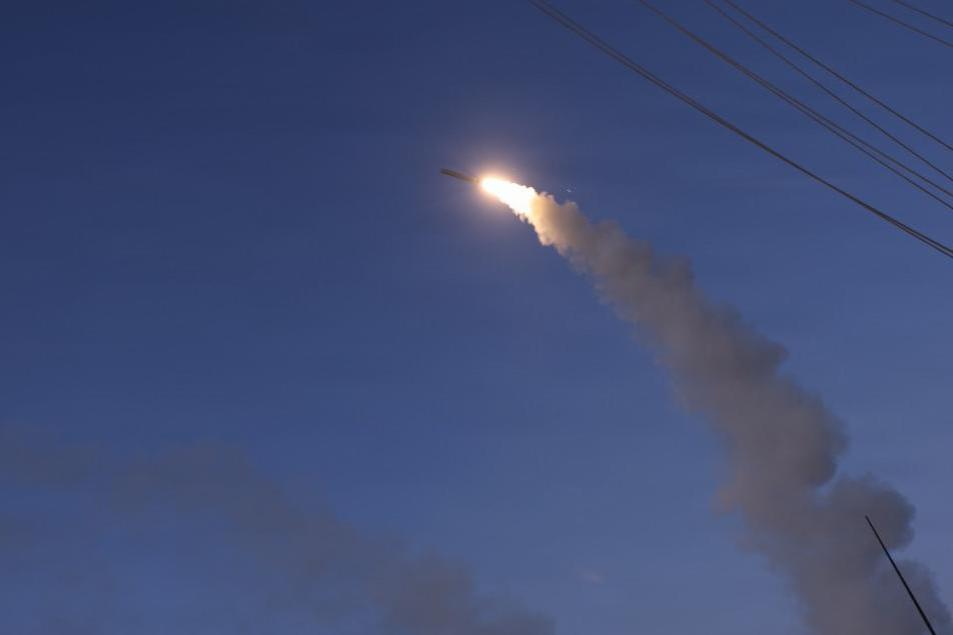 Arleigh Burke-class guided-missile destroyer USS Thomas Hudner (DDG 116) firing a Tomahawk land attack missile at Iran.
"I think it's mutual... a little bit. We've been talking. I'll make a decision at the right time, but everything's going to be taken into account," Trump said, in response to a question on whether he alone will decide.
Few expect major changes under the younger Khamenei, a trained cleric close to Iran's powerful military force the Islamic Revolutionary Guard Corps.
The Guards quickly pledged support for the new leader, who comes into the role with far less experience than his father -- a former president under the first supreme leader, Ayatollah Ruhollah Khomeini.
The Guards said in a statement they were "ready for complete obedience and self-sacrifice in carrying out the divine commands" of the new leader.
Foreign Minister Abbas Araghchi said the naming of the new leader will "guarantee national sovereignty and territorial integrity" as he led Iranian diplomats in declaring "our allegiance" to Khamenei.
- 'Fierce clashes' -
The multi-front war intensified in Lebanon on Monday, with Iran-backed militants Hezbollah saying they were engaging Israeli forces who landed in eastern Lebanon on 15 helicopters across the Syrian border.
Lebanon was drawn into the Middle East war last week when Hezbollah attacked Israel in response to the killing of Ali Khamenei.
Hezbollah said its fighters "engaged the helicopters and the infiltrating force with appropriate weapons, and the confrontation" was ongoing.
Lebanon's state-run National News Agency earlier reported "fierce clashes" around the town of Nabi Sheet, where an Israeli operation over the weekend killed 41 people.
Israel had struck a hotel in central Beirut on Sunday, targeting five commanders of the Revolutionary Guards' international Qods Force, the patron of Hezbollah, as they met at a Beirut hotel.
Lebanon's health ministry said four people died and 10 others were injured in the Beirut strike.
Lebanon's health minister said Israeli strikes have killed at least 394 people since the start of the war, including 83 children and 42 women.
In Bahrain, the health ministry reported 32 people wounded overnight by an Iranian drone attack on the island of Sitra.
The wounded include a 17-year-old girl who suffered severe head and eye injuries, and a two-month-old baby, according to the ministry.
Saudi Arabia said Sunday that two people were killed and 12 wounded as a projectile landed in Al-Kharj province.
Iran's health ministry said Sunday that at least 1,200 civilians had been killed and around 10,000 wounded -- figures AFP could not independently verify.
In Israel, Iranian missile attacks have killed 10 people, according to authorities. Two soldiers were killed in Lebanon, the military said.