‘I don't know if they're alive’: Iranians in Malta fear for loved ones back home
Hundreds believed to have been killed and more than 10,000 detained by Iranian security forces after protests calling for end to government
Iranians living in Malta have described their fear for loved ones back in Iran, as the Islamic Republic continues brutal crackdowns against protesting civilians amid nationwide protests.
Hundreds are believed to have been killed and more than 10,000 people detained by Iranian security forces after protests calling for an end to the government headed by Supreme Leader Ayatollah Ali Khamenei spread to 186 cities across all 31 provinces.
International media reports describe hospitals overwhelmed with dead and injured civilians while the Iranian regime has imposed an internet blackout, limiting the flow of information out of the country.
Soroush, an Iranian Kurd who left Iran six years ago at the age of 30 and who asked Times of Malta not to include his surname, said he was “worried for my family and friends – and my homeland”.
Iranian Kurds have long faced repression in Iran, including targeted brutal crackdowns and economic marginalisation.
Soroush said he had been left without news about his loved ones since the internet blackout, stressing he was “hugely hopeful that we see regime change at last”.
“It’s breaking my heart,” he said, explaining that he had parents and siblings – including a younger brother studying in Tehran – back in Iran.
“The protestors should have happy lives and be starting families of their own,” he said, “not having to protest and being killed by the regime”.
Describing life under Iran’s “brutal regime”, Soroush said the country’s government “want to be involved in everything; they tell us what to wear, who to marry, and force people to obey orders”.
“The young generation is so brave to defy orders,” he said. “Iran is a beautiful country, but with the dictatorship it’s impossible.”
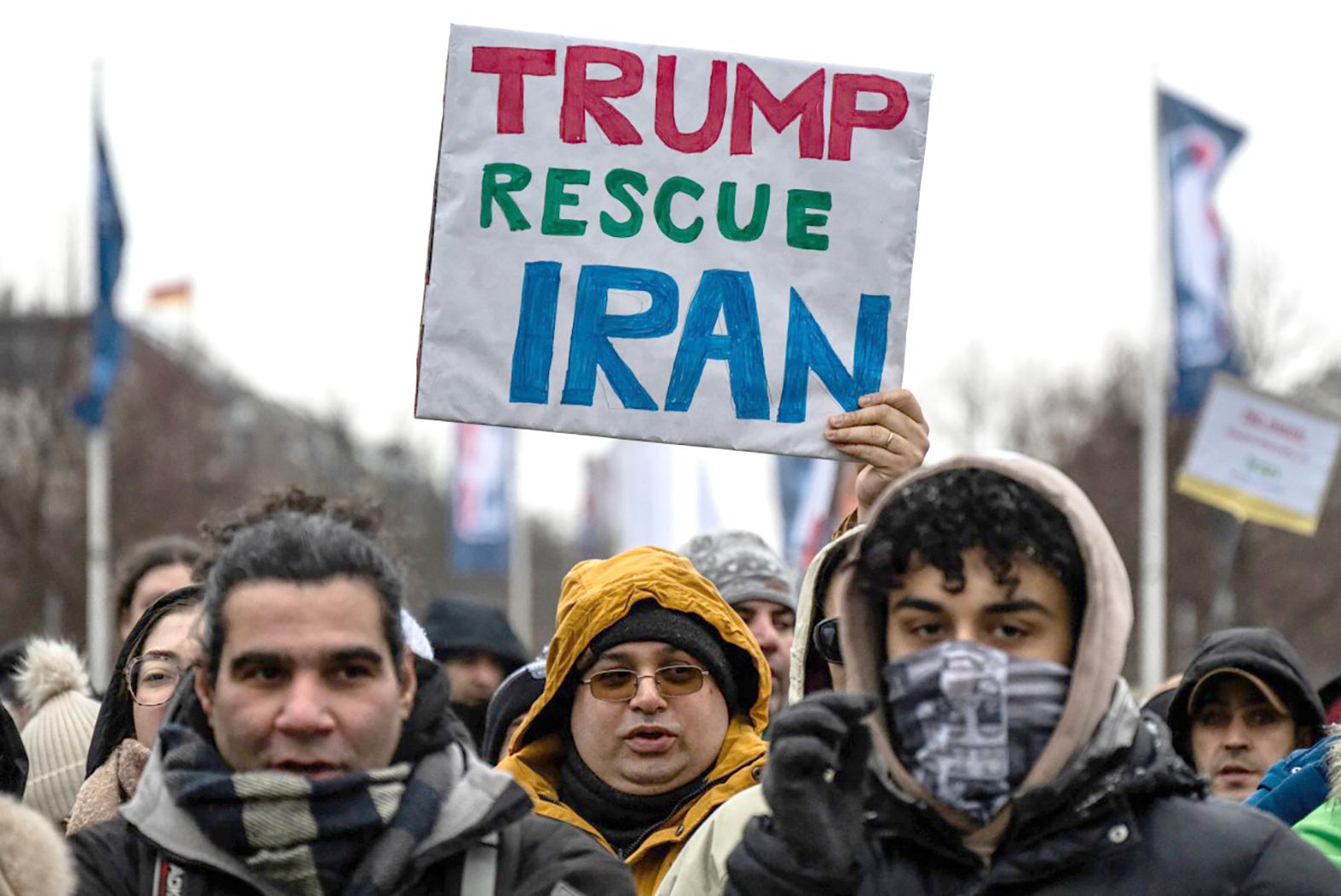 A demonstrator displays a placard calling for the US to intervene in Iran during an anti-Iranian-government protest in Berlin – a call supported by some Iranians living in Malta. Photo: John Macdougall/AFP
‘Very worried'
Mostafa, who fled Iran in 2019, said he was “really angry” about the government action against protesters.
He is “very worried” about his parents and four siblings – two brothers and two sisters – still in the country: “I don’t know if they’re alive”. Mostafa also asked that his surname be withheld, citing fears of retribution.
“For sure my brothers will have gone out to protest – I’m very worried about them”, he said, emphasising his belief that Iran’s government had cut internet to the country to prevent reports of civilian killings reaching the outside world.
Asked his views on possible Western intervention, following US President Donald Trump saying he was considering “very strong” military action against the Islamic Republic in response to the violence, Mostafa said he supported it: “If they help my people, I would be very happy”.
Mostafa recounted an incident when he and his sister were stopped by the country’s ‘morality police’ who took them into custody demanding proof they were related and not in an unmarried romantic relationship, forcing their father to bring their IDs to the police station.
“People are not free; there are no human rights,” he said. “This is why I’m here.”
‘We need support’
Sam Safavi, managing partner of Maltese investment firm Invest4Growth Asset Management and who is Belgian of Iranian heritage, also reported not being able to contact his family or friends in Iran while calling for international action.
“We need support from secular states,” Safavi said, questioning why Western governments continued to maintain Islamic Republic embassies in their countries.
“If we want to change the face of the Middle East and eradicate radicalism, we must put an end to the Islamic Republic,” he added, describing the Iranian regime as the largest exporter of terrorist organisations in the region.
On Monday, the European Parliament banned all Iranian diplomats and representatives from the assembly’s premises in response to the government crackdowns.
Safavi said the current wave of protests represented a decisive break from previous unrest, with worsening economic conditions pushing previously silent groups into open opposition. “This is the end of the regime; the people are now fighting back – they are fighting for their freedom,” Safavi said, adding he remained deeply concerned should authorities remain in power.
He pointed to the regime’s systematic use of the death penalty, including the execution of teenage girls, as evidence of the brutality his compatriots continued to face.
And if Iranians fighting for the same democratic values upheld in Western societies were not supported, the consequences would be catastrophic, he warned.
“There will be a massacre in Iran, and the effects will not stop at its borders – it will lead to more terrorism in the Western world. This is the last battle.”