How Italian anti-tank guns were deployed to defend Malta in 1942
A lesser-known aspect of wartime Malta where a captured weapon was aimed against its former ‘owner’
On June 10, 1940, Italy joined Nazi Germany and declared war on Great Britain and France. At the time, Fascist Italy had a small colonial empire, which included Libya. Il Duce, Benito Mussolini, was very enthusiastic to take over the Suez Canal by kicking the British out of Egypt, and later Anglo-Egyptian Sudan, and thus link Libya with Italian East Africa (Africa Orientale Italiana).
But his Fascist dream failed. The Italian army, led by General Rodolfo Graziani, invaded Egypt in September 1940, but was stopped after reaching the fortified site of Sidi Barrani. The British command then prepared a plan to force the Italians to retreat back and possibly capture Italian Libya.
In December 1940, the British/Commonwealth army, known as the Western Desert Force (the forerunner of the Eighth Army), launched Operation ‘Compass’, which lasted from December 10, 1940, to February 1941. The British not only recovered its lost Egyptian territory, but even succeeded to conquer Cyrenaica, the eastern province of Italian Libya.
Apart from the nearly 130,000 Italian and colonial soldiers captured by the Western Desert Force, a huge amount of Italian war booty was also captured. During the North African campaign, both the Allied and Axis forces made use of captured weapons, turning them against their former ‘owners’.
Among the captured Italian artillery was the Breda 47mm anti-tank gun, known in Italy as the Cannone da 47/32 M1935. This anti-tank gun was originally designed and manufactured by the Austrian firm Böhler. In the 1930s, Italy bought some of these guns from Böhler, and then began to manufacture the weapon under licence, continuing its development.
Two versions of the 47/32 were made – the first with semi-pneumatic disk wheels, and the second, in 1939, with improved barrel and suspension. While it was primarily an anti-tank gun, it was also used as a close support weapon. In 1940, it had roughly the same degree of armour penetration of its contemporaries such as the British 2-pounder gun, the German 3.7cm PaK 35/36 and the Soviet 45mm anti-tank guns.
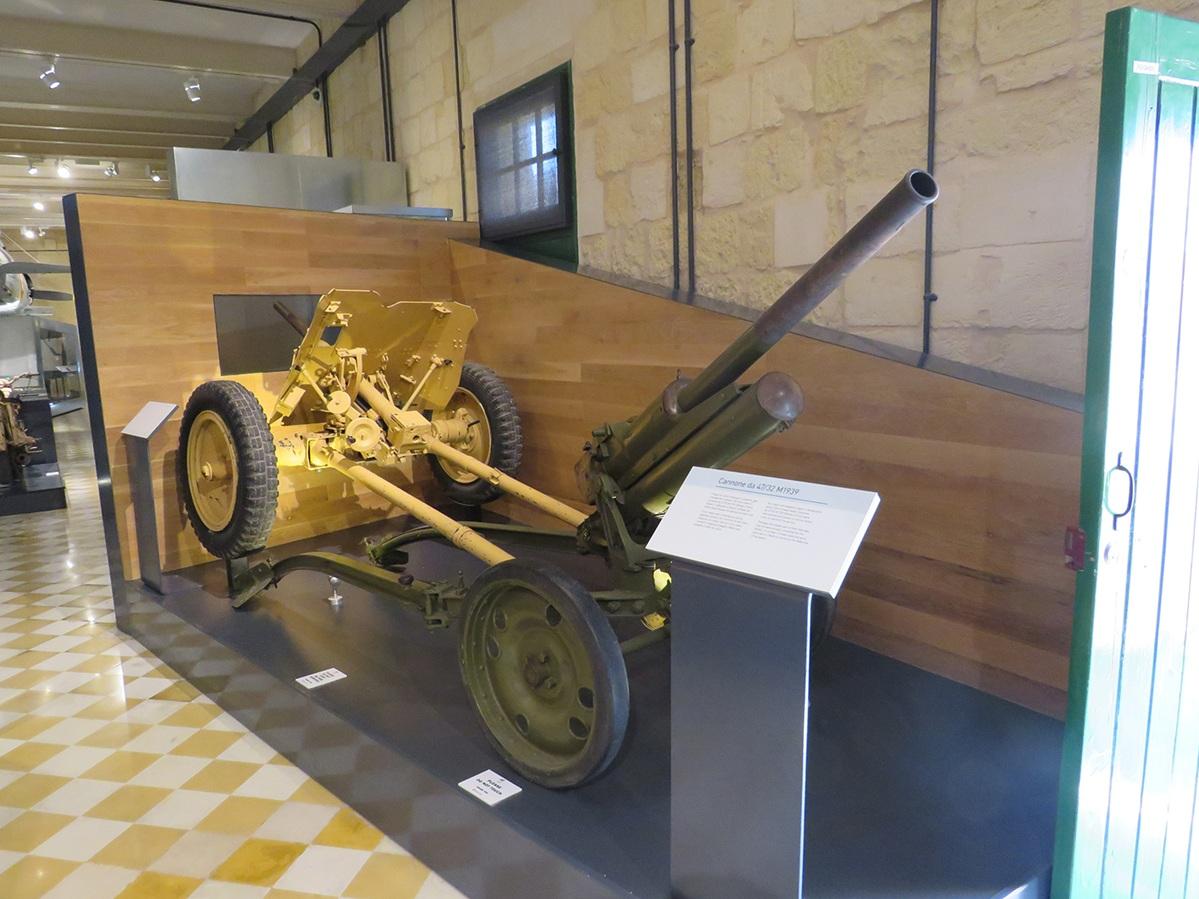 The Cannone da 47/32 M1935 anti-tank gun next to the German 3.7cm PaK 35/36 anti-tank gun as they were exhibited at the old National War Museum from 2015 onwards. Photo: National War Museum Archives
A lesser-known aspect of these Italian weapons captured in Libya is that a small share of them were sent to Malta, and some even made it to British Malaya (modern Malaysia), just before the Japanese invasion of southeast Asia.
If the Breda 47mm anti-tank guns were sent to Malaya in August 1941, when did the Bredas arrive on the island?
Malta’s share of the Italian equipment consisted of the Cannone da 47/32 M1935 anti-tank guns and Carcano rifles. In the Western Desert, the Cannone da 47/32 anti-tank was the most common of all Axis captured artillery and seems that the British/Commonwealth forces also had plenty of ammunition for it.
The Royal Army Ordnance Corps (RAOC) had an entire depot in Egypt dedicated to the salvage of captured Axis weapons. This depot was known as the Captured Ordnance Depot, but was also referred to as the Captured Stores Depot and Captured Weapons Depot.
It is not known when these Italian artillery prizes were sent to Malta, but they probably arrived at the same time that similar ones were sent to British Malaya.
The 27th Australian Brigade, part of the 8th Australian Division, had been sent to Malaya in August 1941 to bolster defences against Japan. Comprising the 2/26th, 2/29th, and 2/30th battalions, the brigade fought in January 1942. After being pushed back in the Battle of Singapore, the unit surrendered on February 15, 1942.
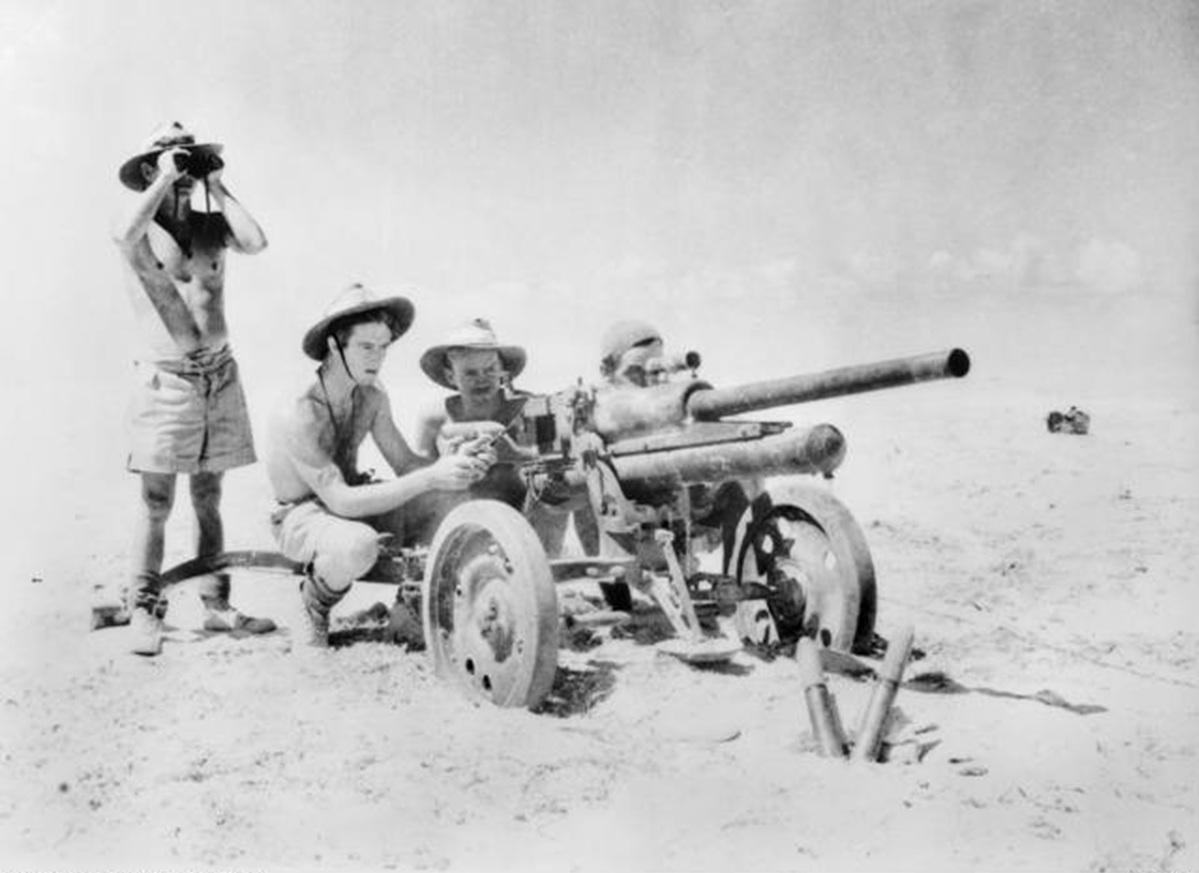 Australian soldiers from 9th Division using a captured Italian Breda 47mm anti-tank gun in Egypt, September 1942. Photo: Australian War Memorial
The 27th Australian Brigade had arrived in Malaya equipped with some captured Italian Breda 47mm anti-tank guns, which were used by the Australian 2/4th Anti-Tank Regiment in Malaya. Most likely when Malaya and Singapore fell in Japanese hands in February 1942, these Bredas also ended up in Japanese service later.
So if the Breda 47mm anti-tank guns were sent to Malaya in August 1941, when did the Bredas arrive on the island? A number of small convoys left from Alexandria in Egypt between August to December 1941, and even in early 1942. The largest convoy sent to Malta in early 1942 was Convoy Operation MW-10, but the three merchant ships were sunk in Maltese harbours. Only a few tons of their cargo were recovered, and presumably no Bredas were included. Research is still being done about this unknown detail of the Malta Bredas.
At least one photo exists of a Cannone da 47/32 M1935 with Malta rubble wall camouflage applied on it. It was taken at Birżebbuġa in 1942.
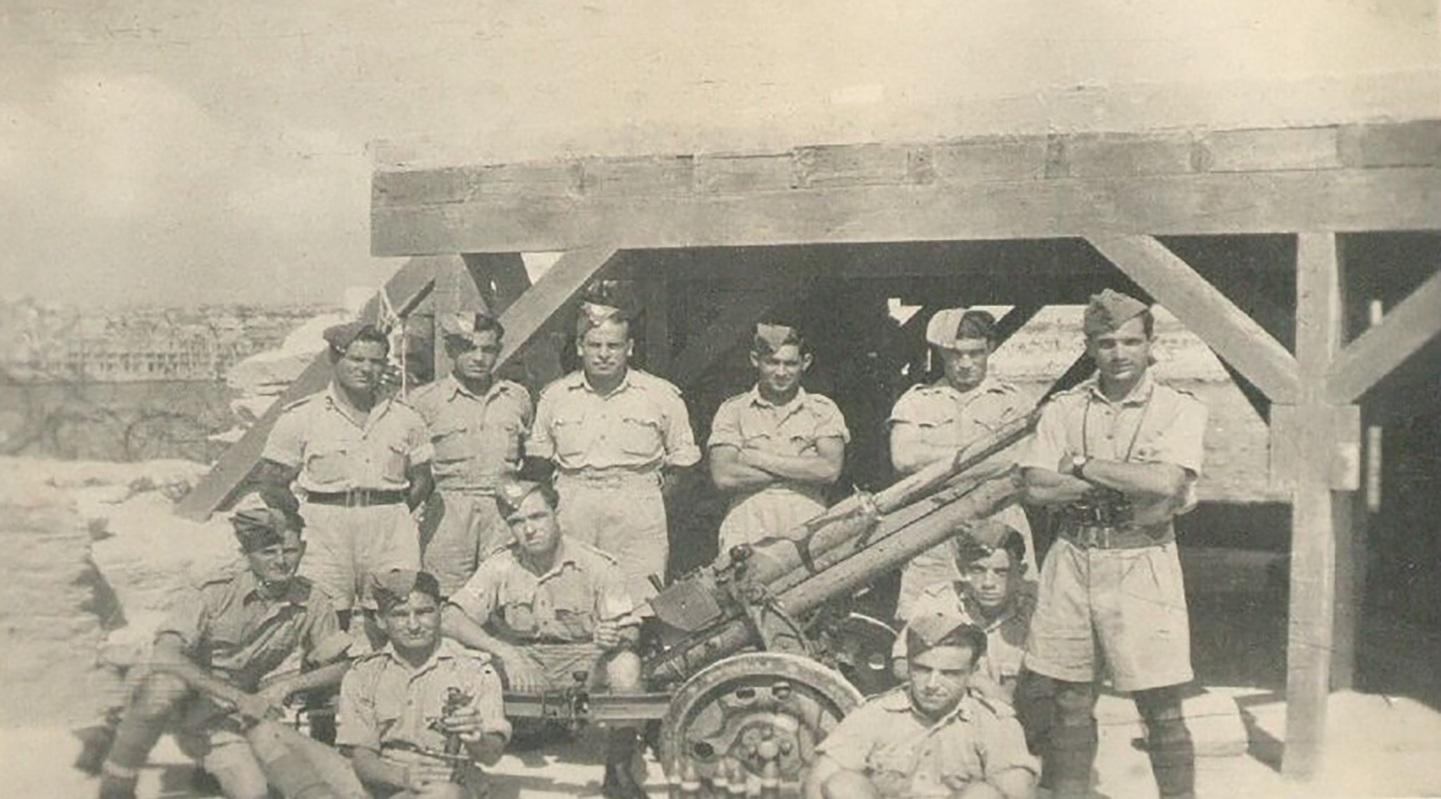 A captured 47mm Breda anti-tank gun in Malta with its crew at Birżebbuġa. Notice the Malta rubble wall camouflage applied on it. Photo: www.kilifish.com
In total, there were 10 such anti-tank guns in Malta, both static and mobile versions. They were distributed as follows: one static at the right-hand side of Mellieħa Bay; two static between Baħar iċ-Ċagħaq and Ras l-Irqieqa (probably one at Fort Madliena and the second at Madliena Tower); one static between Balluta Bay and St Julian’s Tower (probably in the same tower); one static probably at Fort tas-Silġ; one static at Il-Ballut (Marsaxlokk) area; two static at Birżebbuġa (at least one defending Pretty Bay); one mobile at Luqa aerodrome; and the last one mobile somewhere between Għaxaq and Gudja.
It is probable that most of them were housed in existing coastal fortifications or specifically-built gun-posts.
As far as it is known, the static Breda 47mm at Mellieħa Bay was housed in a gun post built at the right-hand side of the bay. This gun post is very large compared to the small size of the Breda which was an anti-tank gun, not coastal gun, but the British may have thought they would need to use it to defend Malta in case the planned Axis invasion of Malta – Operation C.3/Herkules – took place.
Charles Debono is a senior researcher at the National War Museum.