John Grima’s epic art for St Publius, Floriana
The completed artwork was formally unveiled on April 30
I am told I was born in Floriana almost ninety years ago, in Lions Street, and baptised at St Publius’. That, no doubt, counts as legally inadmissible hearsay, but I don’t really care; it elevates me into a kważi-Furjaniż all the same, though my parents whisked me off to Valletta when only a few months’ old. This is an excellent personal reason for me to celebrate the completion of the pictorial decorations in the huge vault of the historic parish church, was formally unveiled on April 30.
Only compulsive faith and a good dollop of pride can explain the perseverance of the people of diminutive Floriana in building, rebuilding, enlarging and embellishing this prominent memorial of their identity and to their uniqueness.
The inhabitants of this conurbation (don’t call it suburb) have persistently, over decades, made it a point to assert their distinctive pride and individuality – be it in their quest for self-determination, be it in over-the-top sports rivalry and fanaticism.
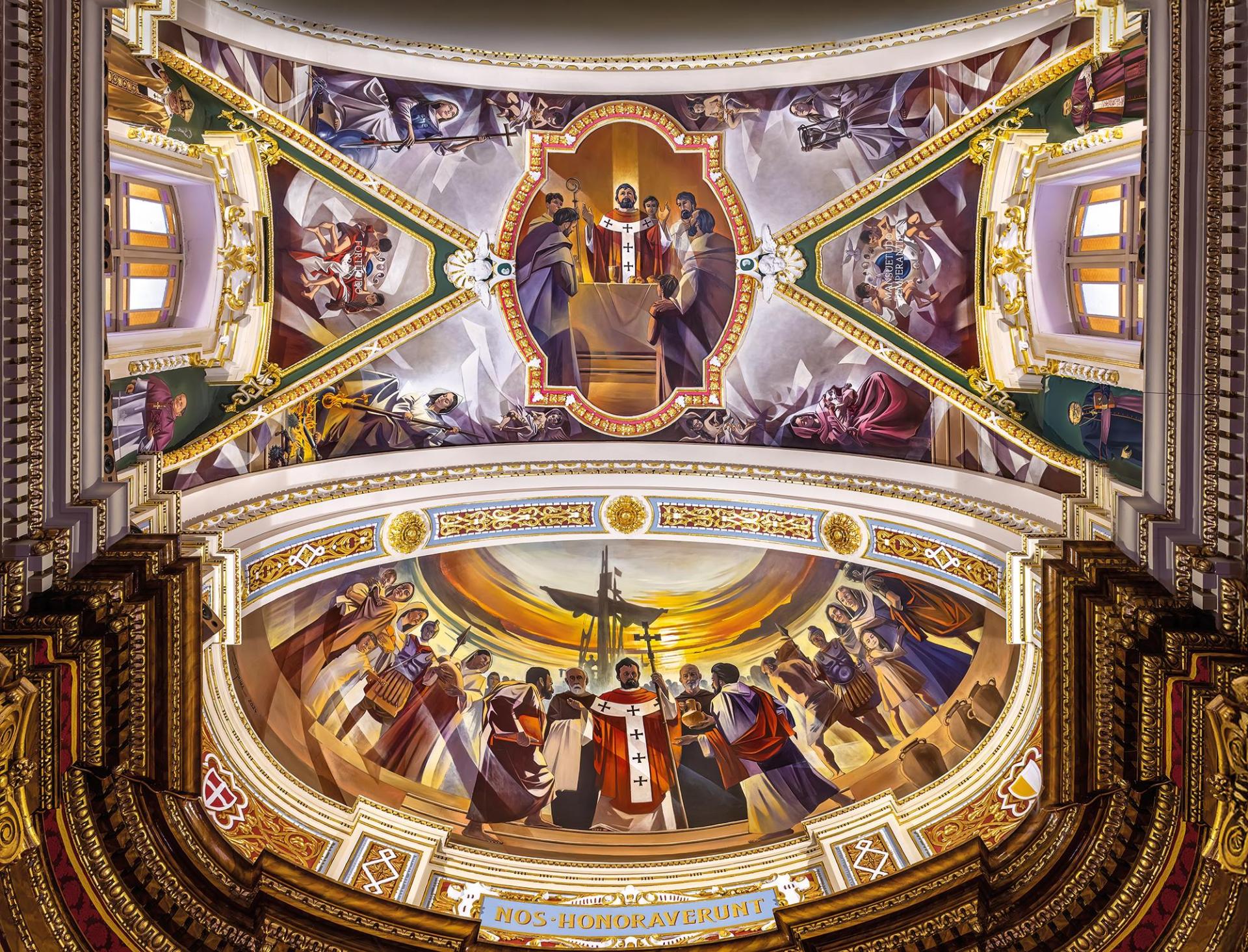 Right apse and vault paintings. Photo: Daniel Cilia
Their nineteenth century battles to be acknowledged as a separate parish, independent from and equal to, Valletta, bear witness to this wholesome pride, and to the fact that the inhabitants did not hesitate to put their money where their mouth was. Some still subscribe to the ethos that nothing is lavish enough for the Lord.
But making the temple the centre of town and village life, of beautifying it to the maximum, also satisfied an eminently egoistic civic necessity. Before the spreading of wealth, of leisure, of travel, of mass media, of easy communication, the cathedral and other important religious shrines remained the only public places where the average man and woman could feast their eyes daily on high art and their ears on great music. Where else?
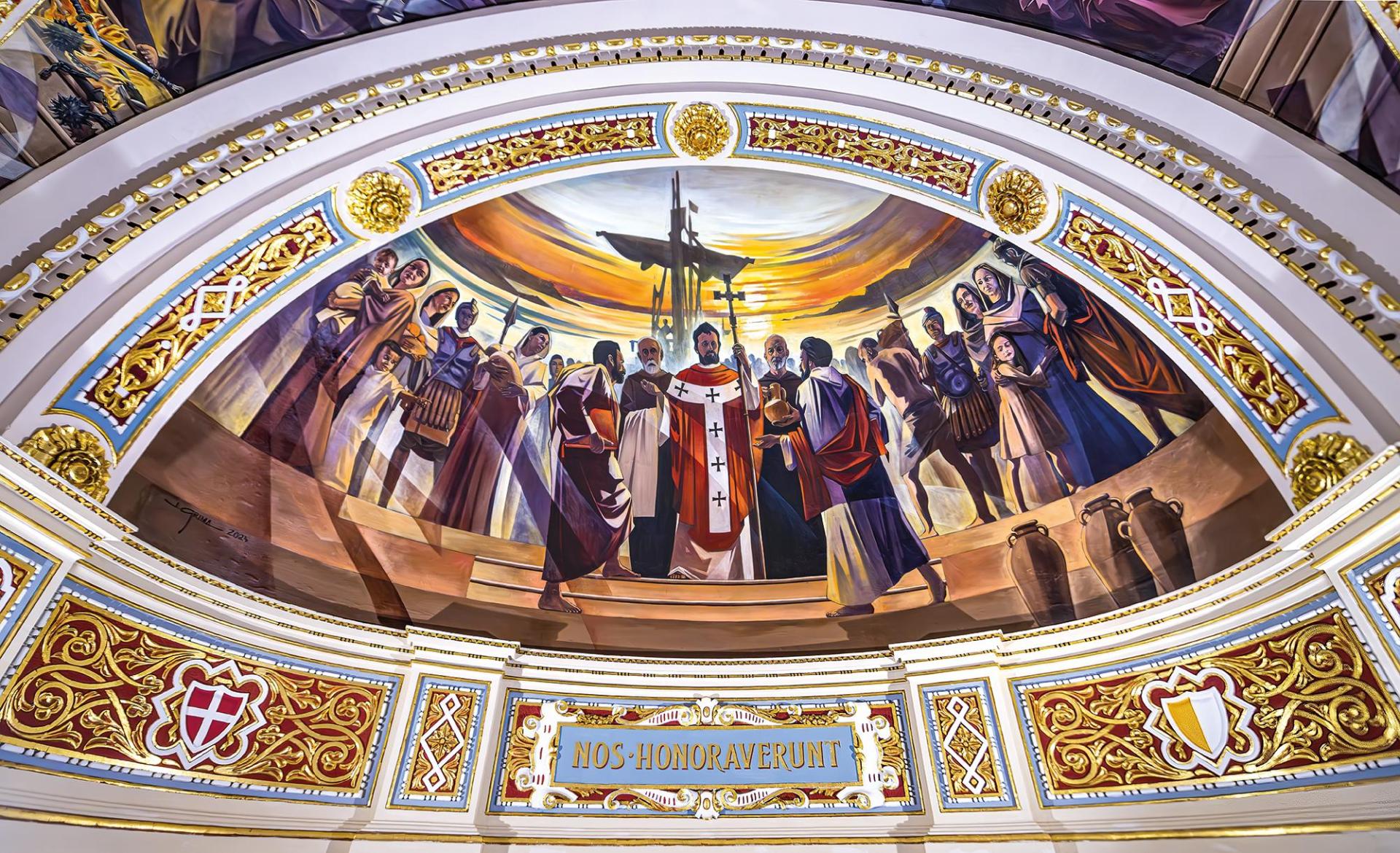 Detail of apse. Photo: Daniel Cilia
We must not forget that for centuries churches remained the one and only centre for the democratisation of visual art, of conceptual music, of organized spectacle. Nowhere else could common men and women access outstanding harmonies and see superior art flourish and where these could be retrieved daily by everyone and for free.
What the parishioners disbursed to ennoble the house of God, equally served to provide them with their only aesthetic experiences in their lifetimes. They spent for the Lord, but also benefited collaterally from their investment.
This pride still survives to a lesser extent in today’s pervading secular culture of the agnostic indifferent. Some persist in defying the modern lay materialistic takeover and are not shy to identify with the intangibles of spirituality. To these must go our gratitude for the completion of the gigantic St Publius cycle in Floriana.
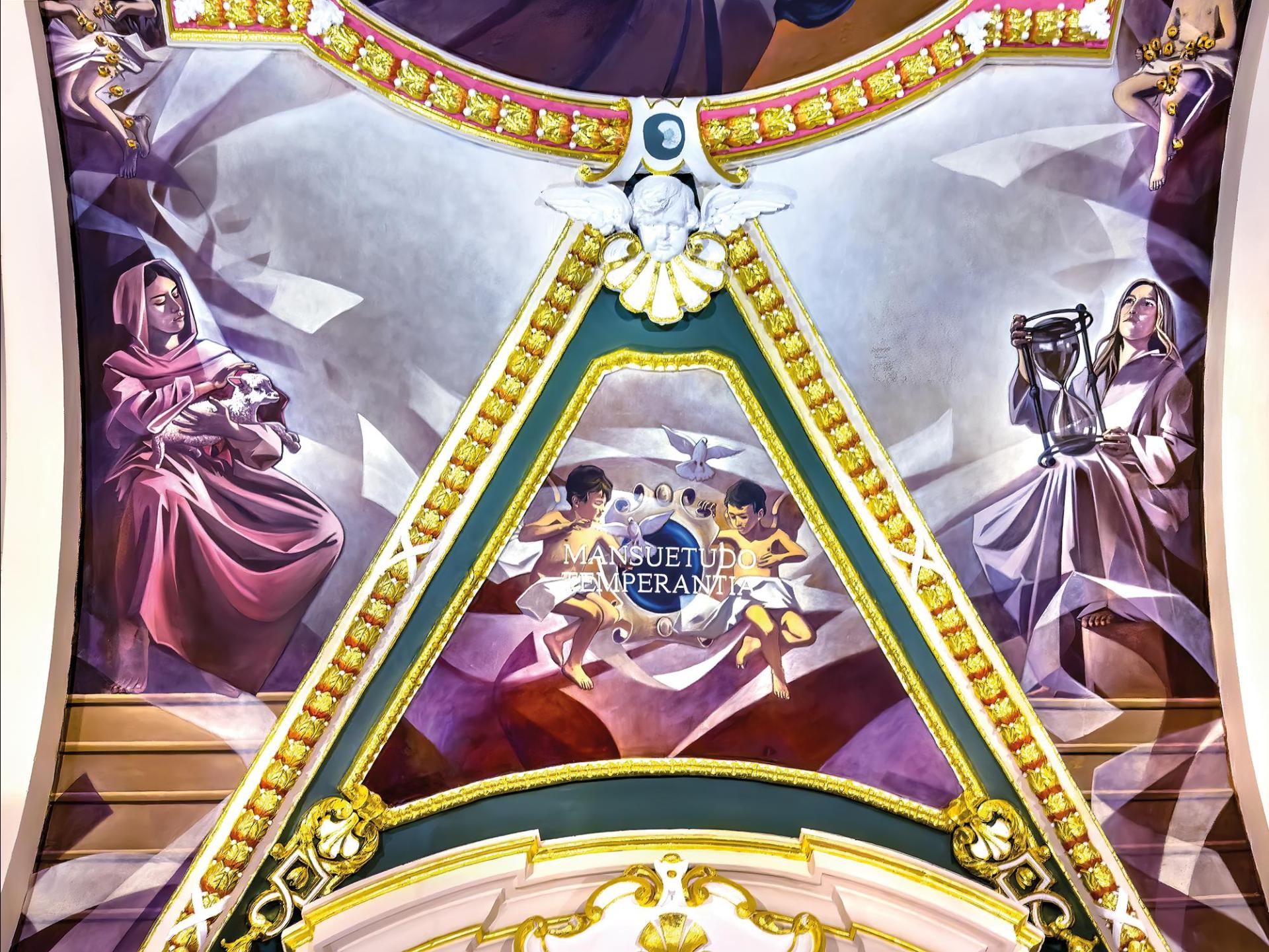 Details of other vault paintings. Photo: Daniel Cilia
The audacious and ambitious dream of covering the vast surfaces of the vault, the apses and the pendentives of the parish church with figurative art was first entrusted to Emvin Cremona, the leading Maltese creative of the twentieth century, a highly sensitive introspect and a master of invention who excelled in both figurative and abstract art, and at the same time also asserted himself as a foremost exponent of religious visuals.
The Rome-trained painter dragged Maltese art, unwilling and screaming, out of the clutches of a lifeless baroque on extreme life-support, which had overstayed its welcome by a mere couple of centuries.
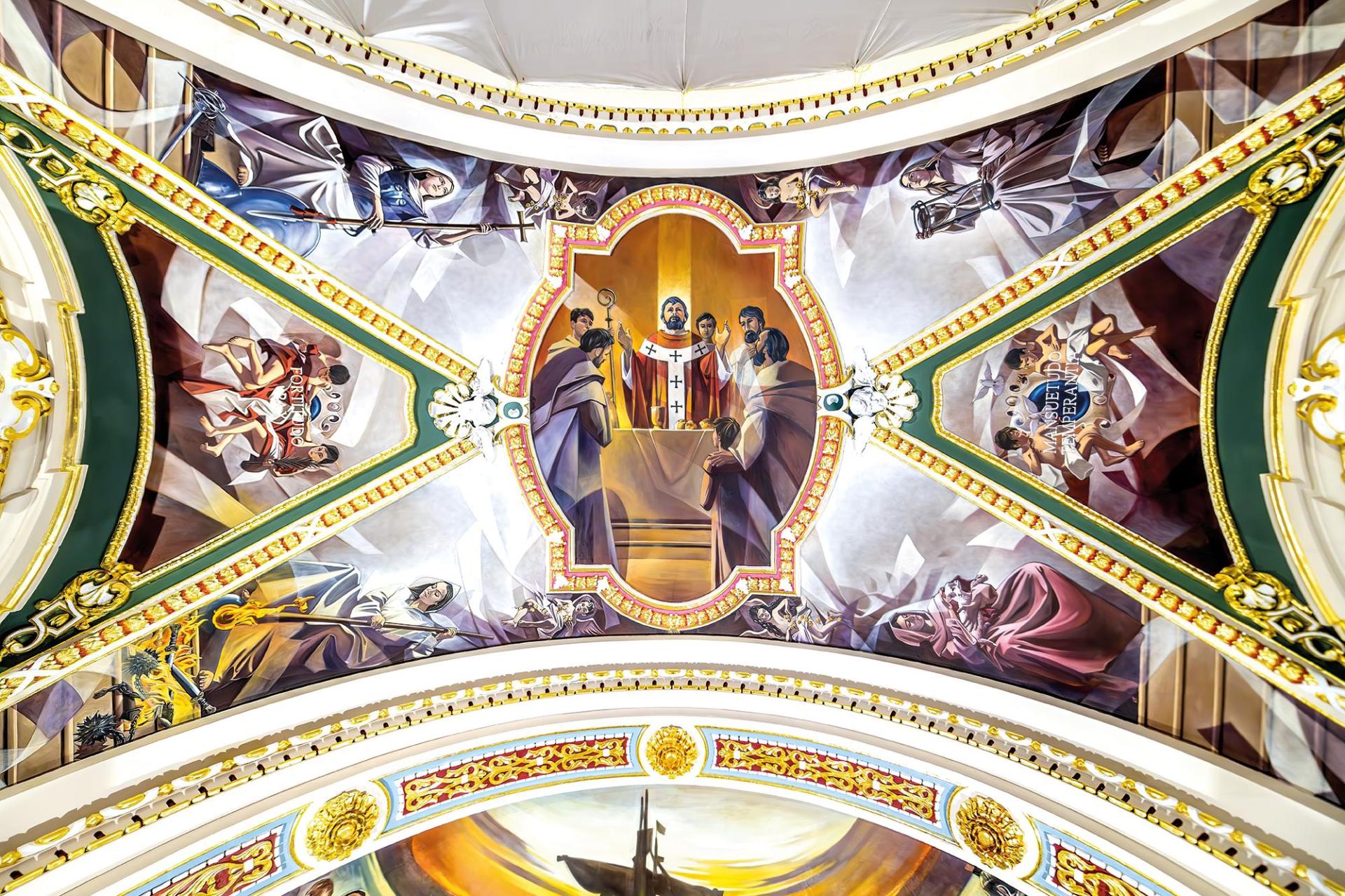 Central vault panel. Photo: Daniel Cilia
Cremona conceptualized the grand decorative scheme, but passed away in 1987, when he had only executed the Floriana project in part. This death proved calamitous for the artist, for the art scene in Malta and equally for his Floriana concept. Who could, and would, take up the baton?
Anything but an easy decision. Either leave the work as an unfinished symphony whose incompleteness itself can morph into a masterpiece – see Schubert’s music and Michelangelo’s sculpture, or push for a completion anyway – see Gaudi’s Sagrada Familia in Barcellona.
A determination to persevere won the day – and the lot fell on John Grima, who was just twenty when Cremona died. Grima, from Gozo, had made an enviable name for himself, as a painter and as sculptor too. Irrepressibly so, seeing the sculptural momentum of the Floriana figures. He has several admirable three-dimensional public works to his credit.
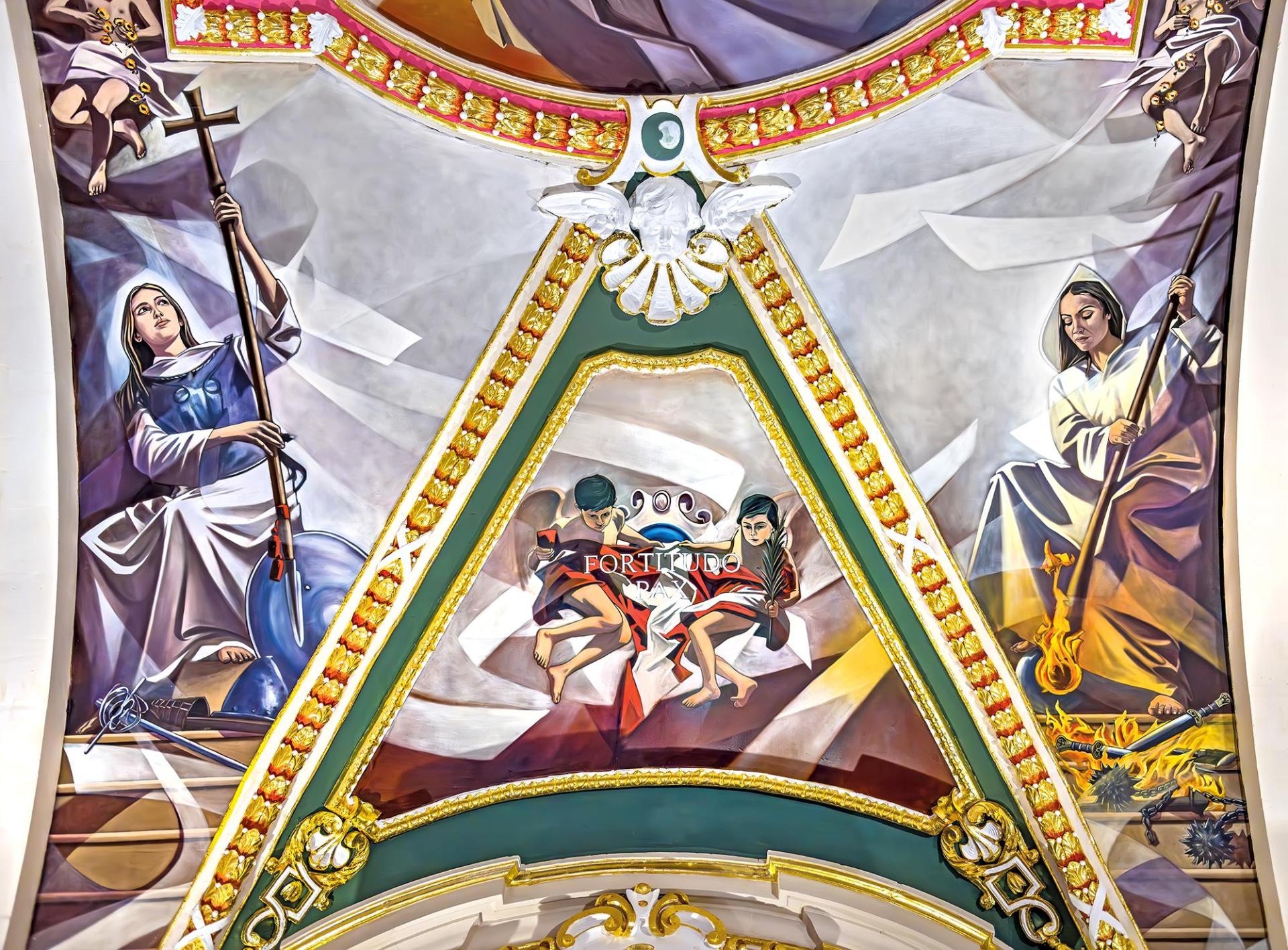 Detail of vault paintings. Photo: Daniel Cilia
A commission that could have turned into a poisoned chalice, that might have challenged and disheartened even an artist abundantly gifted with built-in cockiness.
Officially, Grima had to be Cremona’s heir. In practice, the parish authorities inflicted on him the burden of becoming Cremona’s competitor, dared to equal or excel his predecessor in every brush stroke.
Grima proved well conscious of the challenges facing him – those of continuity with the already existing schemes, and those of not becoming a minor parrot of his precursor – conflicts extremely difficult, if not impossible, to reconcile.
Straying in directions opposite to Cremona’s distinctive and highly personalized graphics would have resulted in an unacceptable hotchpotch of patchwork dissonances conflicting in the same ceiling.
Suppressing his own creativity, his cherished idiosyncrasies, would have demanded the unbearable from an artist as vibrant with creativity as John Grima.
How he managed to achieve this melodious cohabitation, this resolution, mostly through chromatic harmonies, while asserting his own highly distinctive profile, remains a major credit to the artist, over and above his staggering technical bravura and his fine conceptual acumen.
Five years ago, Grima had finished the first part of the grand design – a figurative narrative of the shipwreck of Paul in Malta, of the consecration of the enigmatic Publius as first bishop of the islands and of the early introduction of the pagans to Christianity, all in the chapel of the Holy Rosary. Now Grima pulls the final curtain down on his magnum opus so far in ecclesiastical art. He is still young. He has a lot more to give.
Grima painted a large part of the output in his Gozo studio. I understand he then bonds the canvas to the Floriana masonry and finishes off the work perched on the dizzy scaffolding.
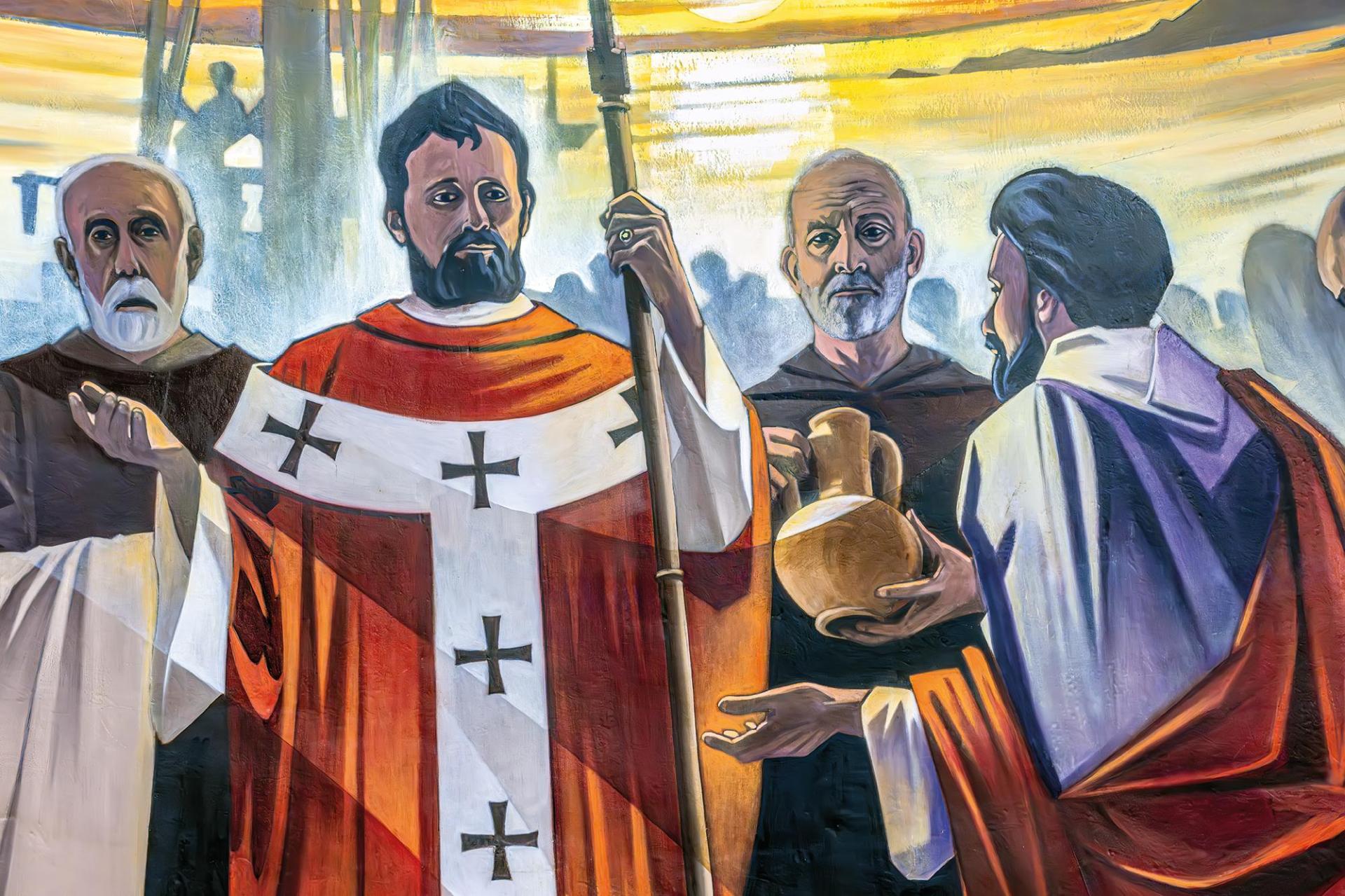 Detail of figures in the painting. Photo: Daniel Cilia
The principal composition shows the celebration of the eucharist by the converted Publius for the benefit of the first Maltese who believed in the Nazarene and spread his word.
The concave apse faces the one completed five years ago, which showed the shipwreck of St Paul; the new one shows the departure from Malta of Saints Paul and Luke, and the Maltese populace generously gifting the apostles with all they might need on their crossing to Rome, where Paul faced martyrdom at the whim of that endearing satrap, Emperor Nero. Paul hands over to Publius a copy of the holy Bible. A new sun rises over a new era.
To compliment the first four virtues: Faith, Hope, Love and Chastity painted in his previous phase, the artist depicted Temperance, Docility, Fortitude, and Concord. He paints the female figure with overwhelming empathy and elegance. Their backgrounds betray the artist’s irrepressible thrall with abstraction.
As a record of Christian continuity through the centuries, flanking the windows he inserted the portraits of four recent spiritual pastors who kept alive and spread the word of Paul and Publius in present times: bishops Emmanuel Galea, Annetto Depasquale, Joseph Galea Curmi and Archbishop Charles Scicluna.
John Grima’s art has an eloquent word for everyone – believer, agnostic or atheist. The faithful will find comfort and reassurance, the others will find aesthetic surfeit.
Happily, he avoids the cloying syrup of some religious painters who seem to equate mysticism with pious skin-deep prettiness. Cremona, Anton Inglott, Willie Apap, Joseph Briffa and in a different direction, Giorgio Preca too, closed that now-irrelevant book just after the war. And, thanks to them, torrents of honeyed treacle did not spillover to soil Grima’s creativity. Look well at the Floriana vault and judge for yourselves.