Labour is 25,000 votes ahead, according to latest Marmarà survey
Gap between Robert Abela and Alex Borg narrows in first survey since PN elected new leader
If a general election were held tomorrow Labour would win by 25,000 votes, according to a survey published Saturday by Professor Vince Marmarà.
The survey - which is the first of its kind since the Nationalist Party elected its new leader - also shows the gap between leaders' trust narrowed to 8%.
In an election tomorrow, PL would secure 51.7% of the vote. This places the party 8.5 percentage points ahead of the PN, which is projected to garner 43.2% of the vote.
While the figures point to a comfortable Labour victory, the results also signal a reduction in the party’s historical majority. The survey shows that the PL’s support has dropped by 3.4 percentage points compared to the 2022 General Election result.
Conversely, the PN has registered a marginal increase in support, gaining 1.5 percentage points since the last election.
Marmarà announced the new poll in a Facebook post on Saturday morning.
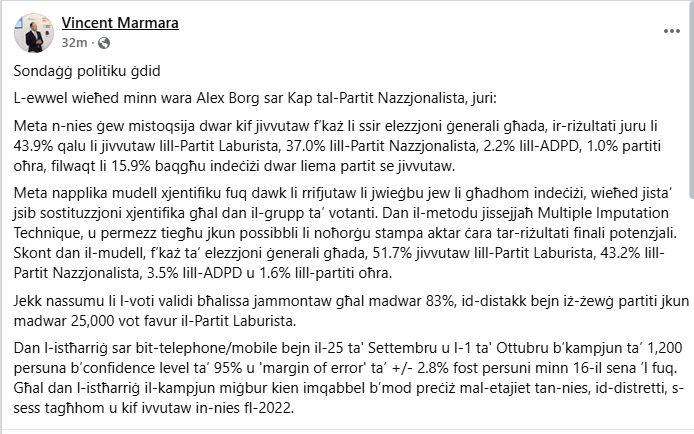 Marmara announced the survey on Facebook.
The current 25,000-vote gap has narrowed slightly from the 27,000-vote advantage Labour held in the previous Marmarà survey in June, which was conducted just before the resignation of former PN leader Bernard Grech.
Marmarà reached the 25,000-vote gap projection assuming a valid voter turnout of 83%.
The small parties, including ADPD, are projected to attract a combined 5.1% of the vote, representing a 1.9 percentage point increase from 2022. Specifically, ADPD is projected to take 3.5% of the vote, with other minor parties taking only 1.6% between them.
Gap between leaders narrows
The trust gap between the two party leaders has narrowed significantly.
Robert Abela enjoyed an average of 15% trust rating over Bernard Grech in previous Marmarà surveys, reaching 13.2% in the February poll when Grech had performed relatively well.
The gap between Abela and new PN leader Alex Borg has now narrowed to 8.1%.
The narrowing gap also suggests party supporters are mobilising to fall in line behind their leaders - a convergence that marks a significant shift from previous surveys.
PN rallies behind Borg, but party yet to make inroads
A major development in this survey is the apparent consolidation of the PN base behind its new leader.
Over 90% of PN voters now express their trust in Alex Borg to be their prime minister. This indicates that PN voters have largely fallen in line behind the new leader shortly after the leadership contest, despite the close result and some internal divisions that surfaced during the campaign.
This high figure suggests Borg enjoys significantly greater support from his own base compared to his predecessors.
Former leader Bernard Grech, for instance, would averge between 60% and 70% support from PN voters in similar Marmarà surveys during his tenure. A survey from last February showed he registered 64% support from PN backers. Adrian Delia sometimes scored even less when he was leader.
Another emerging trend in the PN is that fewer supporters now say they trust a leader other than their current one. Such replies were far more common when the prospect of MEP Roberta Metsola returning as party leader was alive, but now that many supporters are resigned she won't contest the leadership, their support seems to have consolidated behind Borg.
However, the PN has yet to make significant inroads in overall voter numbers.
Also, while there are fewer non-voters this time round, a significant 6% of Labour voters said they would not vote, as opposed to 0.7% of PN voters.
Leadership and party gaps converge
The poll also highlights a classic trend as an election approaches: the gap between the two parties and the gap between their respective leaders have converged.
The gap between the two parties stands at 8.5% (PL 51.7% vs PN 43.2%), while the gap between the two leaders, Robert Abela and Alex Borg, stands at 8.1% (Abela 42.5% vs Borg 34.4%).
Furthermore, another common trend in pre-election polling is evident: the number of undecided voters and non-voters is decreasing, and the projected turnout in this poll (83%) is very close to the actual turnout of the 2022 election.
The research was carried out between September 25 and October 1.
The study used a sample of 1,200 people aged 16 and over, with a confidence level of 95% and margin of error of ±2.8%.
The sample was collected via telephone and mobile calls and was calibrated against the demographic proportions and the 2022 General Election voting patterns.