Leading education in the age of AI: a matter of strategy
Students and educators need to learn to use AI’s vast processing power as an asset rather than a crutch
It would take a person 1.5 million years to read the petabyte (1,015 bytes) of data used to train GPT-4, without resting. Yet, for all that knowledge, the machine has neither consciousness nor intent. It is a paradox of our educational landscape: we are interacting with a vastly knowledgeable and efficient entity that is fundamentally ‘dumb’.
As schools and universities grapple with this technological upheaval, the conversation often drifts towards fear – of plagiarism, job losses and of a generation sliding into cognitive atrophy – the dulling of the skill of thinking. But treating AI merely as a threat or a shortcut misses the strategic imperative.
For institutions like St Ignatius College, upskilling in AI is no longer optional; it is a requirement for survival and growth. The goal is not to compete with the machine but to master a new form of literacy: becoming a ‘conceptual co-creator’. To this end, besides training taking place in our schools, professional development in AI and digital tools are part of the third year of the college’s Erasmusplus accreditation plan.
As the college’s leader, I felt it important to attend an Erasmus course to undergo training myself in order to provide strategic vision based on foresight and to be in a better position to support others. The course was financed by fondi.eu in collaboration with the National European Programme Agency.
The myth of the lying machine
AI neither ‘lies’ nor ‘hallucinates’ in the human sense. To lie requires intent and reasoning, faculties the machine lacks. Instead, large language models (LLMs) – which extend far beyond ChatGPT to platforms like Claude, Perplexity and DeepSeek – operate on probability. The software chucks words into ‘tokens’ and scans its massive database for statistical relevance.
It predicts the next likely connection. If it produces a falsehood, it is simply reproducing a high-probability connection from its training data. Understanding this mechanism is the first step in moving from a passive consumer to an active strategist. Users must constantly engage in a ‘sense-making activity’, verifying outputs rather than accepting them as gospel.
The trap of metacognitive offloading
The danger for students and educators lies in the path of least resistance. When a user treats AI as an oracle, copy-pasting responses without critical engagement, they fall into ‘metacognitive offloading’. This uncritical reliance leads to cognitive laziness and a regression of skills.
We can categorise AI fluency in five distinct stages. At the bottom is the ‘superficial function’ user, who blindly executes commands. As fluency increases, we see the ‘conscious director’ and the ‘interactive thinker’. This hierarchy’s pinnacle is the ‘conceptual co-creator’.
At this level, the human is the strategist, and the AI is the ‘workaholic but dumb assistant’. The human directs the work flow and, with the AI, they build new ways of thinking neither could achieve alone.
Garbage in, garbage out
Reaching this level of co-creation requires mastering the art of the prompt. In technology, the adage ‘garbage in, garbage out’ reigns supreme. The quality of the AI’s output is inextricably linked to the quality of the user’s input.
Literate ‘prompt writers’ do not merely ask a question. They construct a framework. A strong prompt incorporates nine essential elements: the role the AI should play, the specific task, the goal, the target audience, the writing style, the presentation format, concrete examples, clarification questions and explicit restrictions on what the AI should not do. When we align these steps, we ensure that human intellect remains the pilot, using the AI’s vast processing power as an asset rather than a crutch.
Future-proofing assessment
The rise of the co-creator necessitates a pedagogical shift. Educators are rightly concerned about the originality of student work but the solution is not to ban the tool. We must instead ‘AI-proof’ our assessments by shifting focus from the product to the process. If the destination can be reached instantly by a bot, the value lies in the journey.
Assignments should demand personal experience, critical engagement and creative synthesis – areas where AI struggles. We must design tasks that leverage local or recent events that are not yet present in the AI’s database.
Furthermore, verifying understanding through oral or handwritten components ensures that the student has internalised the learning, regardless of the digital assistance they received.
The human first
Ultimately, the strategy is pedagogical, not just technological. We must view AI as a support system for human thinking, synthesising and learning. As illustrated in the visual summary below, the ‘golden rule’ is simple: human first, AI second.
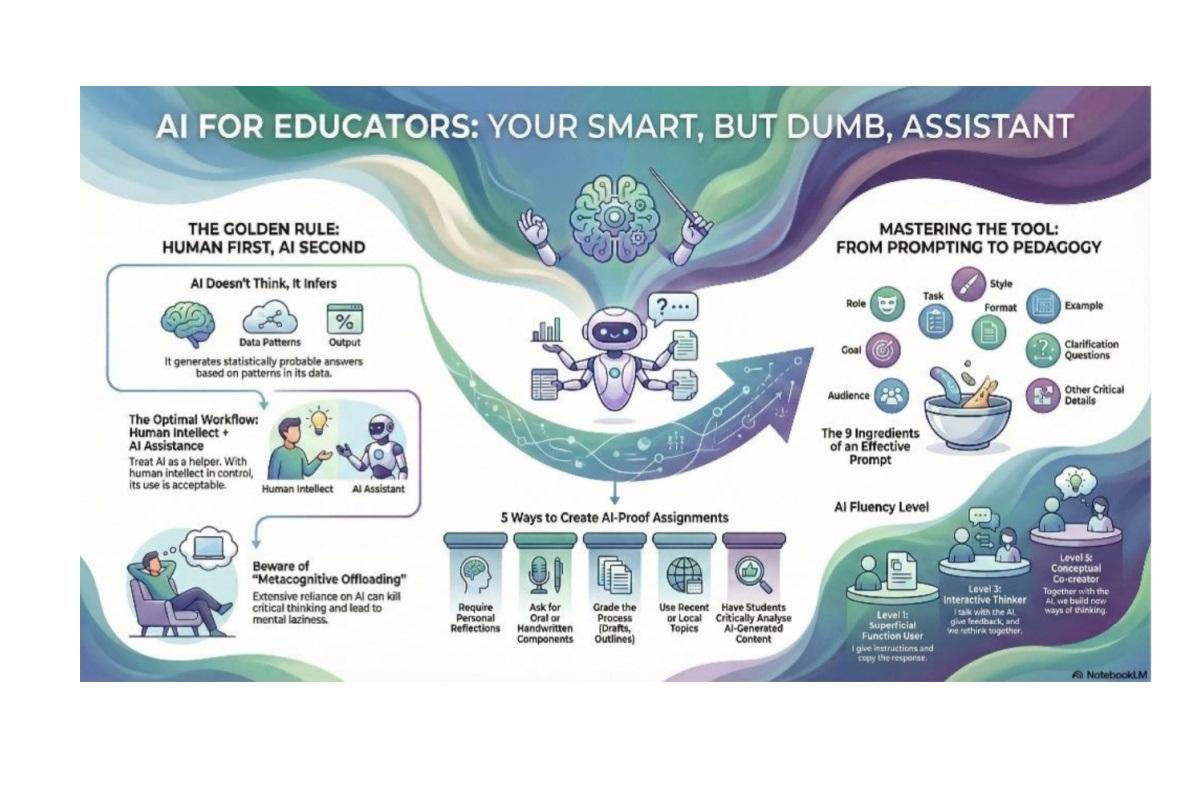 A Google NotebookLM synthesis integrating the author's observations with the provided training documentation.
By visualising the workflow – from the mechanics of inference to the ingredients of a perfect prompt – we see that the power lies in the partnership. The ‘smart but dumb’ assistant can save us time on administrative tasks and spark creative ideas but only if we maintain the discipline to lead the dance.
If we guide it precisely, AI is a servant to mankind. If we surrender our critical faculties, the roles are reversed. The choice is ours.

Doreen Said Pace is head of St Ignatius College Network and legal representative and coordinator of the college’s Erasmusplus accreditation plan.