Letters to the editor – July 1, 2026
Today’s letters by Times of Malta readers
What ‘AI for All’ taught me
Mark Said of Msida writes:
Having successfully completed all three modules of the high-quality online course ‘AI for All’ offered by the Malta Digital Innovation Authority, I learned that the most significant risk associated with artificial intelligence lies not in the mistakes we observe but in those we fail to notice.
Most conversations about AI focus on visible failures. Such highly publicised failures may create a false sense of security. When AI makes an obvious mistake, humans immediately intervene. The problem becomes visible, discussions begin and corrective action follows.
The errors we should worry about most may not be the obvious ones. They may be the believable ones. The danger is not necessarily that AI makes mistakes. The danger is that it can confidently make mistakes.
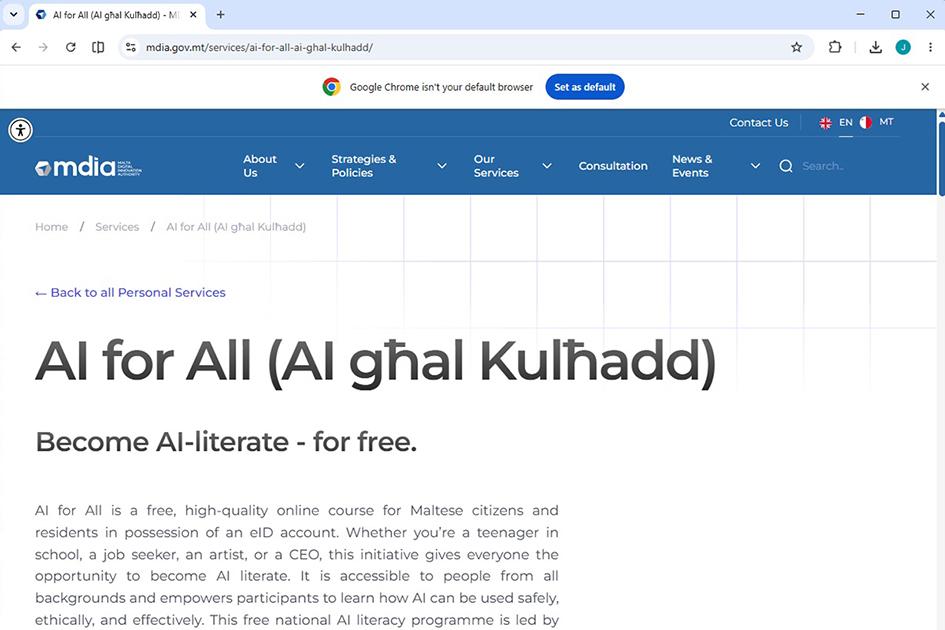 The free online course AI for All.
During the course, I unknowingly and naively ran what could have been a disastrous risk in real life. One of the least-discussed risks surrounding AI is automation bias, which occurs when people place excessive trust in automated systems and become less likely to question their outputs.
It’s like when drivers have followed GPS systems to closed roads and dead ends or pilots have become overly dependent on autopilot systems.
The technology itself is not always the primary problem. The problem often emerges when humans gradually surrender judgement to machines. As AI systems become more sophisticated, this tendency may become even stronger.
After all, it is difficult to challenge a recommendation that appears intelligent.
A flawed AI recommendation that goes unquestioned can often be more dangerous than an obvious mistake that receives immediate attention.
A fundamental misconception I had regarding AI was the assumption that intelligence and judgement are synonymous.
They are not. Sure, AI can process enormous quantities of data but judgement involves something different.
Judgement requires context, ethics, understanding consequences and knowing when a model may not be appropriate. These remain fundamentally human responsibilities.
In the coming years, organisations may discover that the most valuable employees are not necessarily those who can use AI most effectively.
They may be those who understand when it is prudent not to place complete trust in it.
Just as the Industrial Revolution necessitated mechanical literacy and the Information Age demanded digital literacy, the era of artificial intelligence requires a new form of understanding: AI literacy.
This may become one of the most important educational challenges of the 21st century. As AI becomes more capable, society may need to become more disciplined in how it uses it.
The real challenge may be ensuring that humans never become so impressed by artificial intelligence that they stop exercising their own.
I, for one, have already realised that.