Francine Farrugia used MCAST staff names to transfer €2.3m to herself
Bail granted for ex-payroll officer accused of siphoning off money over two years
A finance manager accused of embezzling over €2.3 million from MCAST created fake salary payments using real employee names but redirected the money to her own bank accounts, a court has heard.
Francine Farrugia, 31, is facing a raft of charges including misappropriation, fraud and money laundering after allegedly siphoning off €2,372,583 in public funds over a two-year period.
The compilation of evidence against her began on Thursday before Magistrate Rachel Montebello.
Police inspector Wayne Rodney Borg told the court that Farrugia, whose role gave her access to the payroll system for the Malta College of Arts, Science and Technology, duplicated salary payments.
For example, an employee such as 'John Borg' would receive their usual pay, but a second, much larger payment would also be issued under the name, this time redirected to an account held by Farrugia.
Twelve such payments were identified in May 2025 alone. Over the span of the alleged scheme, between 2023 and 2025, some €1.9 million was sent to Revolut and €422,000 to other accounts.
The main witness on Thursday was Marita Brincat, the Chief Financial Officer for MCAST, who reviewed the system after police alerted the education institute to the alleged crime in July.
'Processed to avoid detection'
She said the duplicate payments did not appear on employee payslips, but were included in the bank files.
In one case, a payslip showed a legitimate salary of just over €2,000, while a second, hidden entry recorded a post-tax adjustment of over €9,000, processed in a way that avoided detection by tax authorities.
Brincat added that fraudulant transactions had been removed from the internal payroll system, making detection more difficult. However a payment of €122,970 destined for Farrugia's Revolut account, was blocked in July after MCAST officials were alerted.
Brincat said she approved the bank file but it only showed global figures so she "wouldn't know" what individuals were paid. There were "amendments" made after Brincat had approved the bank file.
Asked what would happen after these amendments were made, Brincat said she would not receive a new bank file to approve. Instead Farrugia would send her any amendments afterwards through email.
She said that any changes to the system would leave an audit trail but that external auditors PKF Malta never flagged any problems. "We never had our attention drawn to any fraudulent transactions by the auditors," Brincat told the court.
Anita Muscat, another payroll official, testified that Farrugia had previously handled payroll reconciliation.
She described how Farrugia had been off work in July and so Muscat had generated the file. The witness said she then got a call from Farrugia telling her: “I’ve sent her the bank file because I found a mistake in the NI”.
Bail granted against €50,000 deposit
Farrugia, who appeared in court wearing a mask and accompanied by a nurse, was granted bail at the end of Thursday's two-hour sitting.
She must pay a deposit of €50,000, a personal guarantee of €25,000 and sign the bail book daily.
The defendant, who was a PN councillor for Siġġiewi until she was charged, is accused of spending the money on property, cars, jewellery and, clothing, including a spending spree at luxury department store Harrods.
During her arraignment earlier this month, police told the court they found such a large quantity of designer items at her home that “we would fill up the court”.
She denies all charges.
Prosecuting on behalf of the Attorney General were lawyers Alessia Schembri and Michael Muscat, assisted by police inspector Wayne Rodney Borg.
Francine Farrugia was represented by lawyers Peter Fenech and Amy Zahra. Lawyers Stefano Filletti and Thea Lynn Cesare appeared for MCAST and the education ministry.
The case continues.
LIVE BLOG
Sitting ends
1.10pm The sitting is over for today and will resume on August 26. Thanks for joining us.
We'll have a summary above, shortly.
Bail conditions
1.07pm Francine Farrugia must pay a deposit of €50,000, a personal guarantee of €25,000 and sign the bail book daily. There is no curfew, given her criminal record and the nature of the offence. Her ID card and passport have been seized.
Francine Farrugia to be released on bail
1pm The court has upheld the defence's request for bail.
Another payroll employee takes the stand
12.52pm Moira Manche is next up to testify. She does not do any inputting.
Francine: 'I found a mistake'
12.38pm The witness explains that from September 2023 until June 2025 the bank file was generated by Francine Farrugia. If she was not there, the witness would generate it.
Muscat said she generated the file for July. The audit file was finished late at about 7.30pm on Monday evening. She then generated the bank file and sent it to Marita.
The witness says that the next day or two days later she got a call from Francine telling her: “I’ve sent her the bank file because I found a mistake in the NI”.
Both Muscat have access to make deletions and the system can be accessed from home.
Payroll process and oversight
12.32pm Muscat outlines the payroll procedure at MCAST. After data is inputted, Francine Farrugia would generate an audit file and send it to Brincat. Once approved, Farrugia would issue the bank file.
The payroll analysis includes individual payment details for each employee and is sent to the financial controller, who typically checks around 50 entries before giving the green light for the bank file to be released.
Payslips are issued on the last Friday of the month.
Muscat now handles payroll reconciliation, a task previously done by Farrugia. She uses a system known as DAKAR, supported by an Excel sheet viewed by the financial controller.
While the bank file is approved and uploaded by others, Muscat says she does not have access to view it herself.
She adds that if she noticed any mistakes on a payslip, she would stop the process.
Muscat is responsible for inputting salary entries. Employees working on multiple projects may have several entries, but all are combined into a single payslip.
Access to the payroll system varies depending on the employee’s role.
Francine Farrugia's colleague takes the stand
12.25pm Anita Muscat, a Manager I at MCAST, testifies that she joined the institution in 2022 as part of the human resources team. She was later assigned to the payroll unit to fill a staffing gap and remained there.
Muscat says she receives payment claims from various institutes, HR staff, and departments, which she inputs into the system. MCAST has a mix of full-time and part-time employees, some of whom submit claims for overtime (typically at 1.5x rate), coordination work, project roles, and interview board duties.
Francine Farrugia and Moira Manche also worked with her in the payroll unit. Farrugia is her senior and trained her.
'I wouldn't know' who is paid what
12.18pm Under cross examination, the CFO insists that "she wouldn't know" who is paid what as she receives a global figure.
There were 'amendments' made after Brincat had approved the bank file. Both the court and Fenech ask what happens after amendments are made. She says she would not receive a new bank file. Instead Farrugia would send her any amendments through email.
'Did you not notice the same bank account appearing?'
12.07pm Brincat tells the court she felt uneasy about some of the payroll changes she observed.
Asked by defence lawyer Peter Fenech whether she ever audited those changes or identified mistakes, she said she did not because she carries out the audit after the bank file is issued.
She says the payroll analysis she receives differs from the final bank file.
Fenech presses her: did she notice that the same bank account number was used more than once? She replies that it would have been difficult to detect, as the entries were not listed consecutively.
The bank file she receives is sorted by department. For her audit, she re-sorts the data by gross salary and selects a 5% sample across three pay bands: €0–€2,500, €2,500–€4,000, and €4,000+. If she finds anomalies, she expands the sample.
She says the team lead by Mark Borg, who heads the internal audit department, had audited her methodology.
Asked if she received draft financial statements for 2024, she replies: “I did not receive them.”
'Any changes to the system leave an audit trail'
11.48am Farrugia's lawyer Peter Fenech asks Brincat if the system detects any red flags. She says any changes to the styem would leave an audit trail.
The audit trail is held by HR system Dakar and she never asked for it. "It was always done, since the excuse used would be that the union would get involved if the 'lecturer' did not get the money.”
She explains that there was no time to check post-changes since the file needed to be sent by Wednesday morning for the employees to get paid on Friday morning.
“I’d imagine you would send the wrong amount otherwise she would have not received any money,” Fenech remarks. The witness nods.
After the bank file is sent, checks are done, Brincat says. But by that stage “the transactions are removed”.
There is no reconciliation between the bank file and actual expenses, the witness confirms, adding that auditors never flagged this.
'Did you not realise something was wrong?'
11.40am Cross-examination begins. Under questioning, Brincat says MCAST paid out €1.7 - 1.8m in salaries each month in 2022. That rose to €1.9 - 2.2 mln every month by 2023, an increase that reflected the annual cost of living adjustment.
As a CFO Brincat explains she got the file and every month checks 5% of the payroll file. She is asked: "In these 5% you did not even trace one of the misappropriated money?" No, due to the fact the change happened afterwards, she says.
She is further pressed: "Did you not realise something was wrong?" Brincat says she did not, due to the fact that the changes from month to month were not so much.
"There are no big changes if you look at the monthly figures," she says.
HR responsible for salaries
11.36am Brincat explains that, as Manager II, Farrugia held a senior post. She says HR director Adelaide Attard is Farrugia’s senior responsible for HR and salaries.
'Payments' to employees who did not work that month
11.32am Farrugia began making her double transactions in September 2023. In her search Brincat established that in a particular month there were “payments” to some employees who did not even work that month.
When Farrugia did not work, there were no extra transactions. The bank file was sent by someone else. It needed to be received on a certain day each month because any delays mean salaries wont be issued.
External auditors 'never drew attention' to fraud
11.23am Brincat says auditors closed the audit for 2023, the year Farrugia allegedly began siphoning off money. But the witness says it was not fully completed because there was an administrative issue due to change in management. There was a delay in clarifying who would sign off on the report.
She has an audit report up to December 2023. The auditor's opinion remained the same: there were no issues flagged in the findings and no problems when they closed the audit originally. "We never had our attention drawn to any fraudulent transactions by the auditors," Brincat tells the court.
PKF Malta were MCAST's external auditors. An email from the auditors showing that they are chasing MCAST to sign is presented by the witness.
Defrauded transactions removed from internal system
11.16am The court asks the witness whether she had reviewed the bank file and if she knew which transactions were meant to go through.
She explained that during her audits, she was given a report and a bank file prepared by the payroll unit, made up of a Manager II (Farrugia), Manager I, and a clerk. The file, in .xml format, was accompanied by a bank letter and was typically prepared by Farrugia.
This report had to match another internal file. On the payroll system, transactions would normally show but in the case of the alleged fraud, the fake transactions were removed from the system.
Brincat presented a payslip showing one employee received just over €2,000 in a given month. However, a second payslip, never received by the employee and not deleted from the system, showed a post-tax adjustment of €9,135 paid to Farrugia’s account. The adjustment method bypassed the tax authorities.
She says MCAST had “no problem with Inland Revenue” and no employees complained about missing salaries.
Brincat says the system would show, for example, that certain amounts were going to HSBC or BOV, but it was not possible to assume they belonged to the same person, as many employees use the same banks.
Duplicate salaries didn’t appear on payslips
11.11am Brincat explains that she confirmed employees hadn’t received the extra funds by checking their payslips. The inflated payments appeared only in the bank file, and did not not show up on the payslips.
She explains that MCAST staff don’t have fixed salaries. Part-timers, for example, can earn between €40 and €400 for extra hours, which explains some variation in the bank file.
HR verifies hours worked and enters them into an Excel sheet, which is uploaded into the payroll system each month.
Working backwards through the records, Brincat uncovered more duplicate payments to accounts at APS, HSBC, MeDirect, and BOV. Initially, the amounts were “relatively small,” she said.
Transfers to APS, HSBC, BOV linked to Farrugia’s account
11.05am The witness tells the court she was given an account number by police and, upon running a search, found multiple transactions linked to it. The account belonged to Francine Farrugia’s Revolut.
Reviewing transactions from 2023, she found transfers to three APS accounts, one HSBC account, and one at BOV, among others. The amounts ranged between €5,000 and €8,000 in early 2023 but increased to figures like €18,000 closer to 2025.
She explains that the system allows salaries to be split between two accounts, a process she says is managed by HR.
Each month, she audits the bank file and compares it to the payroll file, which she receives in Excel format, to ensure both match.
She presents a file to the court, highlighting that 12 transactions were made to Farrugia’s Revolut account in May 2025 alone. While legitimate MCAST employee names were used, the banking details belonged to Farrugia.
MCAST financial controller testifies
10.59am The defendant's lawyer, Peter Fenech, asks about the organigram of the salaries office. Farrugia responded to a CFO - Marita Brincat, Borg says but he is not sure of the exact structure.
Up next is Marita Brincat, the financial controller of MCAST. She explains that her role is preparing the accounts, and records for the auditing, salaries, and day-to-day running. She knows Farrugia from work. Brincat works in the finance office, and Farrugia in payroll units which fall under HR, she says.
Designer jewellery, handbags, sunglasses
10.55am Farrugia was arrested and assisted police on the searches of her property, which took place on August 11. Inspector Borg says officers found an "impressive" amount of goods in a room.
They include high-end handbags, shoes, sunglasses and a necklace worth €5,200.
Investigators also found evidence of large financial transfers, including €200,000 sent to a notary over the span of two days.
Police said she fully cooperated during the searches.
€1.9 million sent to Revolut
10.53am The inspector repeats some details we first heard during Farrugia’s arraignment. He says €1.9 million was transferred to a Revolut account in Farrugia’s name, while €422,000 went to local bank accounts.
Police contacted the MCAST principal in July to inform him of the investigation, just as another payment for €122,970 was about to be transferred to Farrugia’s Revolut IBAN. MCAST managed to stop the payment in time.
Farrugia's €2.3m embezzlement operation explained
10.44am Inspector Wayne Rodney Borg takes the witness stand. He outlines how Farrugia's alleged embezzlement scheme operated.
According to the inspector, Farrugia had access to payroll systems and was able to create duplicate salary payments using the details of legitimate employees.
For example, an employee like John Borg would receive his normal salary of €2,500 into his account. But a second payment, such as €9,000, would be made using John Borg’s name, but into an account belonging to Farrugia.
The same employee would therefore appear to have received two salaries in one month, one legitimate, and the other fraudulently redirected.
In total, the amount allegedly siphoned off was €2,372,583.
Masked Francine Farrugia
10.40am Francine Farrugia is accompanied into the courtroom wearing a mask. There is also a nurse present in the courtroom.
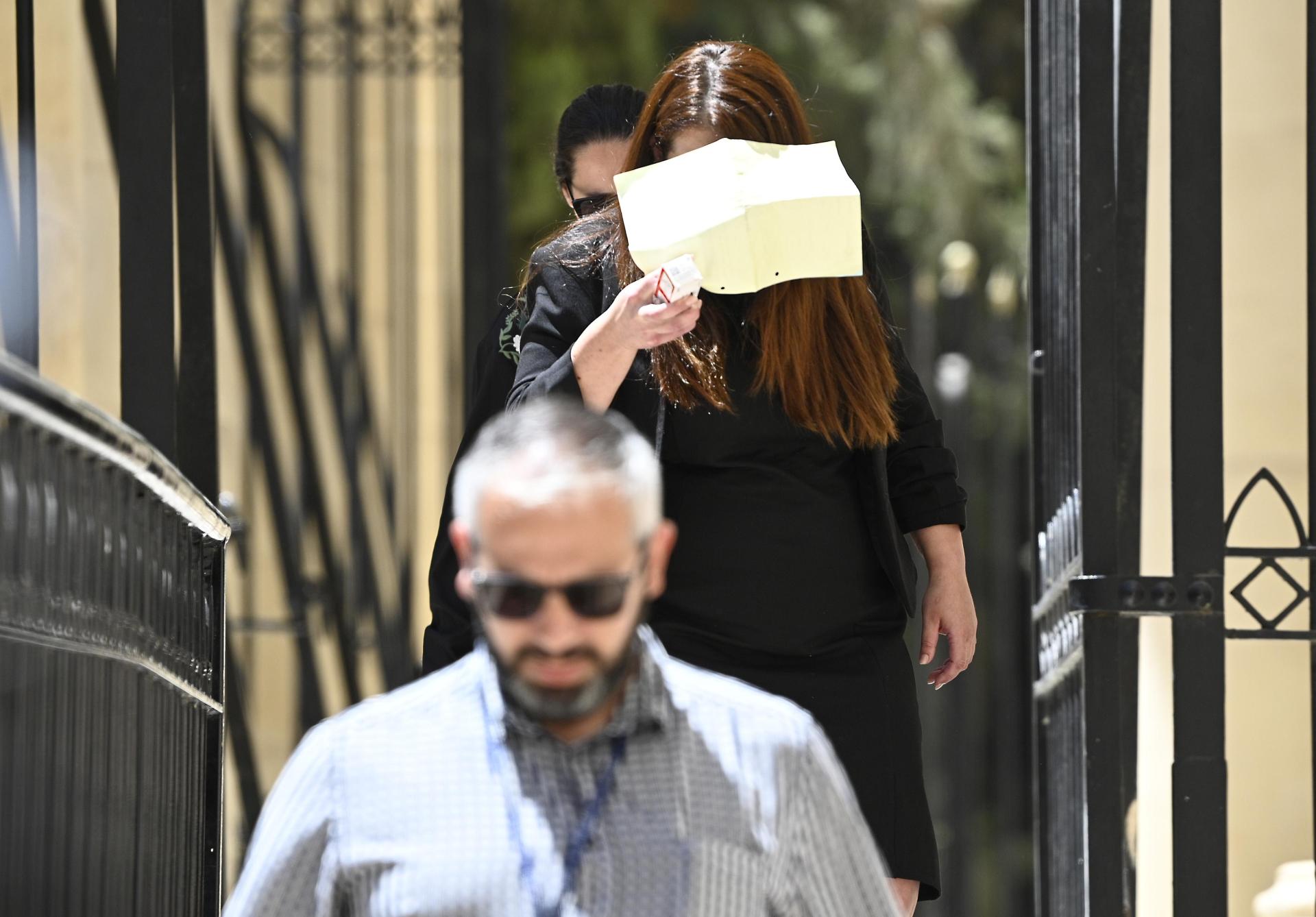 Francine Farrugia covered her face when she was arraigned earlier this month. Photo: Matthew Mirabelli
Who’s who in court today
10.39am Magistrate Rachel Montebello is presiding over the case.
Prosecuting on behalf of the Attorney General are lawyers Alessia Schembri and Michael Muscat, assisted by police inspector Wayne Rodney Borg.
Francine Farrugia is being represented by lawyers Peter Fenech and Amy Zahra. Lawyers Stefano Filletti and Thea Lynn Cesare are appearing for MCAST.
MCAST officials expected to testify
10.08am Good morning and welcome to our live blog. This morning, officials from MCAST are expected to testify in the case against Francine Farrugia.
The educational institution had asked the court to bar its name from being published, but the request was denied.