Malta climbs press freedom index but still among EU’s worst
Press freedom around the world is critically low
Malta has climbed six places in the 2025 World Press Freedom Index, but remains among the EU's worst-ranked countries.
The index, compiled by Reporters Without Borders (RSF) and published on Friday, ranks Malta in 67th place out of 180 countries, up from 73rd last year.
Out of the 27 EU member states, Malta placed 23rd - up from 26th place the previous year.
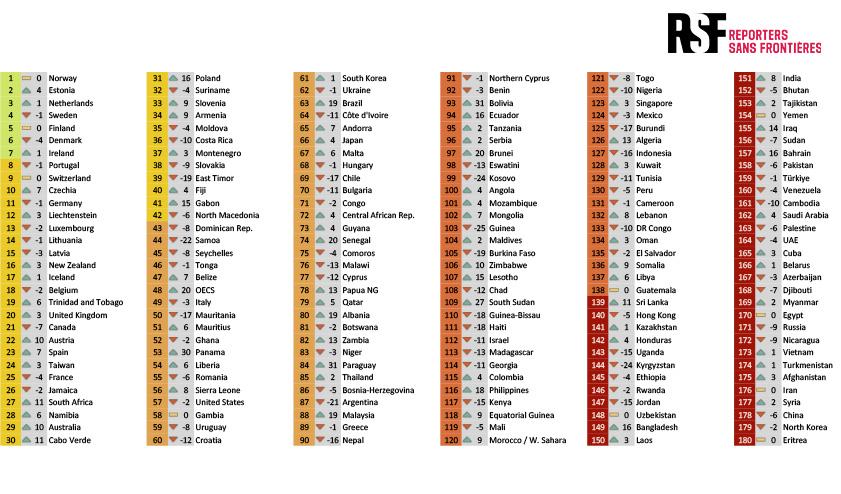 2025 Index Photo: RSF
Pavol Szalai, head of the EU-Balkans desk at RSF, said: “The progress of Malta in the Index can be partly explained by the deterioration of press freedom in other states.”
EU countries that ranked below Malta included Hungary in 68th place, Bulgaria at 70th, Cyprus at 77th, and Greece in 89th place. Norway topped the index, while Eritrea remained the lowest-ranked country.
RSF attributed Malta’s improved score in part to “a certain optimism” following the adoption of the European Media Freedom Act (EMFA) by the EU and recent anti-SLAPP measures introduced by the Maltese government.
Earlier this year, a Council of Europe report noted that Malta missed an opportunity to provide comprehensive anti-SLAPP protection to journalists and set an example for other nations when it limited protection to cross-border SLAPPs.
Szalai also noted that the country’s progress remained limited: “Although they (Malta) slightly improve, Malta's rank and score stay clearly under the levels before the assassination of the journalist Daphne Caruana Galizia.”
He continued: “The 2017 killing - whose alleged mastermind has been released on bail earlier this year - continues to cast a dark shadow on press freedom and journalists' safety in the country.”
RSF said it expects “the ongoing trial with the alleged bomb suppliers in this landmark case for press freedom in the EU to make yet another step towards full justice for the assassination which won't be reached until the mastermind is convicted.”
Szalai also criticised the current restrictions on media coverage of the court proceedings involving the alleged mastermind in Caruana Galizia's murder: “The ban on journalistic coverage of the judicial procedures targeting the alleged mastermind of the assassination of Daphne Caruana Galizia disproportionately limits press freedom, as denounced by RSF”.
Globally, RSF said press freedom is at a critical low, with the situation now officially classified as “difficult” for the first time in the index’s history.
Economic pressures were also highlighted as a growing threat. Media outlets increasingly struggle with ownership concentration, advertising dependency, and a lack of transparent public funding.
This financial strain was echoed in a recent opinion piece in Times of Malta by Nicole Meilak from the Institute of Journalists, who wrote: “As digital pressures mount and media companies cut costs, journalists are forced to wear multiple hats, work unpaid overtime and sacrifice their well-being to keep the news cycle moving.”
She added: “This exploitation doesn’t just harm individual news workers - it is threatening the very quality and independence of the press.”