Malta's HIV diagnosis rate hits a 10-year high
Malta continues to have Europe's highest rate of HIV diagnoses per 100,000
Malta’s per capita rate of new HIV diagnoses has climbed to the highest in a decade while remaining the highest in Europe for the second year in a row, recent data shows.
Last year, there were 20.6 HIV diagnoses per 100,000 people in Malta, equivalent to 116 cases, according to recent figures from the European Centre for Disease Prevention and Control (ECDC).
This was the highest rate seen in Malta since 2015, when the per capita rate of HIV diagnoses was 13.9, equivalent to 61 cases. Malta’s lowest result in the available data was 2021, when the rate was 8.7 (45 cases).
Last year’s result was just under four times the 5.3 average seen across the EU and European Economic Area (EEA) – comprising Iceland, Liechtenstein, and Norway – echoing results from 2020.
In total, there were over 678,000 cases across the EU and EEA last year, the ‘HIV/AIDS Surveillance in Europe 2025’ report found.
Men accounted for the vast majority of HIV diagnoses in Malta, with 106 men testing positive for the infection versus nine women. The resulting male-to-female ratio, 11.8, was by far the highest in the EU and EEA, where the average was 2.8.
There was one recorded diagnosis of HIV in a transgender person last year.
While detections among men remained largely stable last year compared to 2023, when there were 99 cases, diagnoses among women almost doubled, rising from five to nine.
The largest overall jump in the past five years was seen between 2022 and 2023, however, when the number of diagnoses country-wide leapt from 60 to 105.
Those in their 30s were most likely to be diagnosed with HIV last year, while the most common form of transmission – in instances where the cause was known to the patient – was sex between men, the report showed.
This mirrored the situation in other EU/EEA countries such as Hungary, Croatia, Serbia, Netherlands and North Macedonia.
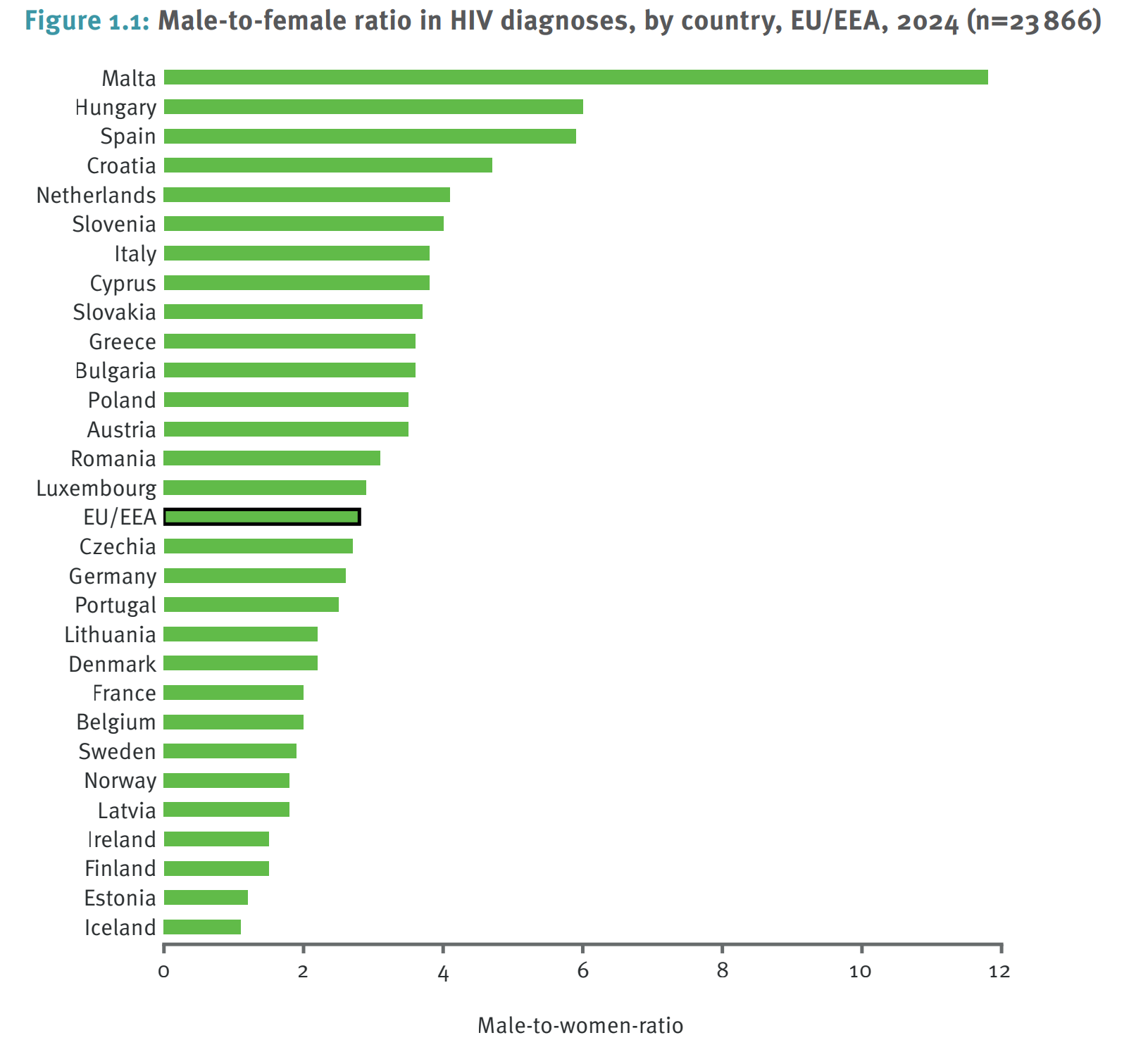 Graphic: ECDC.
Meanwhile, HIV cases in former Soviet countries not in the union or EEA – such as Ukraine, Moldova, Kyrgyzstan, Armenia, Azerbaijan and Belarus – were overwhelmingly attributed to heterosexual sex.
Some of those countries record persistent issues with social acceptance of, or legal protections for LGBTIQ+ rights to varying degrees, however, with progress seen in Ukraine and Moldova amid drives to reach EU standards, but ongoing challenges elsewhere.
There were no recorded cases of HIV attributed to injections of drugs such as heroin or crack cocaine in Malta last year.
Diagnoses among the country’s migrant population were most prevalent among people from Latin America and the Caribbean.
AIDS reemergence
HIV, or human immunodeficiency virus, is a virus that attacks the immune system and is transmittable through bodily fluids such as blood or semen. It can also be transmitted through the sharing of needles, such as among users of illicit substances.
The virus can remain undetected, not causing symptoms for years, though flu-like symptoms may be experienced by those who have just become infected.
Without treatment, HIV can develop into AIDS (Acquired Immunodeficiency Syndrome), a condition which causes severe immune system damage in patients and can be fatal.
Malta recorded its first AIDS diagnoses since 2017 last year, when there were three detections of the condition.
The data suggests that all AIDS sufferers in Malta could be men; there were no recorded diagnoses of AIDS in women in the years included in the European data, covering from 2015 to last year.
The report noted a discrepancy between national and European data, however, with the former recording one woman testing positively for the condition in 2020.
The last recorded deaths from AIDS were in 2016, when three people died in Malta from the condition.
There was no data available for the number of HIV tests carried out in Malta for the decade under review.
While there is no cure for HIV, the condition can be managed with antiretroviral therapy (ART), allowing patients to potentially live for many years without the virus developing into AIDS.
Preventative medicines PrEP and PEP – the former administered before potential exposure and the latter afterwards – have been shown to be highly effective in preventing HIV infections when used correctly.