Malta junior doctors report lowest work-life satisfaction in EU
Many young doctors opt to work excessive hours because their hourly pay is so low
Junior doctors working in Malta have the lowest levels of work-life satisfaction in the European Union, a study has found.
They work some of the longest hours in Europe and take the least days off per month, research carried out by the European Junior Doctors (EJD) Association found.
Researchers carried out a survey which, although it did not specify the number of junior doctors in Malta who took part, stated that the country met the required quota, meaning the results achieved a 95% confidence level with a ±3% margin of error. In total, 19 EU countries were analysed.
When participants were asked about their work-life satisfaction, Greece, Malta, Portugal and Switzerland all reported the highest levels of dissatisfaction. Malta also reported having the fewest respondents who said they were satisfied.
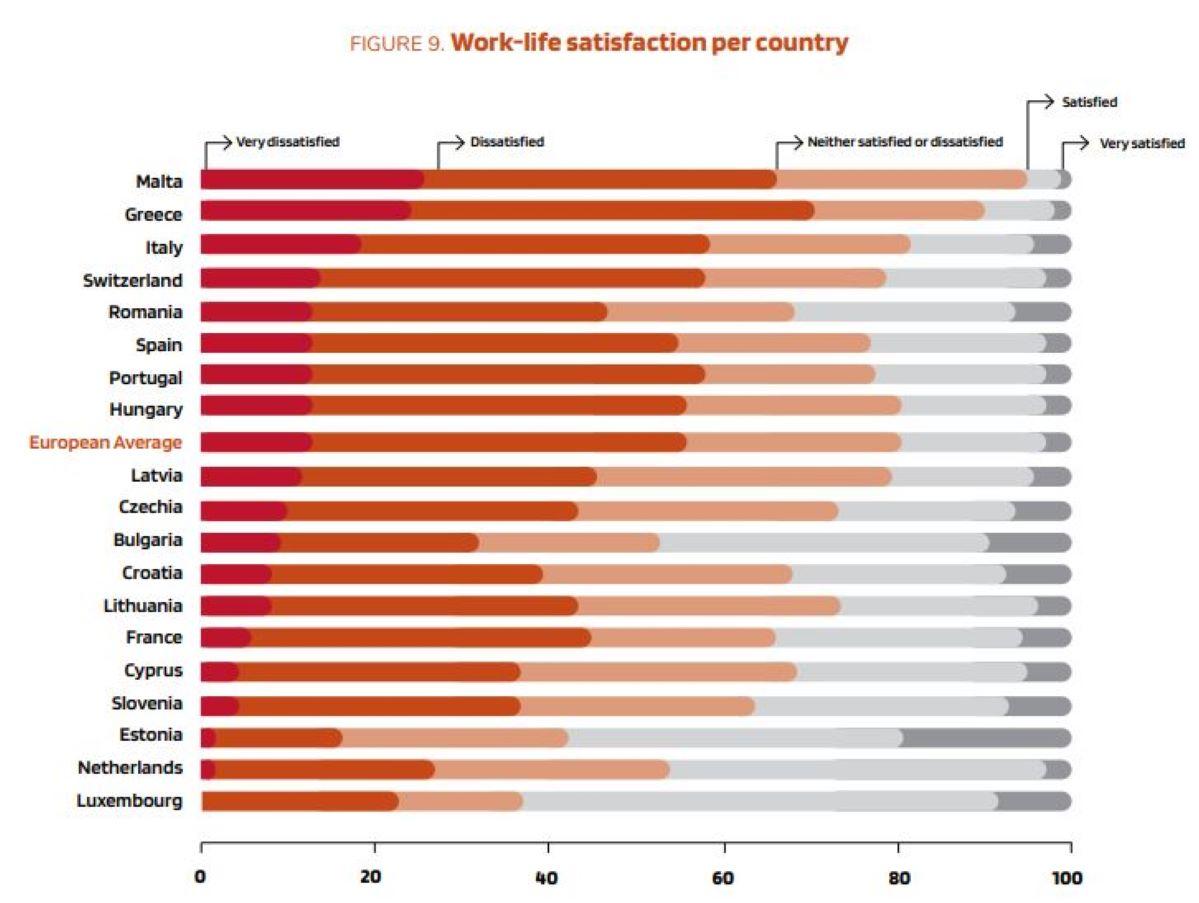 Graph showing how junior doctors in Malta has some of the lowest levels of work-life satisfaction. Photo: EDJ Association
The study attributed the high levels of dissatisfaction to the countries’ longer working hours. The highest satisfaction levels were reported in Estonia, the Netherlands and Luxembourg where young doctors work shorter hours.
On average, young doctors work the longest hours in Greece, Cyprus and Malta – 72, 69 and 65 hours per week, respectively.
The European working time directive (EWTD) sets a 48-hour weekly limit. But most countries exceed this, with the average hours worked per week being 57 hours across the 19 countries that participated in the survey. Most countries surpass the EWTD limit as doctors are allowed to opt out.
Night duty
Meanwhile, 82% of junior doctors in Malta undertake 24-hour shifts and 91% of them partake in night duties, the survey added. On average, junior doctors in Malta average six nights a month, which comes second to Greece with an average of seven a month.
When it comes to rest days, junior doctors in Malta fare the worst, reporting an average of four rest days per month.
The survey also revealed that 9% of junior doctors could not take four weeks of annual leave.
The EJD appealed for Malta to comply with the EWTD limit. It also called for an “urgent” reform to the rota system and better enforcement to ensure doctors get enough rest.
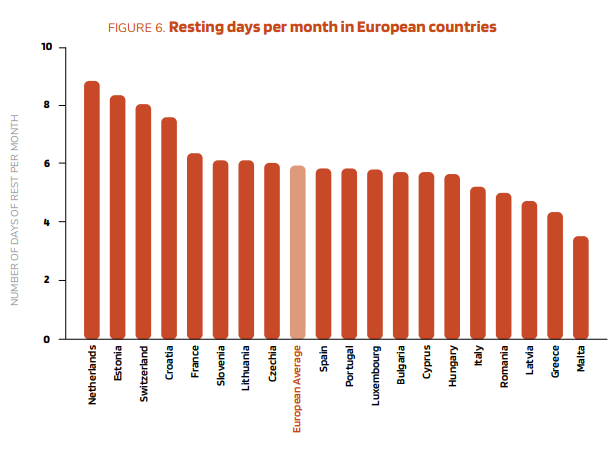 Graph showing how junior doctors in Malta take the least amount of rest days per month. Photo: EDJ Association
The head of the Medical Association of Malta (MAM), Patrick Sammut, said doctors working long hours are part of an outdated system that needs to change.
“Many young doctors opt to work excessive hours because their hourly pay is so low they feel compelled to work longer in order to earn a decent wage,” he said. “In addition, some doctors may feel disadvantaged if they work within the 48-hour limit as they risk being perceived as less hardworking than their peers.”
Remuneration
Some doctors also fear that reducing their hours would limit their access to the medical education they need, he added.
To address this, Sammut said the MAM is working towards improving the remuneration package in the next collective agreement. Also, he said that the MAM is in ongoing discussions with stakeholders and Mater Dei Hospital to explore changes that would distribute workloads more evenly.
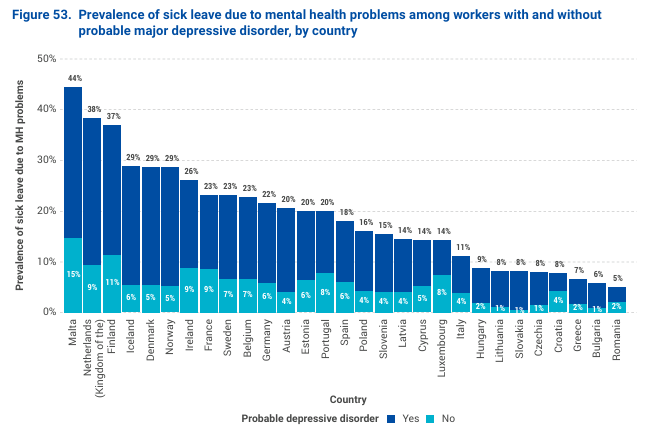 Graph showing how doctors and nurses in Malta are most likely to take sick leave for mental health reasons. Photo: EDJ Association
“This way, doctors will be able to work fewer hours while still being paid well and meeting the hospital’s demand,” he said.
A psychoemotional study interviewed doctors who had crashed following prolonged shifts, exploring feelings of guilt, shame and anger directed towards a system they described as unwilling to change.
Doctors working long hours risk their lives when required to drive home after shifts of up to 32 hours.
In a survey conducted by the World Health Organisation (WHO), nurses and doctors were asked about mental health. It was found that Maltese nurses and doctors work some of the longest hours in Europe.
Up to 29% of respondents reported suffering from anxiety, above the EU average of 22%, and 21% said they suffer from depression, below the 28% EU average.
Doctors and nurses in Malta are, by quite a margin within the EU, most likely to take sick leave due to mental health problems. In fact, 44% of Maltese respondents said they had taken leave for mental health reasons, followed by 38% by the Netherlands.
Hospital admissions have recently increased due to a surge in flu and norovirus cases, placing additional pressure on doctors. Mater Dei’s accident and emergency department has long been scrutinised for operating “beyond its breaking point”.
In an attempt to ease this burden, the government signed a partnership with three private hospitals last year, providing for the outsourcing of emergency services.