Is Malta overpopulated or not?
It is our vision, not statistics, that ultimately determines if we’re overpopulated or not, writes Jake Xuereb
Recently, I managed to get myself caught up in a social media disagreement with two people I respect and consider to be smart and fact based, Steve Zammit Lupi and Jon Mallia. The argument in question “Malta overpopulated jew le?”.
Here I want to explain why I think this is a question that doesn’t really make sense. Worse, I think this issue is being politically weaponised in this election campaign.
There are three ways in which I think the term “overpopulation” can make sense.
1. Whether the population density of an area (number of people living in a kilometre squared) is high relative to other cities/countries of similar size;
2. Whether the infrastructure of a given area can handle the number of people living in the area;
3. Whether the population density of an area matches the population’s vision for it it i.e. urban city vs countryside town.
I’m a physicist by training, so let’s dissect these questions by looking at some data.
Population density
I created the following graphic using 2024 Eurostat Data, IRIS 2024 and Stadt Wien 2025 data. These maps show the population density per square kilometre in Malta, Paris and Vienna. Yellow indicates regions with more than 10,000 people per square kilometre, while green indicates 1000 people and so on.
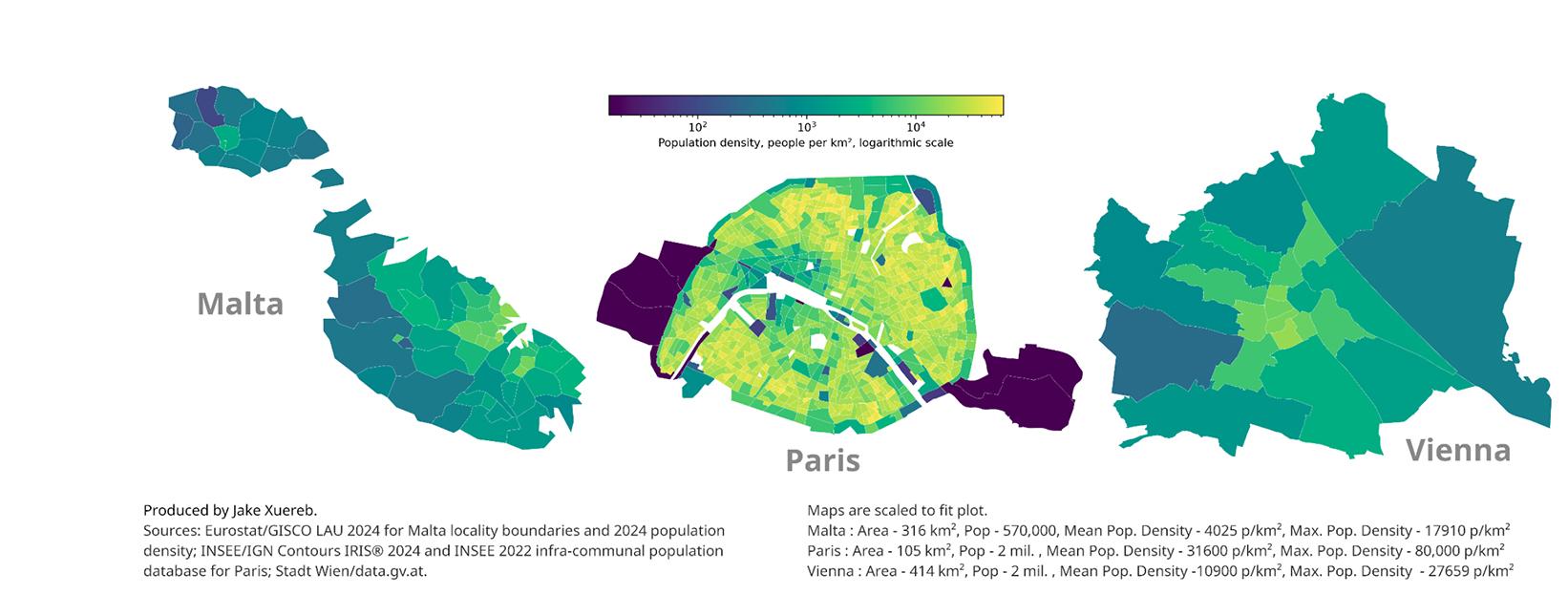 A heat map showing the population density in Malta, Paris and Vienna. Graphic: Jake Xuereb
Malta is three times the size of Paris, and Vienna is around 25% larger than Malta. In Malta the highest population density is 18,000 people per km², in Vienna the highest is 28,000 people per km², while in Paris, the highest is even 45,000 persons per km² in arrondissement 11.
As we can see visually, the population density distribution of Malta is not too dissimilar from that of Vienna, while that of Paris stands out as the most dense out of the three examples. There is no question that Malta is population dense, but it’s nowhere near the densities of New York, Paris, Singapore or even a less dense capital like Vienna. So why do people still feel that Malta is “overpopulated”?
Infrastructure
Let’s consider some infrastructural statistics. On healthcare, the picture is mixed.
According to the OECD’s 2025 Country Health Profile for Malta, Malta had 4.6 physicians per 1,000 people in 2023, slightly above the EU average of 4.3. Malta had 7.9 nurses per 1,000 people, below the EU average of 8.5, and 4.1 hospital beds per 1,000 people, below the EU average of 5.1. In terms of resources to address the health of the country, we seem to be well stocked but as no one can deny, and the OECD report remarks, emergency room waiting times are on the rise.
Traffic is much less ambiguous. According to TomTom’s traffic index, Malta ranks 37th out of 274 European cities for traffic congestion with cars travelling at an average speed of 21.8km/h and taking 27 minutes to cover 10km. Compare that to Bilbao in Spain, a city with around four times Malta’s population density, where cars travel at an average of 30km/h and cover 10km on average in 18 minutes.
I think this issue is being politically weaponised in this election campaign
Green space is perhaps the clearest quality-of-life indicator. A Eurobarometer-based report found that around 49% of Maltese respondents found it difficult to access nature and green spaces, compared with only 9% across the EU.
Then, infrastructurally Malta may not be catering well to the population inhabiting it, which begs the question, “Is Malta overpopulated or is the infrastructure just poor?”
National vision
The last point cannot be answered using data. Data teaches us, as we can see in the above heat maps, that if we want to be a country with economics similar to Paris or Singapore, then we’re underpopulated, whereas if we want to be similar to Sicily or Palma de Mallorca, we are overpopulated.
It is then the vision we have for ourselves as a nation that ultimately determines if we’re overpopulated or not, and not statistics.
So stop being lazy, stop saying “Malta is overpopulated”. It’s wrong and right in more ways than one. Qualify what you mean because if you think Malta is overpopulated, there’s a reason behind it. It could be related to infrastructure or it could be related to your vision of the country or something else. But we owe it ourselves to frame the problems of our country correctly so that we can face them effectively.
Personally, I think we suffer greatly in infrastructure. The Muscatonomics that led Malta to lead Europe in GDP growth year on year for nearly a decade came at the cost of a 25% population increase, stretching our infrastructure to the limit. But does that mean we’re overpopulated? Well, I think not.
Lastly, overpopulation is a populist technique. It creates an us-and-them politique which is divisive and unbecoming of a nation that once prided itself on the saying “Malta ħanina, ħobża u sardina.”
Let’s decide what type of country we want to be and what infrastructure we need to build to get there. So that we can continue to ensure that all those who live in Malta can happily enjoy some sardines on bread lathered in olive oil.
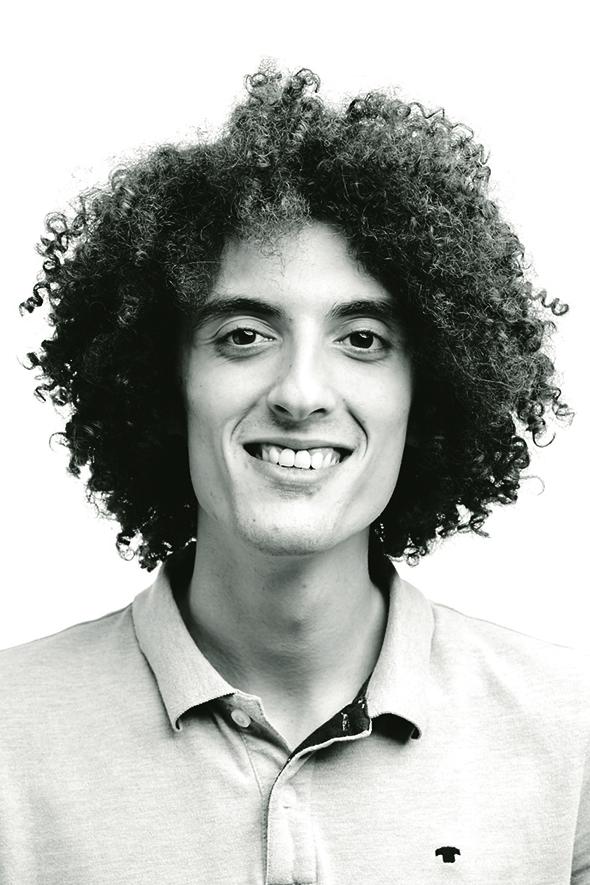
Jake Xuereb is from Marsascala. He is a final year PhD candidate and junior researcher at the Vienna Centre for Quantum Science & Technology, TU Wien and once led an edutech start-up in Malta.