Malta records second-lowest share of renewable electricity in EU
Only Slovakia generated a smaller proportion from renewables, while Denmark, Latvia and Austria topped the list
Malta recorded the second-lowest share of renewable energy in the EU during the second quarter of this year, according to figures published by Eurostat.
From April to June, Malta saw 21.2% of its energy come from renewables. Only Slovakia registered a lower share, at 19.9%.
By contrast, Denmark topped the chart with 94.7% of electricity coming from renewables. Latvia followed with 93.4% and Austria came in third with 91.8%.
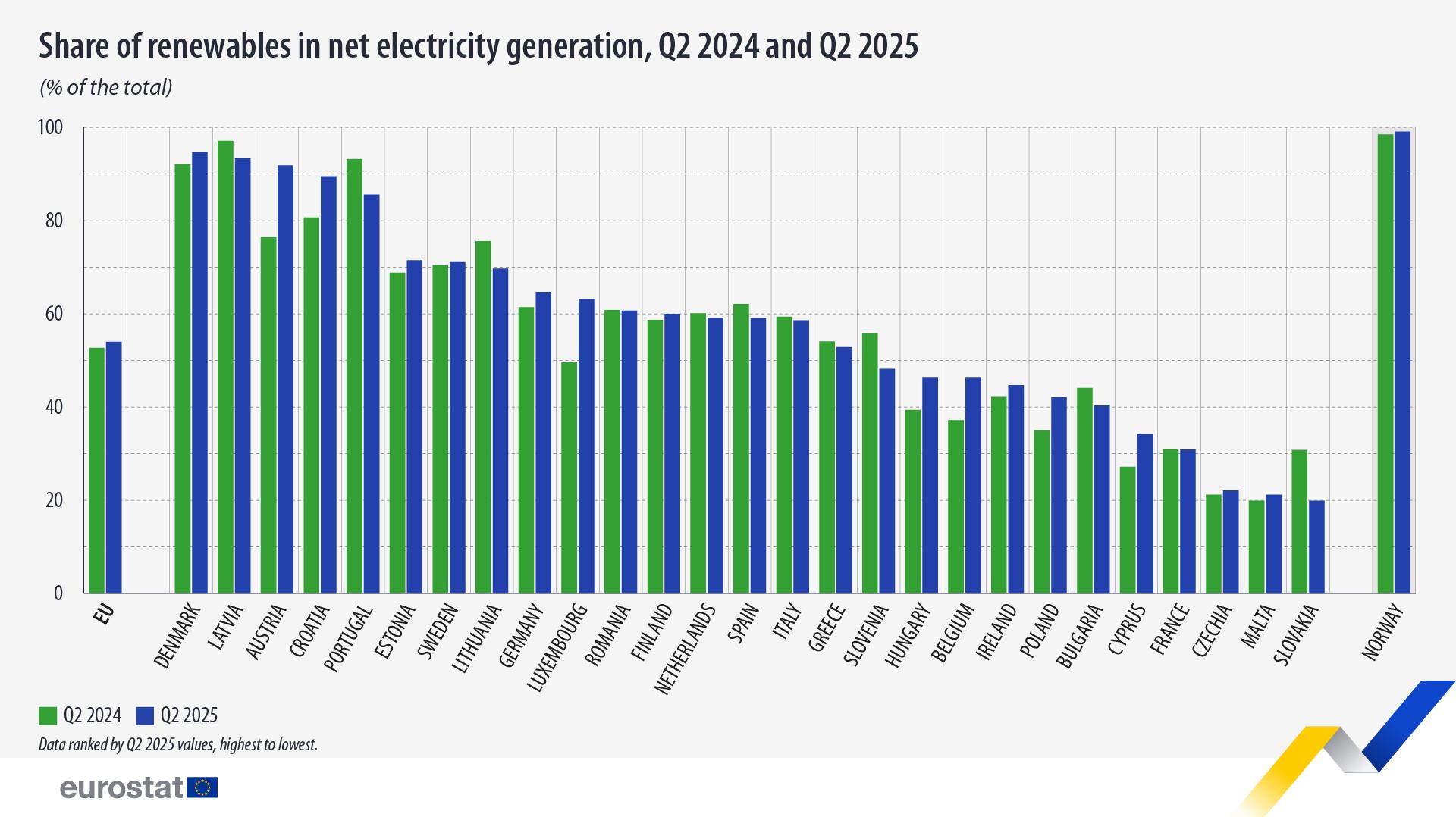 Shares of the second quarter in 2024 and 2025
Over the same period, Malta generated 524 gigawatt-hours (GWh) of renewable electricity, an increase over the 500 GWh generated in the same quarter of last year.
Eurostat noted that June was a milestone month for the EU: “June 2025 was the first month in history where solar energy (22.0%) was the main source of electricity generated in the EU, ahead of nuclear (21.6%), wind (15.8%), hydro (14.1%) and natural gas (13.8%).”
Overall, 54% of electricity generated in the EU in the second quarter came from renewable sources, up from 52.7% in the same period last year. The increase was largely driven by greater use of solar power, which contributed 122,317 GWh during the quarter.
Malta has long lagged behind other EU member states in its share of renewable electricity.
In 2023, just 11% of the country’s electricity needs were met by renewables, one-quarter of the EU average of 45%, and the lowest in the bloc.
Eurostat data going back to 2004, when Malta joined the EU, shows the country has consistently reported the lowest share of renewable electricity.
It was only in 2010 that Malta first reported any renewable energy use in electricity generation, at just 0.03%. Since then, the figure has climbed slowly, exceeding five per cent in 2016 and reaching 10% in 2021.