Malta sees first quarterly emissions drop in almost two years, biggest in EU
ADPD says the emissions drop appears to stem from increased use of the interconnector, thus shifting emissions to Italy
Malta recorded the largest decrease in greenhouse gas emissions in the EU during the first three months of the year, its first quarterly drop in almost two years, according to recent estimates.
Greenhouse gas emissions in Malta decreased by 6.2% during the first quarter of the year, the most significant drop across the EU, according to Eurostat figures published last week.
It is the first time Malta has seen reduced emissions in almost two years, having seen regular increases since the last reduction in the second quarter of 2023.
During the same period last year, the country’s emissions rocketed by 39%.
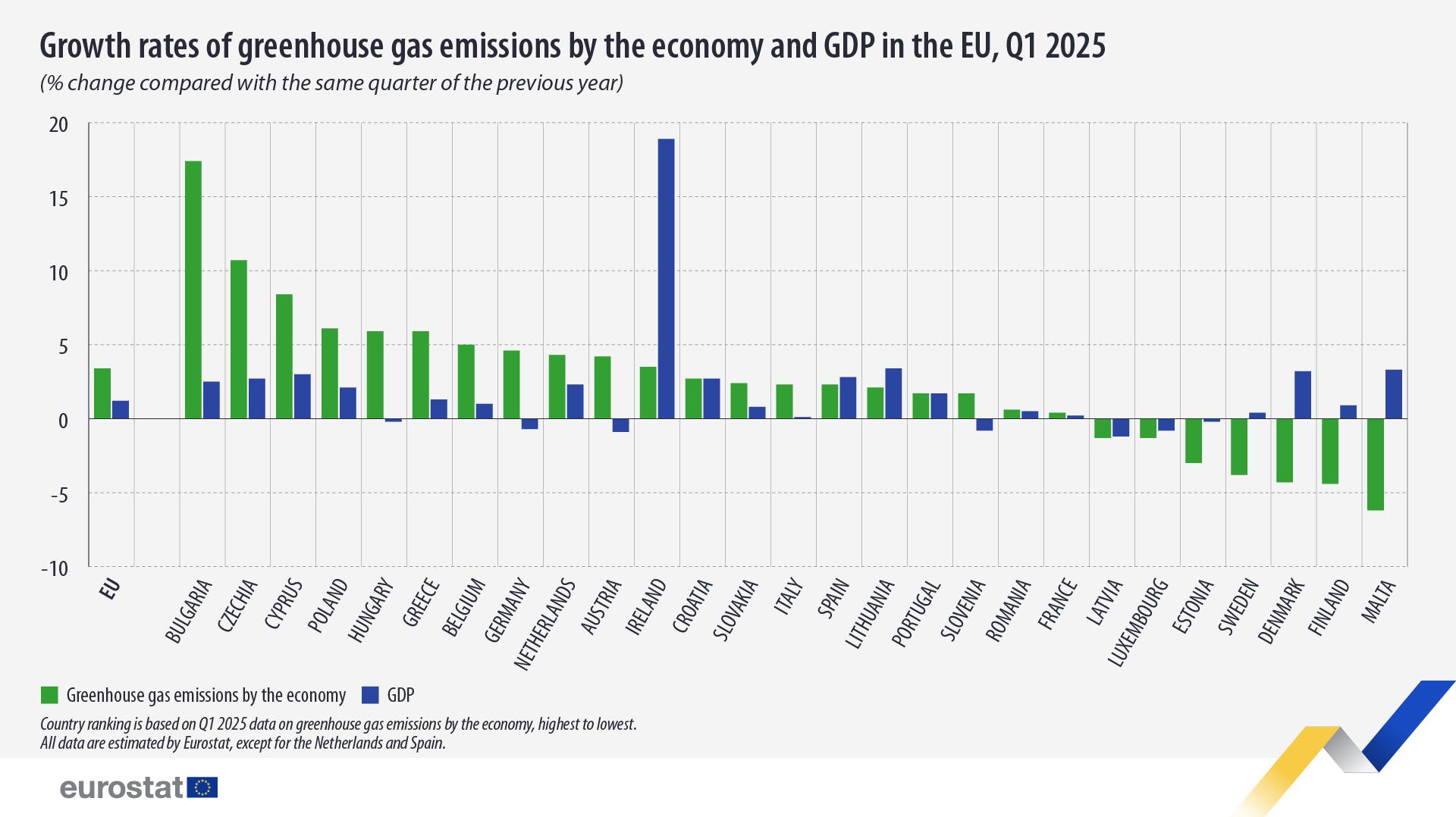 Graphic: Eurostat.
Malta's largest quarterly drop on record was at the start of 2016, when emissions reduced by almost a third, while its largest increase of 44% was recorded in the last quarter of 2021. Records began in 2011.
A total of seven countries saw reduced emissions at the start of this year, with Finland (-4.4%) and Denmark (-4.3%) seeing the second and third biggest decreases, respectively.
Most of the EU, meanwhile, saw increased emissions, led by Bulgaria (17.4%), Czechia (10.6%) and Cyprus (8.4%).
While Malta, Denmark, Finland and Sweden managed to grow their economies while reducing emissions, with all seeing increases in GDP, Estonia, Latvia and Luxembourg saw their GDPs decline as they reduced emissions.
Despite most countries recording increased emissions as their economies grew, there were some outliers; Hungary, Germany, Austria and Slovenia saw their GDPs decline as emissions increased, while Ireland saw its GDP surge ahead of emissions.
Overall, the EU saw an increase in both emissions and GDP, which grew by 3.4% and 1.2%, respectively. Bloc-wide greenhouse gas emissions were estimated to reach 900 million tonnes during the first quarter of the year, Eurostat said.
The two EU sectors responsible for the largest year-on-year increases in emission were electricity, gas, steam and air conditioning supply (+13.6%) and households (+5.6%), while three sectors – manufacturing (-0.2%), transportation and storage (-2.9%) and agriculture, forestry and fishing (-1.4%) – reduced emissions.
While the recent results come as good news to Malta, the country has struggled with its emissions in recent years; Malta saw the highest EU increase in greenhouse gas emissions in 2023.
ADPD says the decrease appears to be an accounting exercise
In a statement, ADPD the Green Party asked if the decrease in emissions was a result of an accounting exercise.
"Despite the decrease in emissions, the figure indicates a growing share of electricity sourced from the Sicily-Malta interconnector. For accounting purposes the emissions generated a few hundred kilometres away are not counted on Malta’s emissions balance sheet. The ‘reduction’ is therefore rendered purely notional, because it is just shifted onto Italy’s balance sheet. It does not necessarily indicate improvements in energy efficiency in Malta, nor a particularly large increase in local renewable energy sources," ADPD general secretary Ralph Cassar said in a statement.
"Electricity imported through the Malta-Sicily interconnector increased by 42% in 2024, with the interconnector responsible for 32.4% Malta’s energy supply. Similar amounts were probably imported in the first quarter of 2025. The Minister for Energy should come clean and state clearly that the reduction is actually purely a result of an accounting exercise. This government's record, following a long tradition of governmental neglect in the sector, is and remains abysmai," he added.