Malta university racing team places 11th at Silverstone
EV26 ranked fourth among electric cars despite driveshaft issue ending endurance run early
The University of Malta’s Formula Student team placed 11th overall at an international engineering competition at Silverstone, after producing one of the strongest-performing electric cars at the event.
UM Racing said its EV26 was ranked as the fourth-best electric vehicle at Formula Student UK 2026, which brought together 69 university teams.
The Maltese team finished fourth in the Sprint event and fifth in Acceleration, while recording the sixth-fastest lap time during the Endurance competition.
Its endurance run was cut short by a mechanical problem with the car’s driveshaft, preventing the team from completing the event and costing it valuable points in the overall classification.
“To finish 11th overall despite being unable to fully complete the Endurance gives us even greater confidence in what our team and our car are capable of achieving,” the team said.
UM Racing also became the third electric vehicle team to successfully pass scrutineering, the extensive technical and safety inspection that cars must clear before being allowed onto the track.
The result followed months of work by a 35-strong student team, which designed and fully built the EV26 within a single year – a first for UM Racing.
Before travelling to Britain, team president Matthias Zammit said the students had reduced the car’s weight by around 15 kilos and focused on refining its chassis, electronics and wiring.
“Rather than reinventing the car, this year has been about updating and fine-tuning it,” he said.
“We’ve reduced the weight by around 15 kilos, completed the chassis and focused on making every detail cleaner, from the electronics to the wiring, because those things also earn you points.”
Formula Student is about more than outright speed. Teams are assessed through acceleration, sprint, handling and endurance events, as well as static assessments covering engineering design, costs and business planning.
During the static events, students must defend their technical decisions before judges drawn from the automotive and motorsport industries.
“They expect you to justify every design choice,” Zammit said ahead of the competition.
“You need to show through simulations and analysis that the decisions you made produced meaningful improvements.”
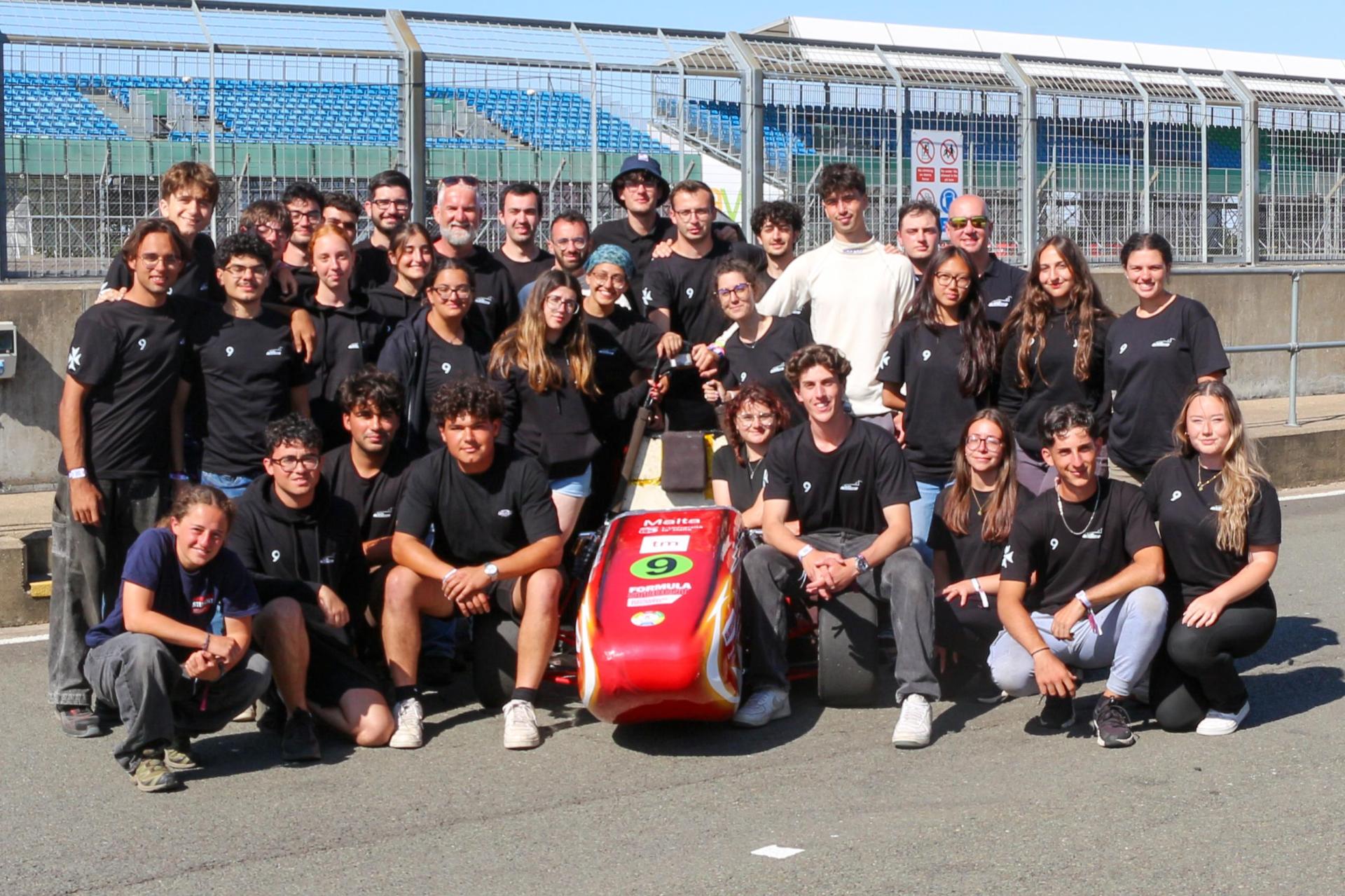 The UM Racing team at Silverstone. Photo: UM Racing
The EV26 builds on the university’s first electric Formula Student car, the EV24, which took around three years to develop.
The team switched from internal combustion to electric power in 2024, introducing Malta’s first student-built electric Formula Student car and presenting its members with a new set of engineering challenges.
“With the EV, we’re constantly learning new systems,” Zammit said. “It’s a completely different challenge.”
UM Racing’s 2020 petrol-powered car accelerated from zero to 100km/h in 4.6 seconds, while its first electric car reduced that time to 3.9 seconds.
The team said the EV26’s performance at Silverstone demonstrated the potential of the newer electric programme, particularly as it remained competitive despite failing to finish the endurance event.
Every component of the car was developed through months of teamwork, testing and problem-solving by students from several disciplines, it said.
The project extends beyond engineering, with members also responsible for fundraising, sponsorship, logistics and project management.
Transporting the car, batteries, tools and equipment to Britain was among the team’s biggest logistical challenges, particularly because of post-Brexit customs requirements.
The volunteer-run project costs around €100,000 in parts, with funding provided through sponsorship agreements and support from the University of Malta.
Founded in 2012, UM Racing first represented Malta at Formula Student in 2014.
Its best overall result at Silverstone came in 2022, when its internal combustion car placed third. It later secured a top-10 finish with its electric programme before placing 11th this year.
The project has also served as a route into the international motorsport industry, with former members going on to work for Formula One teams including Ferrari, Mercedes and Red Bull Racing.
“It’s really rewarding to see the skills students gain here translate into those careers,” Zammit said.
The team said it had returned from Silverstone with a clearer understanding of the EV26’s strengths and the areas that needed improvement.
“Our work will continue, while we also look towards future developments and new innovations that will allow us to come back stronger and push our performance even further,” it said.