Maltese UN envoy received 'serious death threat' after Israeli ambassador clash
UN diplomat Vanessa Frazier says suspect was detained by New York police
Maltese UN diplomat Vanessa Frazier faced a “serious and credible” death threat following a heated exchange with Israeli Ambassador Danny Danon last month, with New York police detaining a suspect over the incident, she has revealed.
Frazier was speaking during a conversation held with Times of Malta subscribers on Thursday evening at Theatre Next Door in Naxxar.
In June, Frazier and Danon clashed during a UN meeting after the Israeli envoy singled out the author of a report documenting sexual violence involving Israeli forces for criticism, accusing her of having an “obsession with targeting Israel”.
The exchange escalated after Frazier stepped in to condemn the personal attack on her colleague and made headlines around the world.
Speaking to Times of Malta editor-in-chief Herman Grech on Thursday, Frazier said she had received several death threats in the days following the exchange, with one in particular standing out.
“I received a very serious death threat, a credible one,” Frazier said. “This person tried to hide their tracks. It was a person who knew what they were doing.”
She said the incident was flagged by security and later referred to the NYPD, which opened an investigation and has since detained a suspect.
According to Frazier, the perpetrator “tried to cover their tracks and hide what they were doing. It shows intent”.
Red Hand Day
In the days following the exchange, Frazier was accused of promoting anti-Semitic content, both by Danon himself and by several social media users.
A poster promoting Thursday’s Times of Malta event, featuring a photo of Frazier holding her red palm aloft, also attracted criticism. Critics claimed the image celebrated the killing of Israeli soldiers by Hamas in the West Bank capital of Ramallah in 2000.
Frazier pointed out that the image is, in fact, part of an annual campaign, called Red Hand Day, against the recruitment of children in armed conflict, an issue that falls squarely within her current mandate as a UN representative for children.
“I remember exactly when that photo was taken,” Frazier recalled. “We were still campaigning for the UN Security Council, so it was even before the Gaza war. Malta was supporting the campaign.”
Frazier also played down suggestions of Danon’s personal antipathy towards her.
“I don’t think it’s particular or personal to me. I’ve known Danny for some time,” she said, hinting that his outburst may have contained an element of political theatre.
“The UN is a very important post for anyone who has political ambitions in Israel,” Frazier said, recalling how even Netanyahu served as Israel’s ambassador to the UN early in his career.
“I wish I was calmer,” Frazier said recalling the exchange with Danon. “But I don’t have men shout at me.”
Frazier takes pride in being a woman navigating the traditionally masculine world of diplomacy, saying “I really believe in the sisterhood”.
The importance of having more women in diplomatic talks is not just symbolic, Frazier argued, pointing to research that shows that “if women are involved in peace processes there’s a longer term of peace”.
“What I’ve learnt is that men want to end the war and women want to bring peace,” she quipped.
“That’s why you need both of them. It’s not the same thing and it’s not a subtle difference.”
Libyan pilots’ defection
Throughout the wide-ranging discussion, Frazier, who joined Malta’s diplomatic service in 1992, reflected on several incidents throughout her career.
Among the most consequential was the 2011 defection of two Libyan fighter pilots to Malta at the start of the Libyan revolution that eventually toppled Muammar Gaddafi.
At the time, Frazier was responsible for setting up the emergency centre (“we used to do drills, but never actually thought we were going to use it!”) when the two fighter pilots defected to Malta, in defiance of the Libyan government’s instructions to bomb protesting civilians.
Frazier recalled withstanding Libyan pressure to return the aircraft, which were among the best in the Libyan military’s arsenal.
“The messages we were receiving were ‘you can keep the pilots, we just want the aircraft’,” Frazier said. Despite Malta having no legal basis to retain the aircraft, it stood firm, she added, with the heavily armed aircraft providing the first tangible proof that the Gaddafi regime was bombing its own civilians.
An assessment of the weapons on board, carried out by bomb expert and later AFM brigadier Jeffrey Curmi, was handed over to NATO and the International Criminal Court, Frazier recalls.
The report proved to be a “very important” factor in an international arrest warrant issued against Gaddafi.
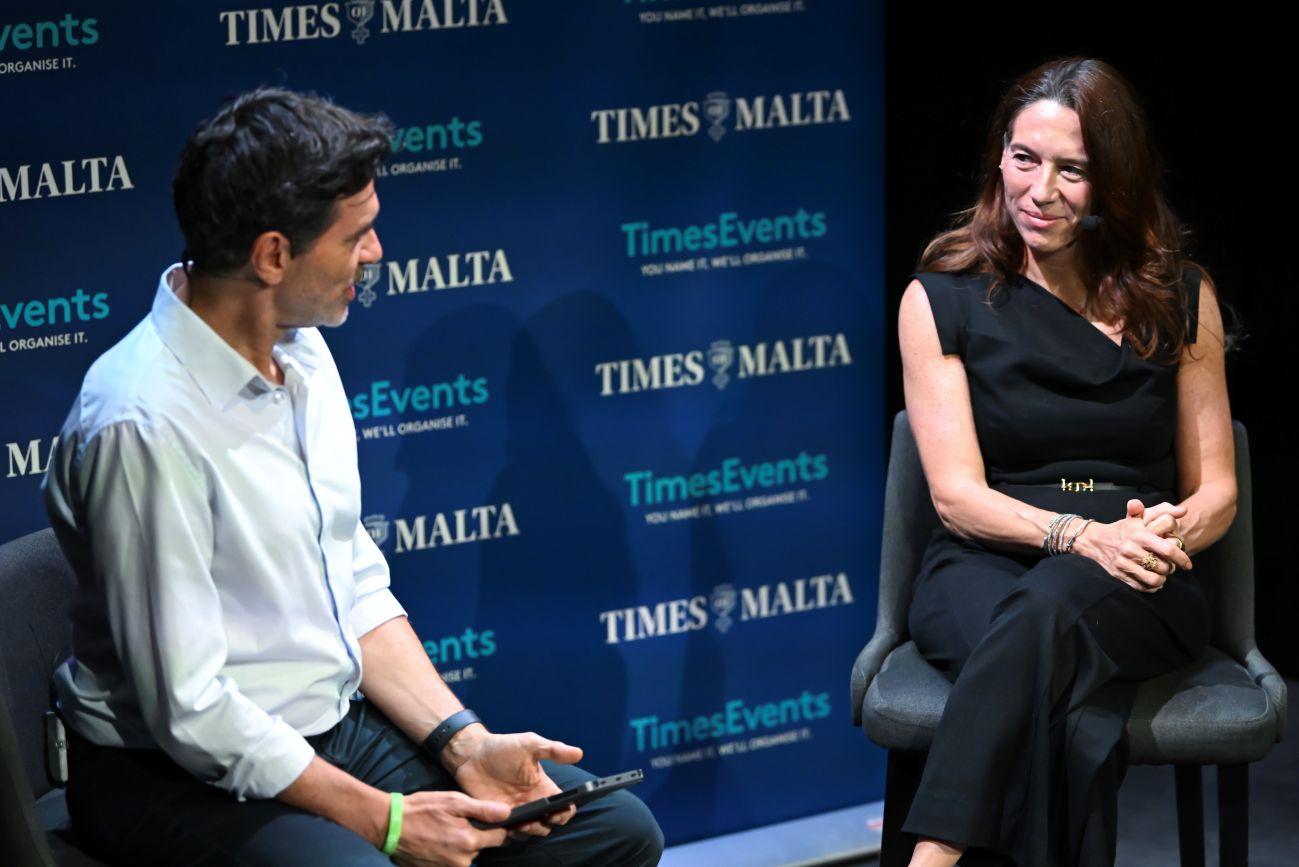 Vanessa Frazier in conversation with Times of Malta editor-in-chief Herman Grech. Photo: Matthew Mirabelli
UN Security Council
The Libyan incident prompted Malta to apply to be a candidate for a non-permanent seat on the UN Security Council, Frazier said, a move that would eventually come to fruition years later.
Frazier calls Malta’s stint on the Security Council “the greatest expression of Malta’s neutrality”.
“We really showed that we’re not aligned to any country, but we’re aligned to our principles,” she said.
Frazier proudly points to Malta’s record within the UN, dating back to before its stint on the Security Council.
“It was Malta that put climate on the UN agenda. Malta has done amazing things, it has a great brand within the UN,” she said.
Malta, and several other small nation-states, have frequently punched above their weight in international affairs, she argued.
“Power is more than just size, it’s the position you are in and how you use it,” she quipped.
Ultimately, “small countries are a moral compass because they don’t have a dog in the race, so you can afford to be principled,” she said.
That moral compass is being increasingly threatened by the “abandonment of international law”, particularly by state actors, Frazier warns.
“Children are dying because there are leaders taking conscious decisions,” she said, pointing to the frequency of military strikes in urban areas in the vicinity of schools or hospitals, in breach of international conventions.
“The problem with international law is that you need a moral compass to interpret it. And sometimes that moral compass isn’t there,” Frazier said.
 Times of Malta subscribers attended the talk at Theatre Next Door.
The emotional toll
Last October, Frazier took up a top role within the UN, advocating for the rights of children impacted by armed conflict.
She said the role has brought her into contact with “the most harrowing stories”, from children seized by Boko Haram in Nigeria to girls trying to escape the cycle of gang violence and rape in Haiti.
“I see a lot of negatives, but I try to focus on the positives,” Frazier said. “Last year we managed to separate 13,000 children from armed groups. That’s a lot of children with new lives.”
Nevertheless, Frazier admits that the job comes with a “heart-wrenching” emotional toll.
She described how, early in the Gaza war, she would “wake up at night suffocating, thinking of (Israeli) child hostages in the tunnels and how many Palestinian babies we were seeing pulled out of the rubble”.
One particular encounter with a Haitian girl caught in a cycle of gang violence was particularly difficult to handle, Frazier said.
The girl had first encountered violence at home before being sent to live with a cousin, only for her to suffer abuse at the hands of the cousin’s boyfriend, prompting her to be kicked out.
With nowhere to go, she found herself cycling in and out of five gangs. “When you’re in a Haitian gang you don’t belong to one person, you belong to the gang,” Frazier said.
“The girls are gang-raped continuously.”
After escaping the gangs, she moved to a cemetery in search of solace, only for another homeless man living in the same cemetery to start raping her each night.
“When I met her she was only 15, she had been through all of this before that.”
Asked how she handles the emotional toll of her job, she replied: “I go home and I cry a little bit every day. I think it’s really important to do it, the day I’m not able to do that I will stop.”
The conversation with Vanessa Frazier was the first in a new series of exclusive in-person meetings organised by Times of Malta for its subscribers. Subscribe to Times of Malta here to receive an invite for future events: https://timesofmalta.com/subscribe