Maltese scientist leads deep-sea expedition to explore remote part of Atlantic
Aaron Micallef joined by 19 other researchers in the exploration of Doldrums Transform Margin
A Maltese marine geoscientist is leading an international team of researchers on a five-week expedition to one of the least explored parts of the Atlantic Ocean.
Aaron Micallef, a senior scientist at the Monterey Bay Aquarium Research Institute in California, is chief scientist aboard the research vessel Falkor (too), operated by the Schmidt Ocean Institute.
The expedition, which began from Fortaleza in Brazil on May 17 and runs to June 20, is studying the Doldrums Transform and Fracture Zone, a remote system of faults and cracks on the seafloor near the Mid-Atlantic Ridge in the equatorial Atlantic.
Micallef is leading a team of 19 researchers from institutions in the US, Brazil, Italy, Colombia and Saudi Arabia.
The team will investigate whether deep fault systems in the region allow seawater to circulate through the Earth’s crust, effectively acting as hidden plumbing beneath the ocean floor.
Scientists believe that in some areas, seawater can react with rocks originally formed deep inside the Earth. Those reactions can produce chemicals such as hydrogen and methane, which may provide energy for microbes and other deep-sea life.
The Doldrums region is of interest because transform margins are major features of the ocean floor, but remain poorly understood. They form where tectonic plates slide past each other, creating long fault zones that may expose deep rocks from the Earth’s mantle and shape how heat and chemicals move between the ocean and the Earth’s interior.
During the expedition, the team will first survey the seafloor using multibeam sonar aboard Falkor (too). It will then deploy the autonomous underwater vehicle The Childlike Empress to collect higher-resolution maps and chemical data, before using the remotely operated vehicle SuBastian to examine selected sites in detail.
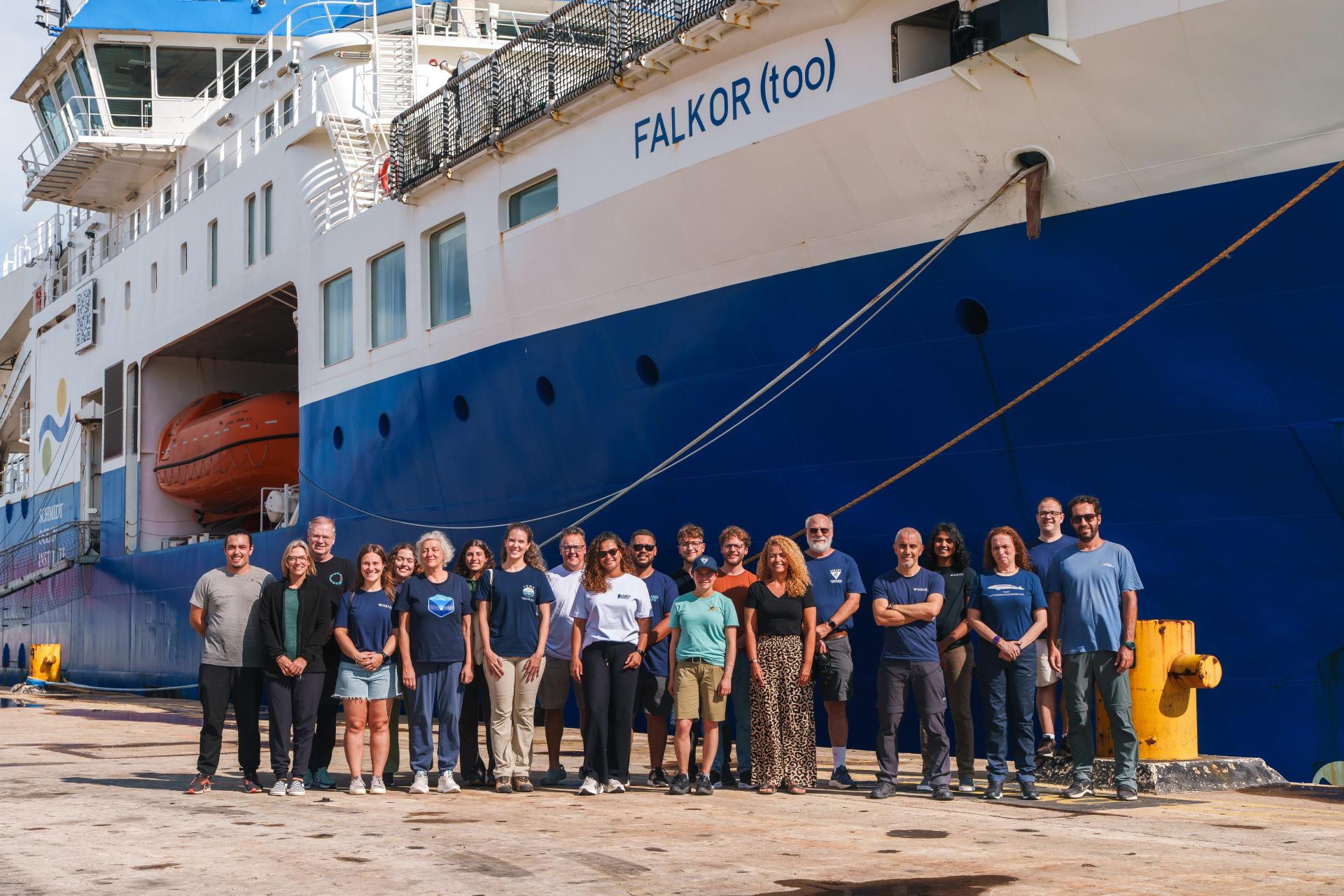 The research team.
The expedition will look for hydrothermal venting and chemical seepage from the seafloor, both of which could support specialised biological communities in an extreme deep-sea environment.
Micallef has previously led research into major geological processes beneath the sea. Last year, a Malta-led team headed by him published evidence supporting the theory that the largest flood in known Earth history refilled the Mediterranean more than five million years ago.
He has also studied how climate change is affecting the seabed around Antarctica, including areas where freshwater may be “leaking” from the ocean floor.
Members of the public can follow parts of the latest expedition through live-streamed dives shared by the Schmidt Ocean Institute.