A Tuscan nobleman, a foiled uprising and the bloody conspiracy that shook Malta
Marucelli – an unknown Malta Favray in an Italian museum?
The noble Tuscan dynasty of the Marucelli did not regularly top up the ranks of the Order of Malta. While the cadets of innumerable Italian aristocratic families chose a Hospitaller future for their careers, only one Marucelli seems to have enlisted over the centuries: Fra Gio Maria Filippo, from Florence, who professed on July 13, 1722, solemnly embracing the vows of poverty, chastity and obedience.
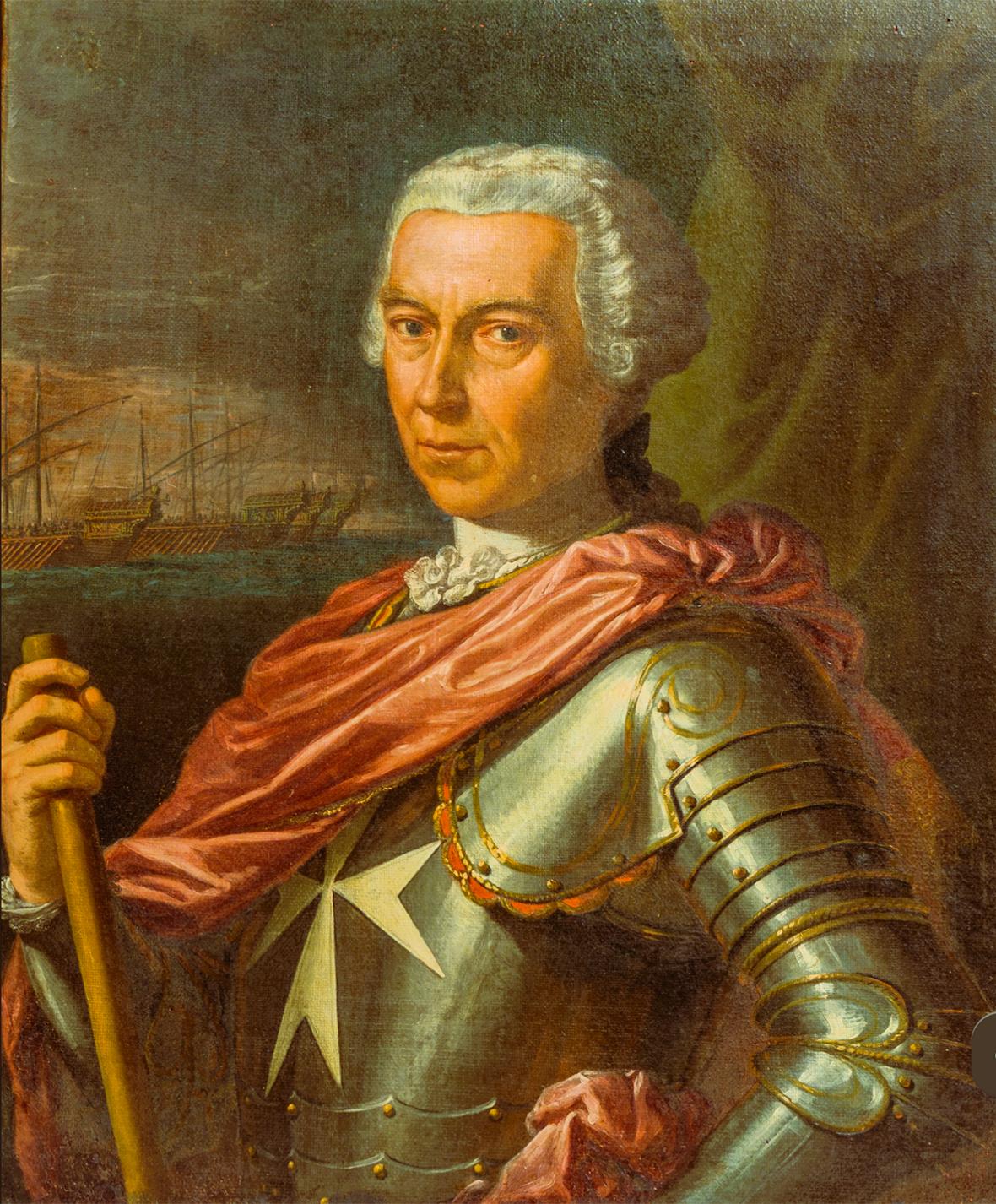 The portrait in oils of captain-general Gio Maria Filippo Maruccelli in the Crotona museum, which the author tentatively attributes to Antoine Favray.
That month alone, four other prominent Italian youngsters joined the Order: Fra Tommaso Ruffo dei Duchi della Bagnara, Fra Guido Ubaldo Bonarelli della Rovere, Fra Ettore dei Conti Antonini and Fra Carlo di Gregorio dei Marchesi di Trani.
Though the young Gio Maria Filippo – named after his more renowned uncle the scholar Giovanni Filippo (1628 -1680) – carved himself an honourable career in Malta, his name rarely appears in the annals, either famously or infamously. Praise, scandal and gossip seem to have bypassed him.
A man of culture, with artistic and antiquarian inclinations, he served his Order through a progressive naval career, identifying with the daring Hospitaller navy, perpetually corsairing the eastern and southern Mediterranean, then still a force to be reckoned with.
On August 10, 1728, Manoel de Vilhena appointed Marucelli captain of the galley San Luigi – confirming his distinguished seamanship in the Order’s regular naval training courses, the carovane. Marucelli peaked his naval career in Malta on November 5, 1748, when Grand Master Pinto promoted him to captain general (official title: capitano generale delle armi di nostra Sacra Religione in mare, today’s admiral of the fleet), a highly prestigious position lasting two years.
In that interval, the minutes of the Council of State record four instructions to Marucelli (here Maruscelli, Maruccelli) about the fleet’s plans and activities. The Order expected the bali to accomplish his missions “with your habitual prudence and zeal and with the advice of the other captains and pilots”.
Marucelli’s command of the Order’s fleet coincided with one of the most sinister and terrifying events in the history of the island – the conspiracy of the slaves organised in its minutest detail by the then captive Mustata Pasha of Rhodes, a revolt of c. 2,000 Muslim captives (other estimates put the figure much higher, c. 9,000) and the assassination of the grand master and all the leading knights, on Mnarja, the feast of St Peter and St Paul, June 29, 1749, to take over the island for the Ottoman Sultan.
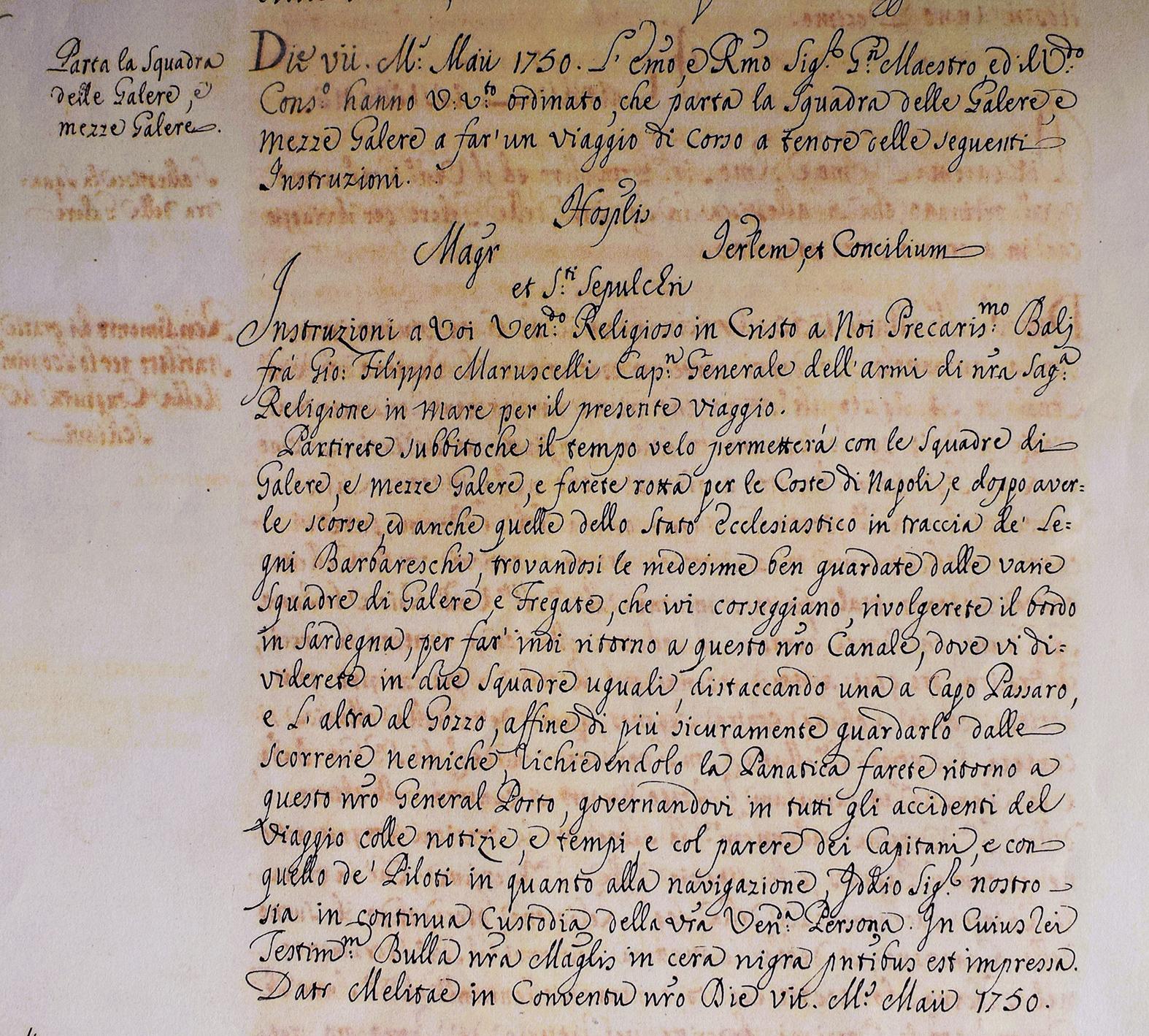 One of the original 1750 instructions by the Order to captain-general Marucelli regarding the conduct of the fleet under his command.
Integral to the conspiracy was to be the uprising of the rower slaves on the galleys then under Marucelli, already out at sea on their summer cruise. One of the leading conspirators, Eisa, the trusted personal servant to Marucelli, had to kill his master, having been promised the rank of captain general of the fleet on the success of the plot. Similarly, other galley slaves expected spectacular promotions on capturing the vessels on which they served.
At a synchronised time, the plotters on the vessels were to poison the stores of wine and the cooked soup to be served to the knights, to the officers and crew. The crates of dry cereals hid guns and knives. The conspirators on the galleys had prearranged a system of signals – a piece of white cloth on Marucelli’s cabin door to kick off the proceedings, followed by a red duster as soon as the poison took effect. Selected slaves had to knife all the armed guards on board.
On land, Pinto’s personal servant Imselleti had to stab the grand master to death with a poisoned dagger, then hurl a vase into the courtyard and appear in a window brandishing Pinto’s severed head. This signalled the uprising to the other slaves in the Palace and the general massacre of all knights and Christians.
Fortuitously, Pinto learnt of the lethal conspiracy just in time. He had Marucelli informed instantly. The scorned grand master reacted with appalling savagery – 80 of the ringleaders suffered torture and executions too excruciating to recount. Printed narratives of the interrogations and judicial executions left the rest of Europe in shock, driving the pope to relegate them to the Index of Prohibited Books.
Many of Marucelli’s slaves endured unbearable torments and capital punishments − not on his orders. The victims’ ignominy had to outlast their death. The torturers believed the heads of those decapitated and the limbs of those dismembered served a pedagogical function and ordered them to remain impaled on spears raised high on Forts St Elmo, St Angelo and Ricasoli, in perpetuity.
On the termination of his naval functions as captain general in 1752, Marucelli formally donated his personal Banner of Victory, flown from the Capitana’s lateen boom, to the sanctuary of Santa Margherita in Cortona. It shows an exquisitely painted Blessed Virgin, her feet crushing a serpent entwined round a crescent moon − here a symbol of Islam? In the fly, Marucelli’s coat of arms under a coronet, over an eight-pointed cross, a trophy and a grappling hook. Embroidered designs border the banner, now on display in the Cortona Museum.
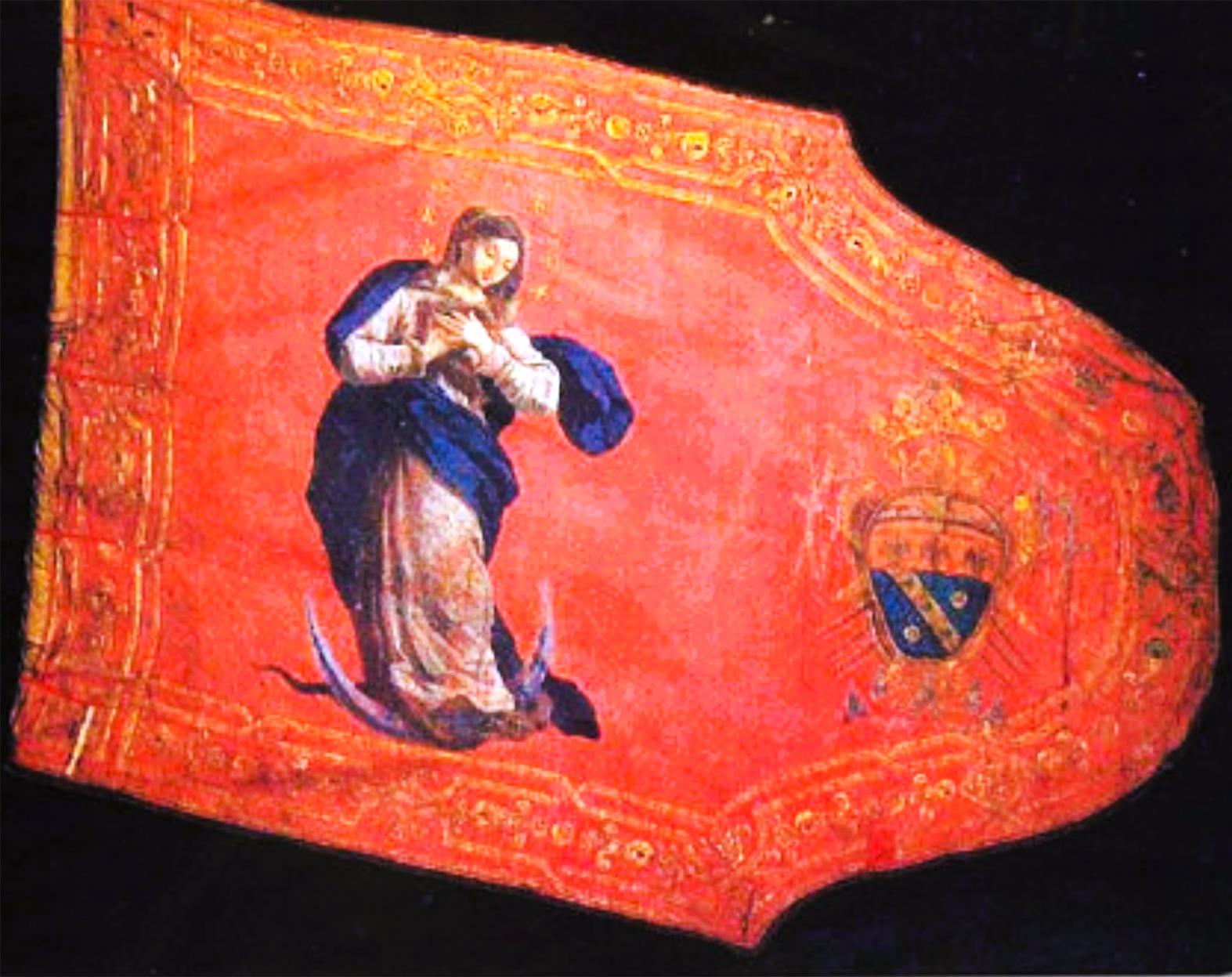 The personal ‘Banner of Victory’ used by Marucelli in Malta, which he donated to the Cortona sanctuary of Santa Margherita.
That museum also houses an enigmatic portrait in oils of bali Marucelli. He wears a full steel breastplate with fabric trimmings displaying the Maltese eight-pointed cross prominently on the front. Although metal body armour had gone out of fashion over a century earlier, members of the Order persisted in having their portraits painted in obsolete metal envelopes to advertise their military vocation. Marucelli’s baton symbolises command. Prominent in the background, the whole Order’s navy proudly confirms the bali wanted his portrait to record his authority over the fleet.
No document so far suggests a name for the painter of Marucelli’s portrait. Very tentatively I propose one: Antoine Favray, the ‘official’ resident artist for the Order in the captain general’s time. Overall, the style closely approximates Favray’s.
I am reluctant to accept: follower or school of Favray. Why would the wealthy and art-loving bali of the Order settle for an obscure untalented follower, copyist, student or imitator, when he, like other leading knights, had the maestro himself within easy reach?
I haven’t examined the painting personally and only rely on photographs, which admittedly weaken certainty. The splendid burnished steel sheen on the armour mimics favourably other Favray portraits of warrior-knights. And another Favray give-away: the large eight-pointed cross shows a dark fillet tracing the inside of the contours – exactly like other eight-pointed crosses in Favray’s armour portraits. The face, though competently brush-stroked, may lack the finesse some other Favray portraits display. That prompts my hesitation.
Marucelli’s detailed wills, preserved in the Malta archives, do not mention his portrait. All unlisted valuables automatically devolved on the Order which held auctions of items it did not opt to keep.
After 1755, Marucelli’s traces in Malta fade. We next know of his membership in the erudite Accademia Etrusca of Cortona, founded in 1726 by an elite group of intellectuals to promote Tuscan archaeology and culture. The members elected their president, the Lucumone (an Etruscan designation for high priest monarch) for five-year terms. Marucelli occupied that top post in 1765.
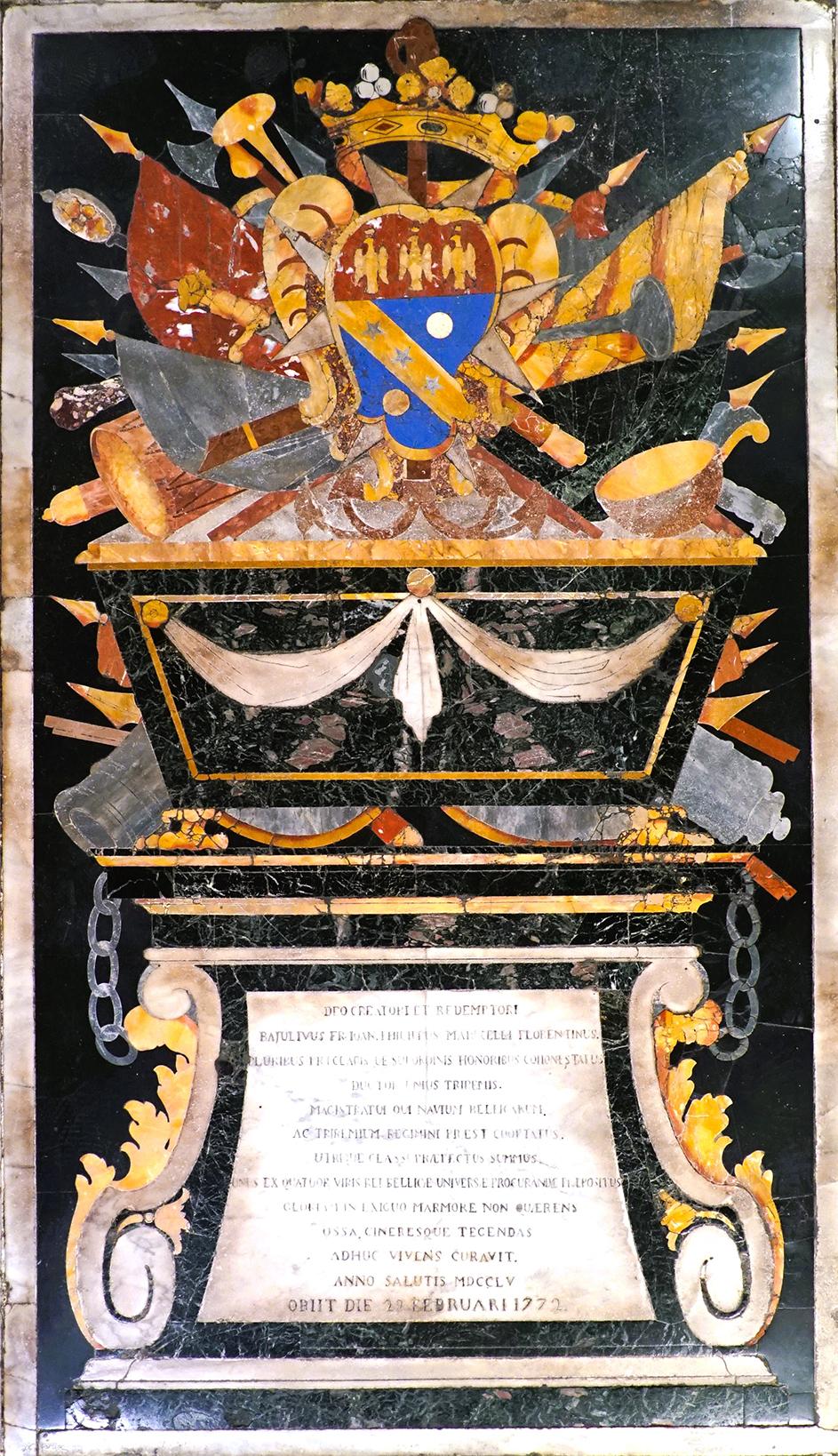 The marble tombstone of Marucelli at St John’s Co-Cathedral prepared in 1755. He died in 1772 and is buried in Florence. Photo: St John’s Co-Cathedral Foundation
Like many other prominent knights, bali Marucelli had the foresight to prepare his baroque marble intarsia tombstone in St John’s conventual church in 1755, well in advance of his death. He passed in Florence, where he is probably buried, on February 28, 1772.
The Order’s statutes determined that all the property of its members devolved automatically on the Order when the cavaliere died. But the knight could obtain permission to dispose freely of one-fifth of his estate − the quinto. Marucelli, like most knights, earned this faculty (from Grand Master Vilhena in 1726). He drew up four wills in Florence, on May 28, 1765, and three in 1769 − his spoglio and dispropriamento. These confirm that he had returned to Florence many years earlier.
Marucelli details fastidiously his disposable quinto – jewellery, rings with gems or cameos, eight-pointed crosses, chains, seals, buttons, shoe and belt buckles and a pocket-watch, all in gold, silverware, clothes, shoes, coins, books, antiques (even some derogative anticaglie), paintings, drawings, cutlery and personal belongings, including tablecloths, cash, bed linen, underwear, towels, kitchen utensils and shaving razors, carriages and horses.
He willed them to named members of his family and friends – not overlooking his cohort of employees: clerks, servants, waiters, cooks, coach drivers, scullery and stable boys, farm workers, agents. Word-count restrictions prevent me from recording the items and the beneficiaries in greater detail.
The Florentine’s inventories list several paintings and drawings, but only attribute two to named artists, besides some generic descriptions as bambocciante or Fiammingo. Those by Giuseppe Zocchi (1716–1767) and by Rembrandt’s pupil Bernardo di Danimarca (known as Monsu Bernardo, 1624-1687) he left to his nephew, the former monk Franco Marucelli.
Acknowledgements
All my gratitude to Mgr Emmanuel Agius, Paolo Bruschetti, Piero Crociani, Jeremy Debono, Edward DeGaetano, Tonio Mallia and Theresa Vella.