Watch: Medical supplies delivered by drone for first time
First blood samples carried between Saint James Hospitals, in Żejtun and Sliema
A drone has been used to carry blood samples between two private hospitals, marking the start of commercial drone deliveries for medical supplies in Malta.
The drone operated by SKY Mobility (Malta) Ltd. delivered blood samples with its Flying ZERO Air Services from Saint James Hospital, Żejtun, to the healthcare provider’s Sliema premises on Tuesday.
This was the first time medical supplies were carried by drone on the island.
The 13.4-kilometre flight took just nine minutes and 43 seconds, delivering on the drone company’s pledge to halve delivery times between the two hospitals compared to road transport.
The flight marked the beginning of commercial operations between Flying ZERO and St James Hospital as the companies plan for daily drone flights.
Flying ZERO founder and CEO Alexander Esslinger expressed his “excitement” at seeing Tuesday’s flight, saying it had been conducted safely and according to plan.
“Today, we did what we had already practised many times, so now, that excitement is also because there is more to come,” he said. “From now on, we will fly twice a day. We are excited, our team is ready, and all set for take-off.”
The first flight saw the drone rapidly take off vertically before heading east at speed, quickly becoming lost in blue skies overhead. Most of the route was over the sea along Malta’s east coast, with onboard cameras capturing the scenery as the drone moved northeast and then inland to Sliema.
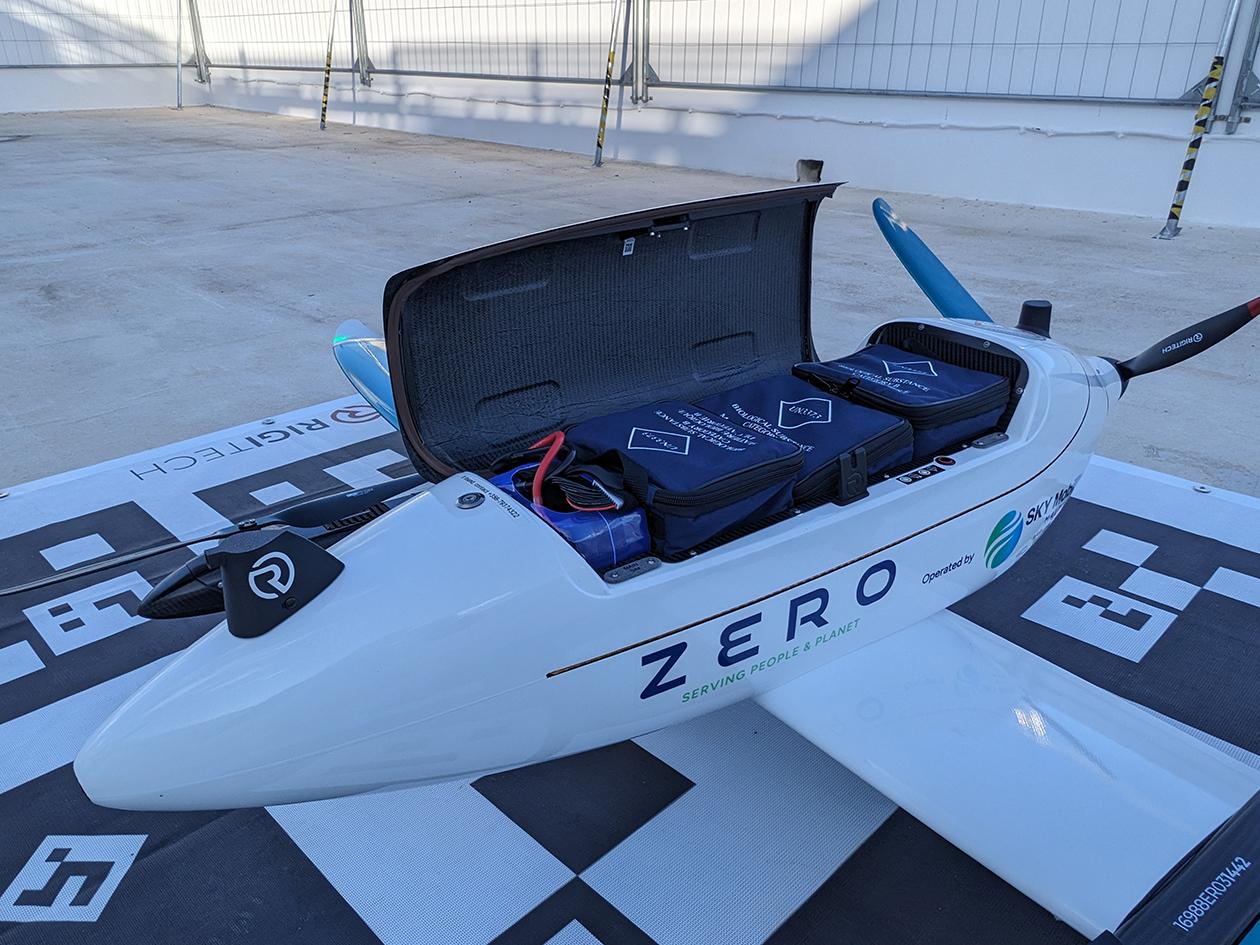 The drone carried blood samples from Saint James Hospital, Żejtun, to the healthcare provider’s Sliema laboratory. Photo: James Cummings
Remote pilot Simon Desira, stationed in Żejtun, explained that the drone was travelling at about 28 metres per second, taking Times of Malta through the laptop controls for the drone.
On-screen buttons allow the remote pilot to pause the drone’s flight, hovering in place, which, Desira pointed out, could be needed due to unforeseen air traffic, such as an AFM helicopter flying untracked at low altitude, or return to its origin point.
“We monitor air traffic so that if there’s a flight that is not visible on flight tracking sites, we’ll know about it,” he said, adding that the drone’s flight path had been approved in advance by the transport authorities.
Other controls allow the pilot to send the drone to predetermined rally points, immediately land, or, should the need arise, switch off the drone’s power and deploy its parachute.
Post-flight reports allow the crew to measure important information about each trip, such as the vibrations experienced onboard due to turbulence.
Saint James Hospital head of laboratory services, Paul Sultana said the healthcare provider was “very happy to be the first in Malta to have medical supplies transported by drone”.
Sultana said the service would prove especially useful for “emergency testing, when it’s imperative we get results out as soon as possible”, adding he foresaw the service eventually expanding to connect other clinics and even facilities in Gozo.
He said an “incredible” amount of preparation had gone into the flight.
“It’s like a normal aeroplane flight in terms of permits and safety checks; a lot went into this," he said.
Last year similar services began to operate in Belgium, Dubai, the American state of North Dakota and Dublin, Ireland.