Roberta Metsola rallies voters as they 'choose country's future direction'
The European Parliament president joins PN leader at party rally on eve of early voting
European Parliament president Roberta Metsola urged the Maltese public to treat every vote as a decision on Malta’s future, as she joined PN leader Alex Borg at a campaign event in Swieqi on the eve of early voting.
Metsola told the audience at the event, which was meant to take place last week but was cancelled due to rain, that the choice facing voters would not only determine the country’s direction for the next five years but would also shape Malta’s future beyond the coming legislature.
“Every vote will give direction,” she said, arguing that the country needed a strong economy that translated into better opportunities, cleaner energy, improved quality of life and a government that listened to people’s concerns.
The event, which was also addressed by PN MEPs Peter Agius and David Casa came as the PN enters the final stretch of an early general election campaign that Borg has repeatedly framed as a choice between the status quo and “a new direction” for the country.
Metsola called for politics to move beyond tribalism. “This is not football, us versus them or red versus blue. Politics should instead be a way for people to shape the country’s future together,” she said.
Her speech touched on several of the PN’s key campaign themes, including traffic, power cuts, taxes, healthcare, overdevelopment, parks, Gozo and education.
She said people were spending too many hours stuck in traffic, losing time that could otherwise be spent with family or on leisure. Traffic, she said, was not only a financial burden but also one that caused pollution and affected people’s daily lives.
Borg used his speech to return to one of the PN’s central campaign pledges, launched earlier on Friday: a mass transport project which he said would start being implemented from day one of a PN government.
Borg, together with Adrian Delia and architect and PN candidate Julian Borg, unveiled the party’s €1.4 billion underground metro proposal, promising that the first line would be operational within five years.
The PN plan envisages an underground rail line between the airport and Pembroke, running 11.5km across eight stations, including stops at St Vincent de Paul, Qormi, Mater Dei and the University of Malta, Gżira, Sliema and St Julian’s. Julian Borg gave a technical review of the project, saying the line would run eight trips an hour, with a seven-minute waiting time between journeys.
The PN says around 30% of the first line’s cost would be financed through EU funds, with the remaining expense covered through loans and other financial instruments, including the Malta Development Bank. The service would be free for residents, while tourists would pay to use it.
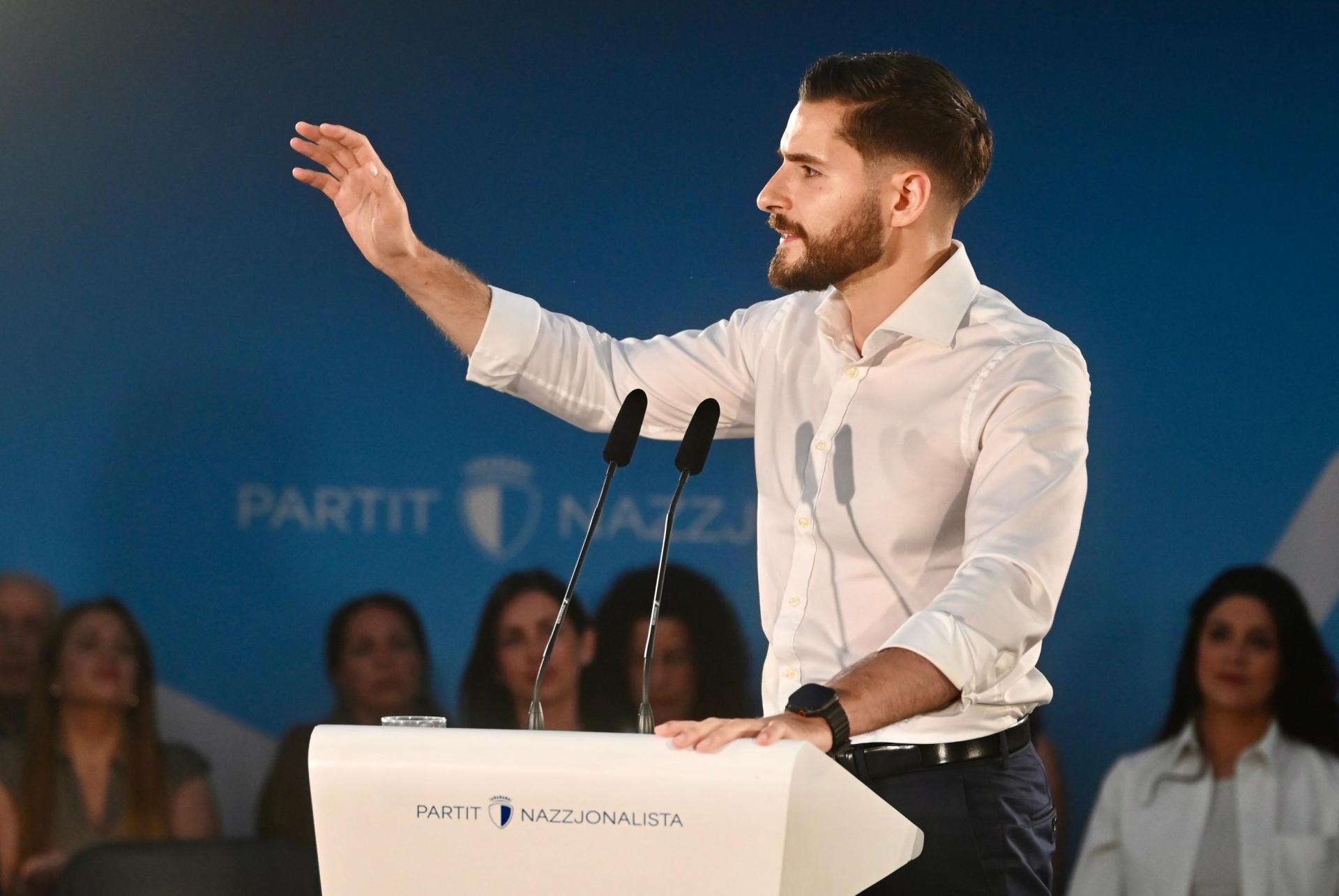 PN Leader Alex Borg said traffic congestion should not be accepted as normal. Photo: Jonathan Borg
At the Swieqi event, Borg said traffic was no longer a mere inconvenience but a burden on families, workers, businesses, health, productivity and quality of life.
Parents taking children to school, workers arriving tired at their workplace and businesses losing productivity had all come to reflect a system that people had come to accept as normal, he said.
“We should not accept this as normality,” he told the crowd.
Borg contrasted the PN’s plan with the government’s “Malta in Motion” transport proposal, which includes a 24km light rail line linking St Paul’s Bay to the airport as part of a 15-year transport plan. The government has said the line would form the backbone of a redesigned transport network integrating buses, ferries and cycle routes.
The PN leader questioned the credibility of Labour’s proposal, pointing to Finance Minister Clyde Caruana’s caution over mass transport costs.
Borg said the difference between the parties was that the PN had presented a team, technical details and a financing plan. He said Delia had committed himself to signing off on the project, calling that “competence and credibility”, echoing recent messaging by Prime Minister Robert Abela.
Borg said Malta had ended up in this situation because, after 13 years of Labour government, the car remained the only transport method people felt they could trust. Public transport, he argued, was under pressure because it used the same congested roads as everyone else.
He said the PN’s underground system was not intended to take cars away from people but to give them a credible alternative that was punctual and reliable.
Borg also referred to another PN transport pledge announced earlier this week: reducing or removing circulation licence fees for low-mileage vehicles. Under the proposal, cars driven up to 500km a year would pay no licence fee, while vehicles driven between 500km and 5,000km would pay a gradually increasing fee up to 80% of the full amount.
He said the measure would be fairer on people who use their cars less, while encouraging reduced car dependency.