Mid-way mark: Venice’s Architecture Biennale under the summer sun
Ann Dingli reviews the 19th edition of the event, curated by Italian architect Carlo Ratti
Reviews of the Venice Architecture Biennale usually emerge before or around its opening in spring. But visiting, once the clamour of press and VIPs has dissipated, brings a rarified, quieter reading.
It’s August and the pulse of Venice is steady but intense under the beating rays of a mature summer sun.
The 19th edition of the Architecture Biennale is curated by Carlo Ratti to the theme Intelligens. Natural. Artificial. Collective. In simple terms, the grouping of all kinds of knowledge or advancement – whether cerebral, intellectual, technological, artificial, communal or other – towards enabling the built environment to save, or at least not destroy, the world.
Because it’s mid-way through the biennale’s run, verdicts on its success or failure have already been cast. Most have remarked on the curation’s link to political conservativism even ahead of the event’s opening, its overwhelming list of participants (760 in total), its perceived masculinity, alienating volume and its many robots.
Ratti is an Italian architect who is known as an ally to technology and the digital world – his focus being on how they can enhance the way urbanity progresses. He is professor of Urban Technologies and Planning at the Massachusetts Institute of Technology (MIT), where he directs the ‘Senseable City Lab’, which specifically explores the impact of digital technologies on cities.
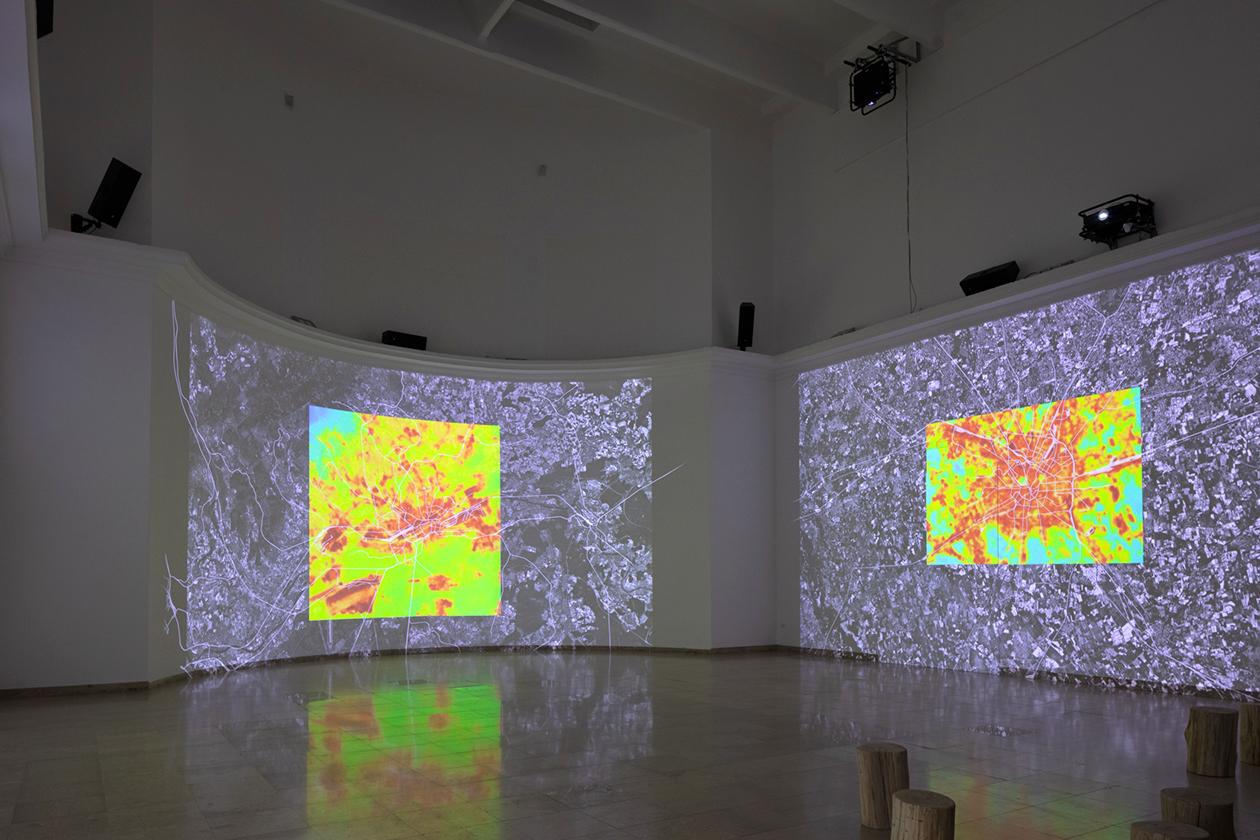 Pavilion of Germany, STRESSTEST. Photo: Luca Capuano, Courtesy of La Biennale di Venezia
His appointment following Leslie Lokko’s curation in 2023 brought about obvious contrast. Ratti’s sensibilities have fashioned what he calls a deliberate return to “architecture in the traditional sense”.
Lokko’s biennale was defiantly multidisciplinary and, to many a mind, somewhat excursive. Ratti seems to have built a biennale in direct response to this commentary – most explicitly to the mournful cry of Zaha Hadid Architects’ Patrik Schumacher, who stamp-footedly declared Lokko’s contribution as an “anti-architectural biennale”.
But curatorial politics die down past the biennale’s opening weekend and its flurry of reviews. After that, there is nothing left to consume but its content – the metres and metres of exhibits that attempt to answer the most pressing trials of today’s built world.
Overwhelmingly, climate change stands out as the number- one topic in this edition. There are others of course, seemingly hundreds of ‘problem’ topics that have been paired with a solution of varying format, from robotics to biological, engineered to hand-crafted, and everything imaginable in between. But the highest-level feeling is that of a dangerously warming world and is most emphatically expressed by the Arsenale’s entry exhibit, Terms and Conditions.
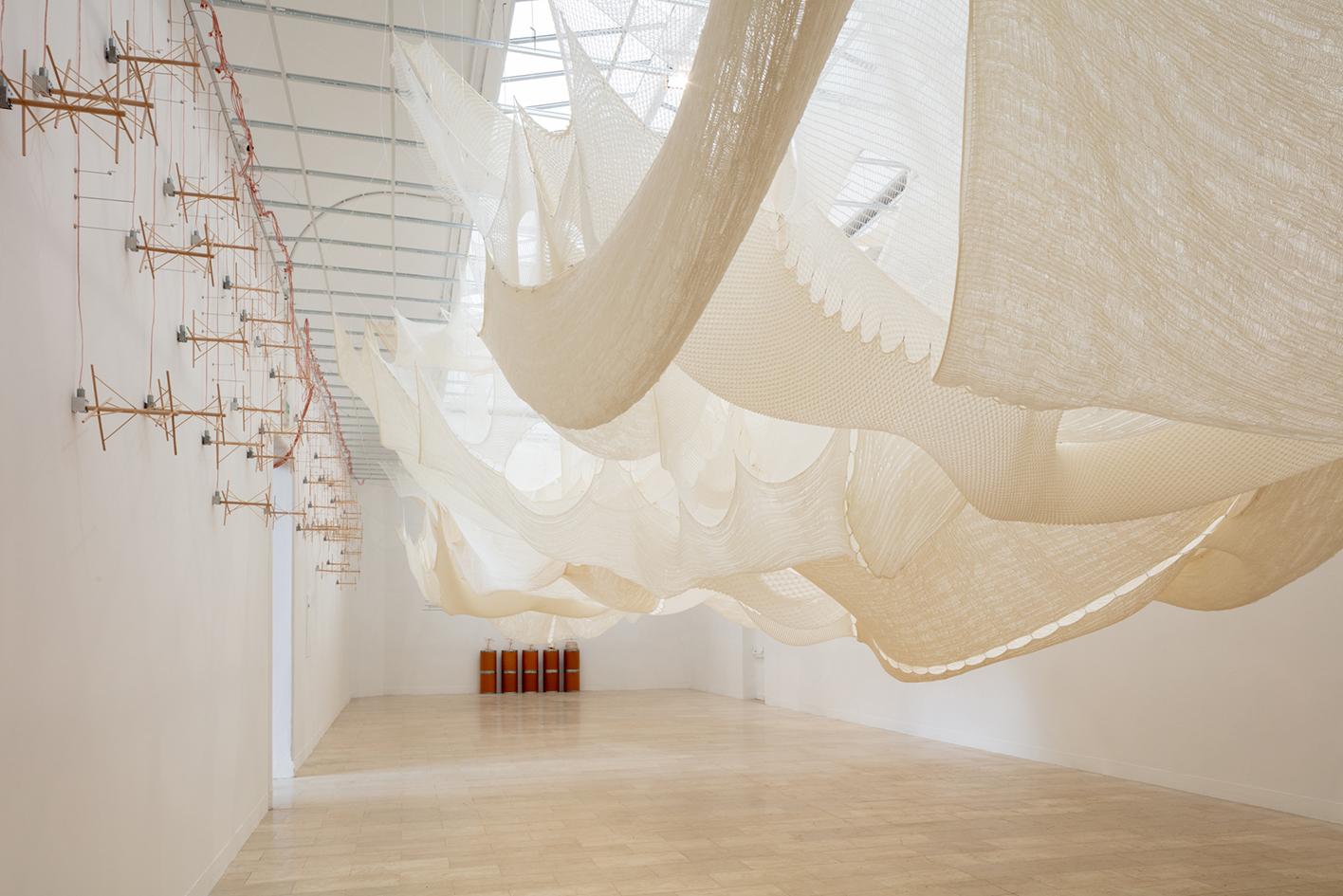 Unravelling: New Spaces, Pavilion of Serbia. Photo: Luca Capuano, Courtesy of La Biennale di Venezia
It’s a deceptive start. The installation, authored by Transsolar, Bilge Kobas, Daniel A. Barber and Sonia Seneviratne, is viscerally impactful. Air-conditioning units are suspended over flat bodies of water, halos of light vibrating behind them.
The temperature of the space has been turned up to a bearably uncomfortable degree. Because of the water elements, it feels damp and swampy.
The idea is to simulate the environmental consequences that conditioned air might have on the natural world – the carbon needed to artificially cool our spaces will over time have impacts on how the environment can regulate itself; those are its ‘terms and conditions’.
It’s a strong and very sensorial opening to the main curation’s showcase – but it does not start as it means to go on.
Beyond this entry, the Arsenale hall is condensed with displays more akin to trade fair than biennale semiotics. Information panels (each famously carrying a short AI summation at the end of, admittedly far too lengthy, human descriptions) are homogenous, with little hierarchy across the entire hall. The space is at once dense with information, yet very difficult to understand in any real detail.
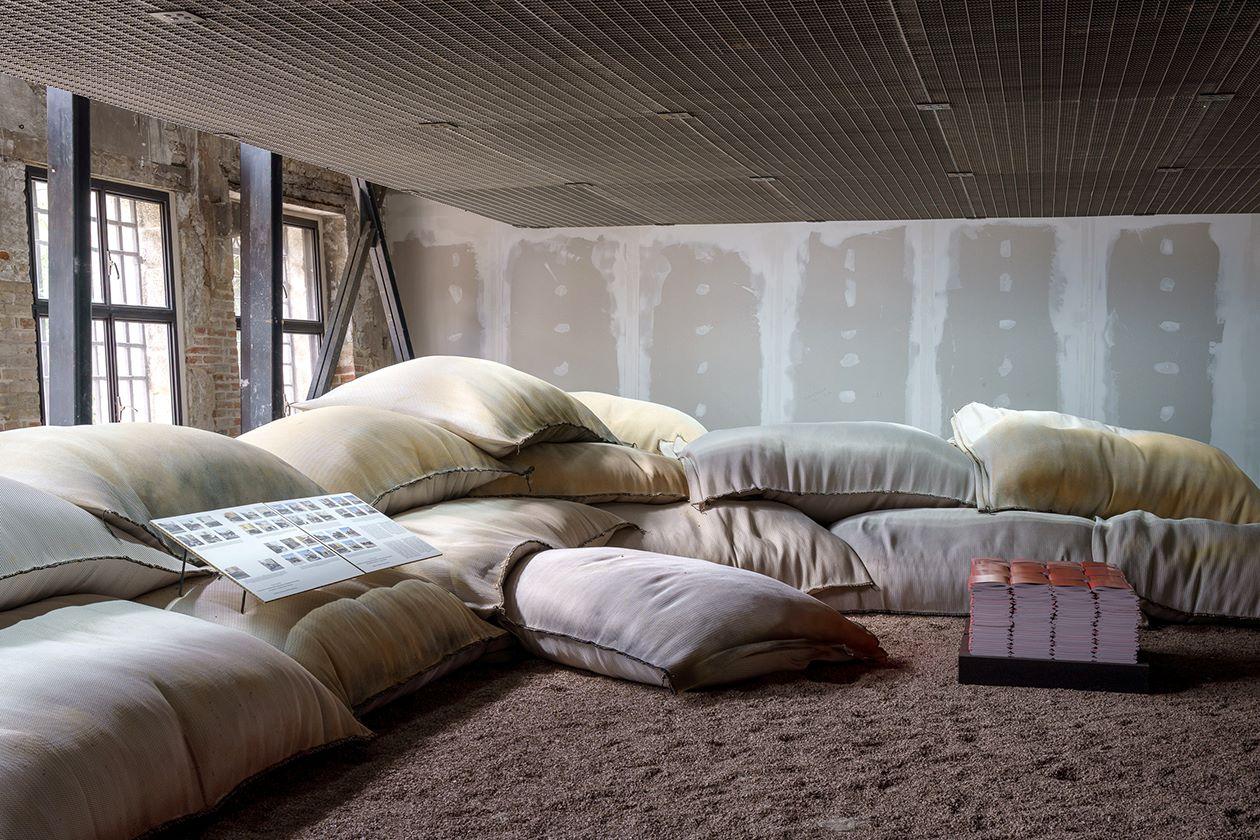 Heatwave, Pavilion of Bahrain (Kingdom of). Photo: Andrea Avezzù, Courtesy of La Biennale di Venezia
Perhaps however, in lieu of a melodic, flowing curation, Ratti has presented what might be the most truthful representation of our world – a world of so much abundance that it is impossible to capture or comprehend. The excess of invention and technological advancement that modern life carries is infinite, with the detail of what it all truly addresses, evasive.
The hardest part – and what the main curation also fails to do in a digestible way – is humanly conceiving of how all this ‘intellegens’ might be useful, or actionable. How can we harness all these tools and their technological might towards actually changing the world? How do we find the time and resource to deploy it all?
Because of the excess, the urgency of the biennale’s message dilutes. Except in the German national pavilion, aptly titled STRESSTEST, where the reality of climate change boils into the brain of anyone who enters. It shows, in a simple yet highly visual manner, the speed and scale at which major cities on Earth will heat up over time. It is jolting, reminding anyone who enters that they are burning.
This is where this biennale succeeds – in the moments that bring it back to humanity and back to how all these advancements will affect human life. The most visually arresting exhibits are the ones that are tactile, like the Serbian contribution, Unravelling: New Spaces, which juxtaposes human and non-human knitting practices and which is simply beautiful to look at.
The Bahrain pavilion, Heatwave, which won this year’s Golden Lion award, also succeeds for its humanity – its ability to conjure an imagining of how we, as sentient, walking, corporeal beings, might inhabit future spaces in this changing world.
It is these moments, where the biennale literally comes back to Earth, that the intention of its vastness can somehow come into focus. Ironically, Ratti’s zooming in on technology only achieves potency when it is framed by moments of naturalness.
Stepping out of the pavilions and into the August sun is perhaps the most instructive action a biennale visitor can take, reminding themselves that there is a lot worth saving.