More than a quarter of women have faced sexual harassment at work
Quarter of women also face stalking and violence at the hands of their partner
More than a quarter of women have experienced sexual harassment in the workplace, according to a recent report from the National Statistics Office (NSO).
Just over 27% of women said they had faced sexual harassment at work, compared to just 11% of men, according to the Survey on Safety and Well-being 2022.
Meanwhile, 26% of women also reported having experienced violence at the hands of an intimate partner while just over 25% said they had encountered stalking.
Over 3,000 women were surveyed between February and May 2022 alongside just under 2,000 men. The survey was carried out to measure how common gender-based violence is in Malta.
The report paints a bleak picture of the female work experience, with one-fifth (20%) of women saying they had experienced inappropriate staring or leering and 17% reporting being subjected to indecent remarks or jokes.
One in 10 (10%) women said they had been asked out on a date by a colleague, while 8% said they faced unwanted physical contact. Six per cent said they had faced inappropriate advances on social media or had been sent sexually explicit messages by a colleague.
More than six out of 10 (62%) women said they faced sexual harassment from a co-worker, while one-quarter said they had received unwanted attention from their boss.
However, the report suggests that the situation could show signs of improving over time, with 57% of women saying the reported incidents of sexual harassment had taken place more than five years before the study was carried out.
Twenty-five per cent said the abuse took place between one and five years before, while 17% said it had happened in the previous year.
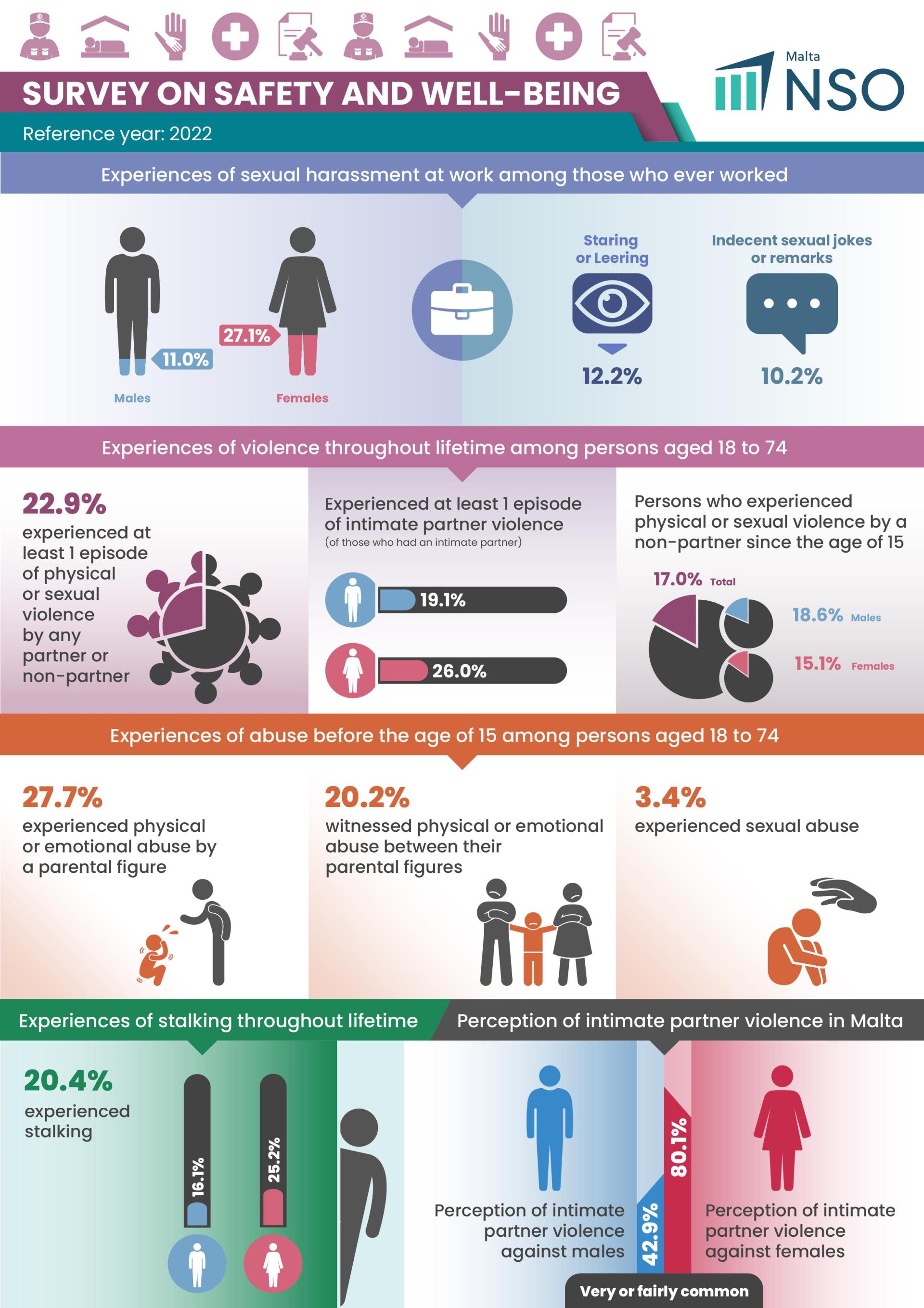 The survey revealed how men and women encounter threats to their well-being. Graphic: NSO
Despite the report suggesting 47,000 women in the country have experienced sexual harassment at work, this contrasts with how prevalent it is thought to be, with more than half of those surveyed – including both men and women – believing it to be uncommon or not happening at all.
Violence against women
Women were more likely to suffer psychological, physical and sexual violence at the hands of an intimate partner than their male counterparts, with more than a quarter (26%) of women reporting such incidents versus just less than one in five (19%) men.
One in four women said they had experienced psychological violence such as jealous outbursts, intimidation, having their movements tracked or being forbidden from working or seeing friends and family.
The most common kind of psychological abuse reported by women was being made to feel belittled or humiliated.
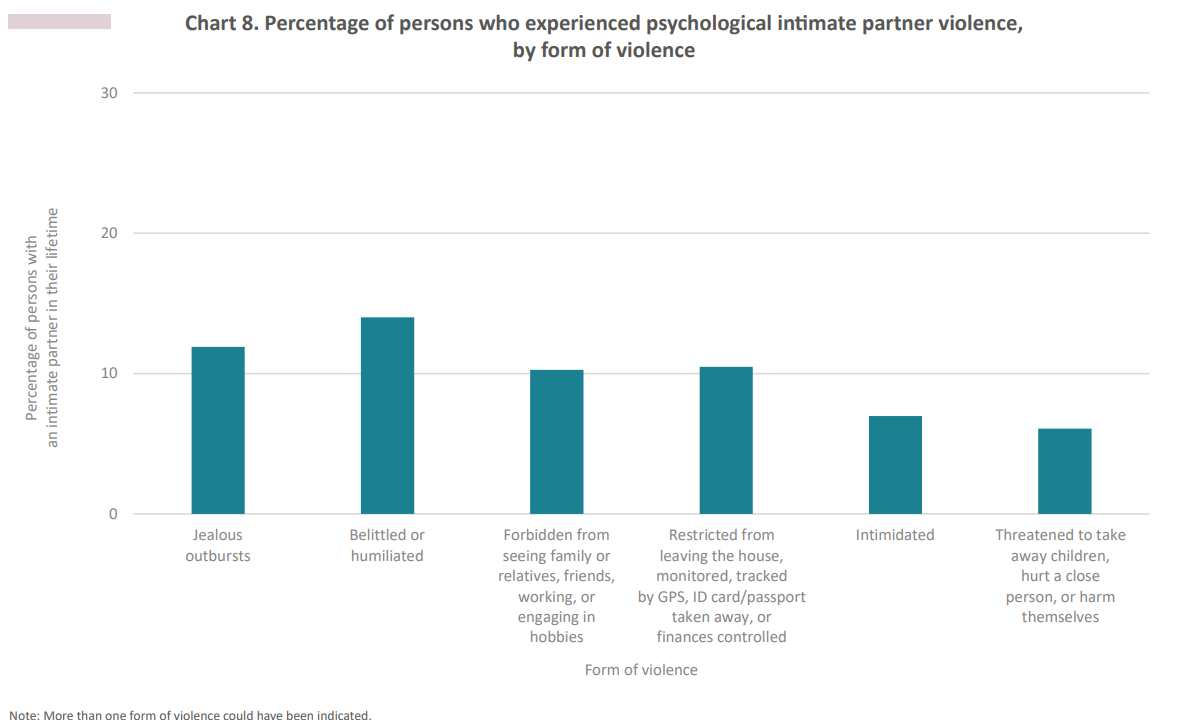 Psychological abuse against both sexes can take different forms. Graphic: NSO
Stalking
One in five of all people surveyed said they had encountered stalking, equivalent to 25% of women and 16% of men.
The most common forms of stalking were repeatedly being sent unwanted messages or gifts, followed by threatening or silent phone calls, being followed or spied on, having pets or possessions damaged and receiving offensive and embarrassing comments in public.
More than a quarter of those who suffered stalking said they had changed their behaviour as a result, including changing their contact details, not going out alone or carrying an item for self-defence.
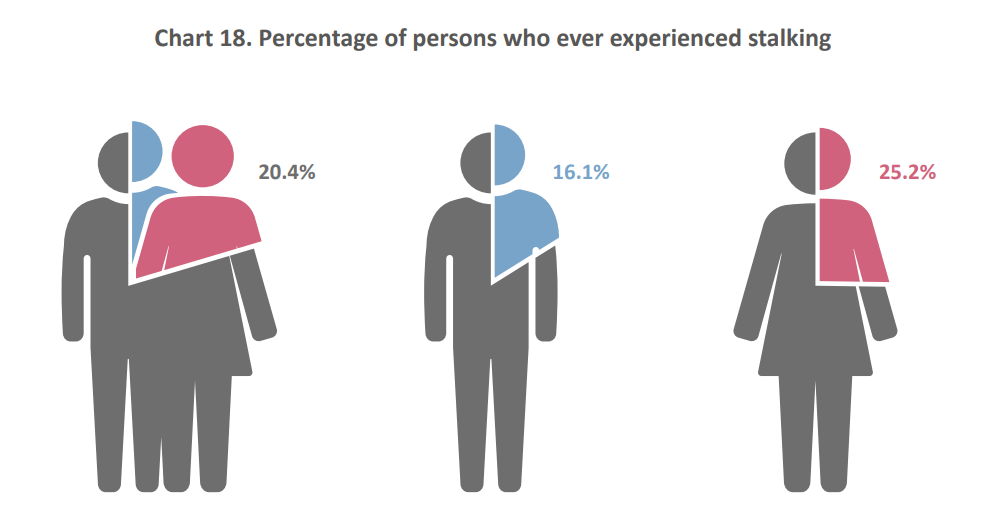 Women were more likely to be the victims of stalking than men. Graphic: NSO
The male experience
While women were more likely to suffer sexual harassment, violence at the hands of a partner or stalking, men were more likely to suffer violence at the hands of a non-partner such as a stranger or a friend and suffered more physical abuse during childhood.
Almost 19% of men said they had experienced at least one incident of violence from someone who wasn’t their partner compared with 15% of women, equivalent to around 39,000 men. The most common age group to encounter such abuse was those between the ages of 18 to 29.
Meanwhile, more than a quarter of men (27%) said they had encountered physical or emotional abuse at the hands of a father figure before the age of 15, compared with 19% of women. Both sexes encountered similar levels of abuse at the hands of a mother figure (around 18%).
Just over 30% of men said they had been physically or emotionally abused by a parent before the age of 15, five percentage points more than in women.
Childhood
Men and women were exposed to inter-parent abuse at similar levels, with around one in five of both sexes witnessing such behaviour before the age of 15.
Just less than one-fifth (18%) of respondents said they had seen their mother be humiliated or belittled by their father, compared to 13% who said they had seen their father be subjected to the same abuse.
Overall, 28% of those surveyed said they had experienced physical or emotional abuse at the hands of a parental figure, while 20% said they had witnessed such abuse taking place between their parents.
The Survey on Safety and Well-being 2022 was partly funded by the European Union and was undertaken in collaboration with Eurostat and other partners in the European Statistical System.
Over 5,000 people between the ages of 18 and 74 were interviewed over the phone or in person for the survey.