Mosaics by accused priest covered up at Lourdes – but not at Gozo’s Ta’ Pinu
Marko Rupnik accused of abusing multiple women, including nuns, in the span of 30 years
The Gozo Diocese has doubled down on its decision to keep on display at Ta’ Pinu Sanctuary mosaics created by a priest accused of sexual assault, even as similar works are covered up at pilgrimage site Lourdes.
A series of mosaics at Ta’ Pinu, including one above the main door, were created by the internationally renowned Slovenian artist-priest Marko Rupnik.
Rupnik is being investigated for psychological and sexual violence on at least 20 women over a period of nearly 30 years. His victims have asked the dioceses to take down any of his works on display.
Earlier this week, Bishop Jean-Marc Micas of the Marian shrine at Lourdes, France, announced that the entrance doors of the basilica, which feature mosaics by Rupnik, will be covered with aluminium panels.
He said the move was to facilitate access to the basilica for “those who currently feel unable to cross its threshold”.
But when Times of Malta asked the Gozo Diocese if it planned to similarly cover the mosaics at Ta’ Pinu Sanctuary, a spokesperson said it had “nothing further to add to the position it took in this regard in 2023”.
Rupnik was dismissed by the Jesuit community in 2023 after he was accused of sexually abusing nuns in the 1990s.
At that time, the Gozo diocese said that it would not be removing or covering the mosaic, as it was “distinguishing between the artist and the work of art”.
“No one would ever imagine removing Caravaggio’s paintings because of the grave moral mistakes he committed,” the spokesperson said at the time. “Even though we are here speaking of sacred art, the same argument applies.”
Ta’ Pinu’s mosaics were inaugurated in 2017. One of Rupnik’s mosaics depicting Our Lady presenting Jesus is found above the main door of the church. Other works can be found along the walls of the church’s parvis.
No one would ever imagine removing Caravaggio’s paintings
More than 200 of Rupnik’s mosaics adorn churches around the world, from Madrid to Washington and at pilgrimage sites including Fátima in Portugal and the Vatican itself.
Last year, Lourdes decided to no longer light up Rupnik’s mosaics and set up a think tank of bishops, art experts, victims and psychologists to decide whether or not to remove them.
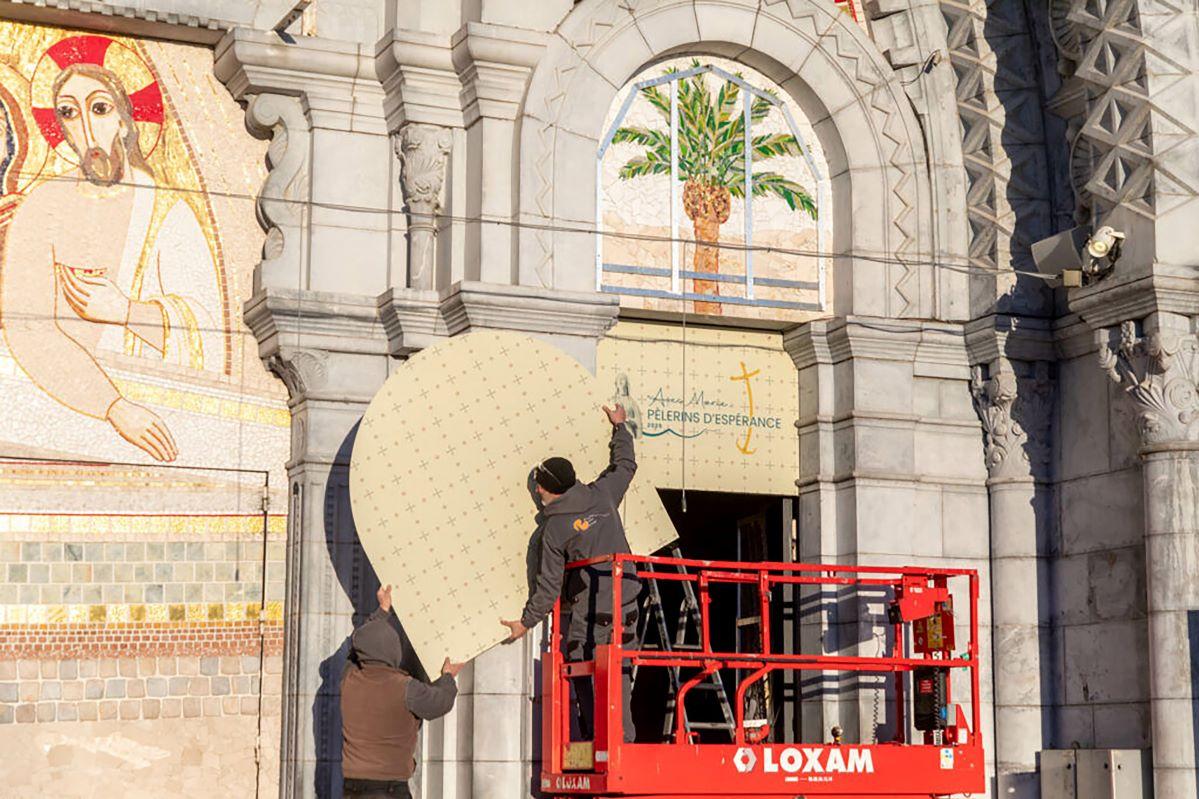 Workers begin to cover the mosaics at basilica of Our Lady of the Rosary in Lourdes. Photo: Lourdes Sanctuary
Bishop Micas took the “second step” of covering up the mosaics in a decision announced on March 31, on the eve of the plenary assembly of the French bishops.
In Portugal, the shrine of Fátima said it is not considering removing the large mosaic panel on the back wall of the basilica of the Holy Trinity at the shrine of Fátima created by Rupnik’s workshop.
However, it decided to suspend using all images of the artwork in promotional materials, telling religious newspaper 7 Margens that it “unequivocally condemns the actions” of Rupnik.
Rupnik expelled for ‘disobedience’
The artist was dismissed after the Society of Jesus received numerous complaints of “spiritual, psychological or sexual abuse” of multiple women, including nuns, spanning 30 years.
Many of the women who accuse Rupnik of abuse are nuns from a convent in Ljubljana he co-founded in the early 1990s. Other accusations involve his time at a Rome art institute he subsequently founded.
The Church briefly excommunicated him in 2020 after he absolved someone of having sexual relations with him but reinstated him after he formally repented.
Then, in June 2023, Rupnik was expelled from the Jesuit order, of which Pope Francis is a member. In October, Francis waived the statute of limitations on the offences, opening the way for potential disciplinary proceedings.