Mosta and its first band
Insight into our national history
Saviour Dimech and Frans Deguara, Il-Mosta u l-Ewwel Banda Tagħha, 2 vols., xii + 1200 pp + numerous colour and black-and-white photos, Soċjetà Filarmonika Nicolò Isouard, 2025.
This book is a well-documented history of Mosta and its first band, the Soċjetà Filarmonika Nicolò Isouard, spread over two volumes, covering the periods 1871–1985 and 1986–2023 respectively.
Despite its title, the book is of interest to Mostin and non-Mostin alike. The reasons are manifold. Not only because of the richness of primary sources it contains, but also because, through the local history of Mosta, it offers insight into our national history.
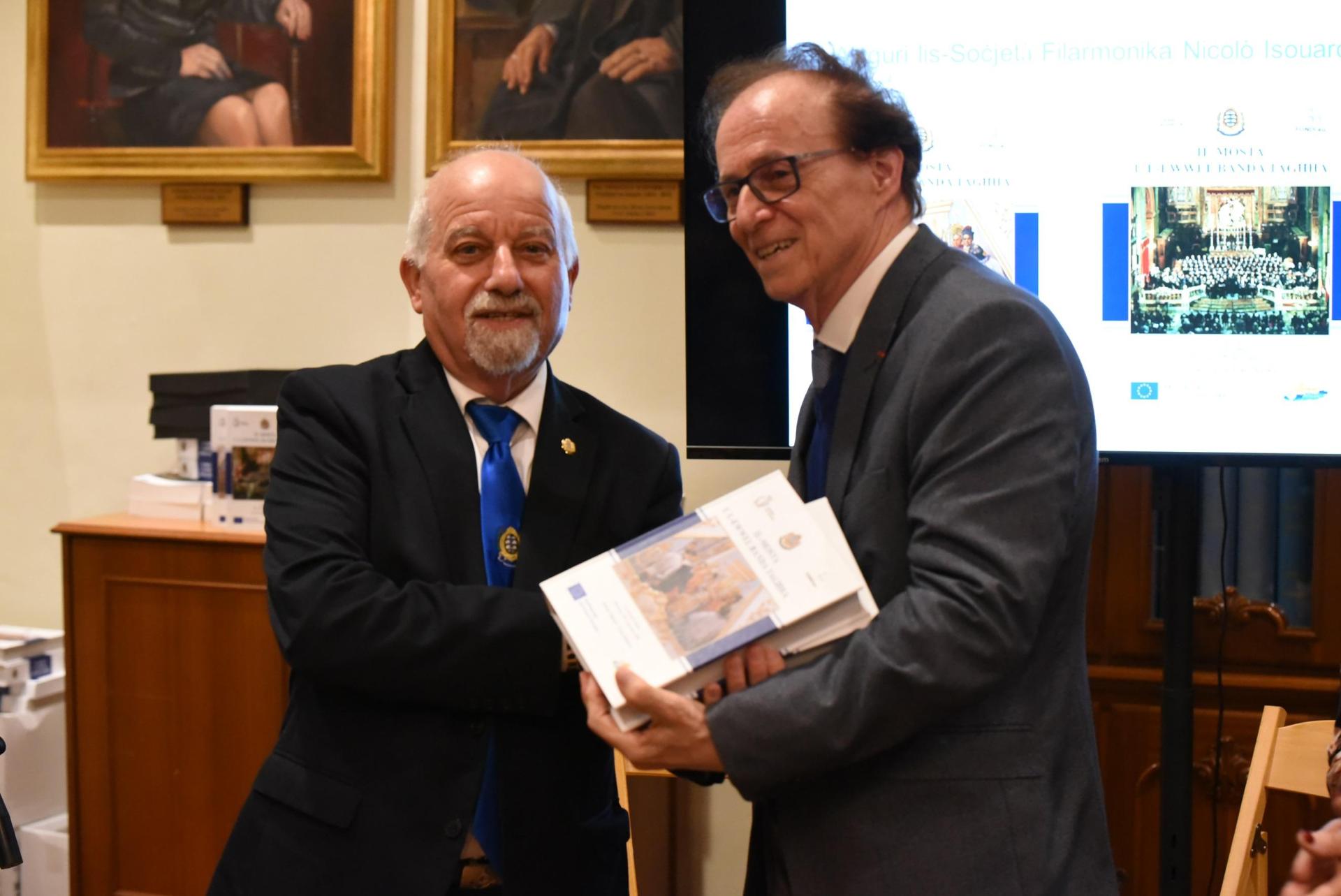 The editor Frans Deguara presents another copy to Dr Charles Xuereb, the principal guest of the event.
The Maltese każin tal-banda was obviously inspired by its Sicilian counterpart (the “Associazione Culturale Musicale”), even though, as Simon Farrugia remarks in his 2023 book The Maltese Wind Band, ‘most Sicilian bands are not as big as Maltese bands, which have a larger number of musicians’. There has recently been in Italy a heightened interest in the history of band clubs. In her 2015 essay ‘Le bande musicali nell'Italia meridionale dell'Ottocento: il contributo di nuovi documenti d’archivio’, musicologist Teresa Chirico wrote that these clubs ‘furono legate ... alle attività politiche, alle celebrazioni civili e religiose, alla vita militare e artistica’ (‘were linked to political activities, civil and religious celebrations, military and artistic life’). The deeds of both the clubs and their more prominent members had an important role ‘in tutto il tessuto sociale del Meridione’ (‘throughout the social fabric of Southern Italy’).
Chirico’s observations fit the Maltese context like a glove: on both islands the rulers were foreign and not too ready to share power with the population. The Band Club’s role in Malta’s constitutional history (crucial, if underrated by historians) is the narrative flowing like a subterranean river beneath the book on Mosta’s first band, at least until the attainment of national independence.
Il-Mosta u l-Ewwel Banda Tagħha is also a trove of archival material. It had to be, as its authors’ task was twofold. They had to collect the primary sources, almost in their raw shape, and at the same time narrate the history of the band and its town. I’m inverting the order on purpose: the club was pivotal in the social construction of the town, just like the Band Club (the institution found virtually in every town, almost always in pairs, chirally) was pivotal in the social construction of the Nation.
Usually, the problem with such books is how to pique the interest of potential readers possessing little or no connection with the town. In this particular case, the problem is minimal. At least, for the reader interested in the contribution given by local protagonists to the weaving of the Nation’s historical tapestry. Once the reader accepts that local politics played out across the Islands progressively coagulated into national movements, moods, and maturation, then the true value of the book is realised.
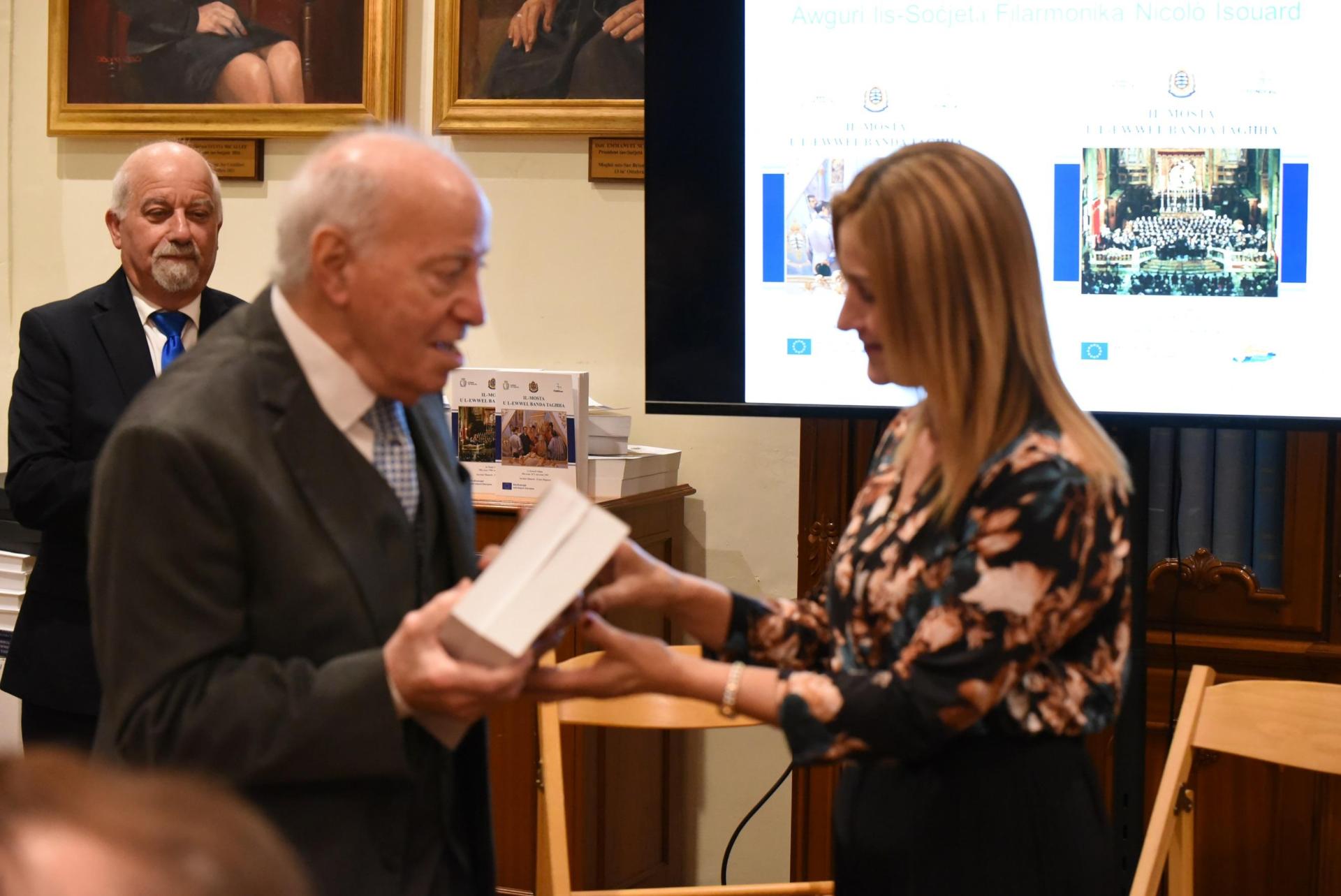 The author Saviour Dimech presents the first copy to the President of the Society, Sylvia Micallef, during the launching on November 29, 2025.
Il-Mosta u l-Ewwel Banda Tagħha isn’t a book about clarinets, bass drums, and popular marches – or, at least, not only. It’s a book about community, identity, non-state politics, and, in the ultimate analysis, the making of nationhood on this small archipelago. Maltese nationhood is fragile, like a delicate flower that can be easily crushed by the rain of geopolitics, the winds of history, and the drought of ignorance. Whenever, say, foreigners refer to our institutions in English (under the influence of geopolitics and history) and whenever our own rulers do the same (the drought of ignorance), that little flower risks extinction. Books like this one are panes in the glasshouse protecting it.
 Il-Mosta u l-Ewwel Banda Tagħha