Municipal waste increased by 6.1% last year, biggest increase being bio-waste
Municipal waste that underwent treatment by energy recovery decreased by 17%
Municipal waste last year amounted to 353,525 tonnes, up by 20,287 tonnes, or 6.1 per cent over 2023, the National Statistics Office said.
The highest increases by waste type were recorded in bio-waste from gardens and parks (5,910 tonnes), bio-waste from kitchens and canteens (5,826 tonnes) and other waste (4,082 tonnes). On the other hand, decreases were registered for mixed municipal waste (2,642 tonnes), metals (1,293 tonnes), and glass (123 tonnes).
 Municipal waste collection last year.
Waste generation data by waste collection type showed that in 2024 the main increases were registered in the ‘Other’ category (15,076 tonnes), followed by street cleaning (3,432 tonnes) and the organic waste collection (2,444 tonnes). These increases were offset by reductions recorded in the categories for the black bag from businesses and institutions (2,287 tonnes), civic amenity sites (384 tonnes), and the black bag from the door-to-door collection by local councils (356 tonnes).
"Indicators for the municipal waste generation per capita based on the mid-year resident population show that each person generated 621 kilograms of waste in 2024, up by 3.1 per cent over the previous year. Moreover, when factoring in the net tourist daily population in addition to the mid-year resident population, the per capita municipal waste generation for 2024 amounted to 574 kilograms, increasing by 2.1 per cent over 2023," the NSO said.
Municipal waste that was recycled in 2024 increased by 1,723 tonnes, or 3.1 per cent, to a total of 58,156 tonnes. The most recycled material in 2024 was paper and cardboard with a share of 60.0 per cent from the total recycled municipal waste. Increases in recycling were registered for kitchen and canteen bio-waste (25.0 per cent), paper and cardboard (24.5 per cent) and plastic (11.5 per cent). On the other hand, decreases were recorded for clothes and textiles (46.6 per cent), glass (36.0 per cent), metals (31.4 per cent), and waste electrical and electronic equipment.
In 2024, municipal waste that underwent treatment by energy recovery decreased by 17.0 per cent, reaching 7,530 tonnes.
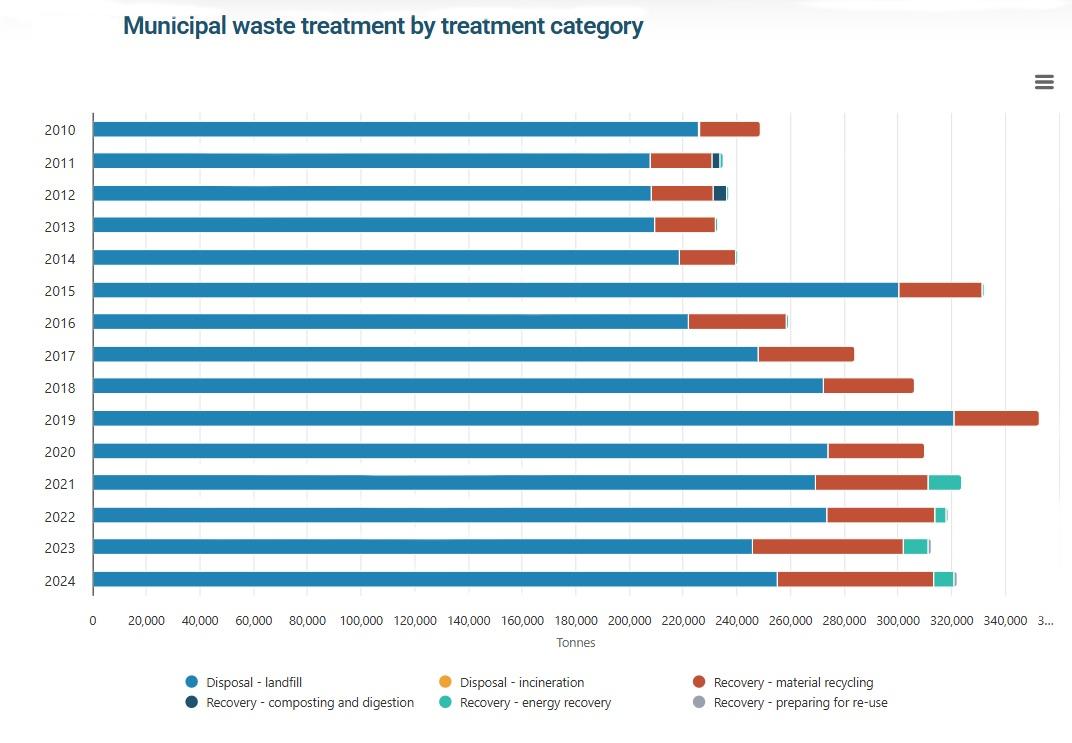 More waste is ending up in landfills, data shows. NSO graphic.