A word on the words of the national anthem
Rather than telling us who we are, the Maltese anthem urges us to ask who we want to become, what we still need to do and where we should be heading
When it was written in 1922, the anthem was a political and symbolic statement. The bloody Sette Giugno events were still fresh and the language question still simmering – the choice of language a question of power, identity and the making of a nation.
In Dun Karm’s own words: “At a time marked by political antagonism, I sought to draw everyone together in a bond of religious and patriotic love.” The lines do not impose a linguistic identity; rather, they create a space in which a nation still in the process of formation can speak to itself in its own words.
Words chosen for music
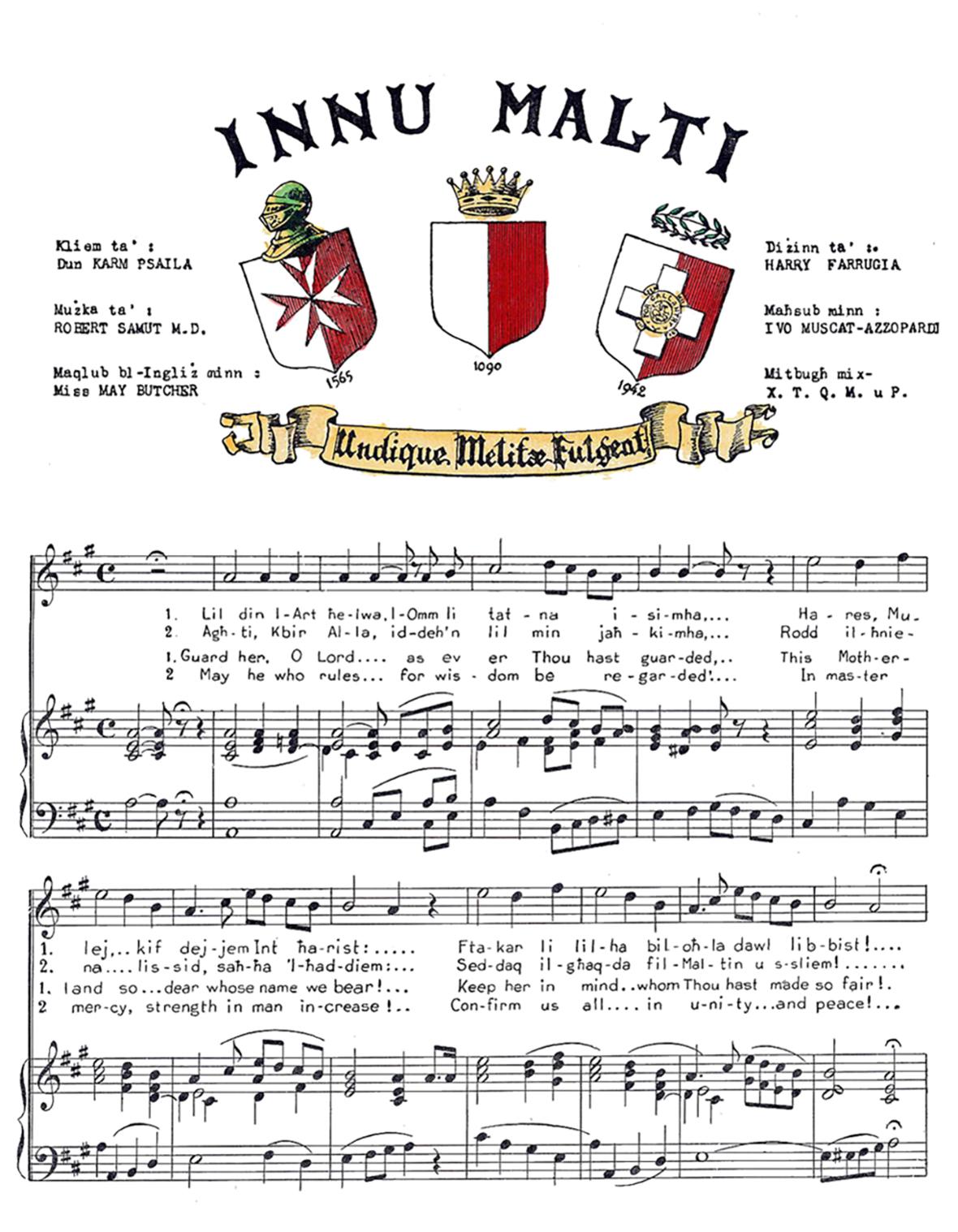
The music came first. Robert Samut was studying in Scotland. One day, his fellow students asked him to sing his country’s anthem. What could he sing? Upon returning to Malta, he composed a melody and played it to Albert Laferla, director of government elementary schools, who then met Dun Karm. From his pocket, Laferla produced a slip of paper with a few musical notes and asked Dun Karm to write some lines for schoolchildren to sing.
Ninu Cremona recounts: “As soon as he entered the house, Dun Karm sat at the piano and played the musical motif as best he could, trying to match it with a rhythm of Maltese lines. He realised no line could fit the motif of those notes except the hendecasyllabic line; and since the motif was short, only three of those hendecasyllabic lines could fit, which, when the stanza is repeated, make six.”
Common, simple and short
Many of the words are monosyllabic (lil, din, art, omm, kif, int, dawl, kbir, dehen, min, rodd, sid, sliem), chosen for musical and communicative reasons. There is no military, territorial or triumphalist language. From the words emerges a national vision that is not confrontational but an appeal for unity.
This is not an anthem that celebrates victory, power or liberation. It is, first and foremost, a prayer. Not a timid, murmured prayer, but an assertive call by a people who first acknowledge their roots: a name (identity) given by the land, clothed in supreme light (faith), and who then aspire to wise governance (dehen lil min jaħkimha), ethical labour relations (ħniena lis-sid, saħħa ’l-ħaddiem) and the healing of social division (seddaq l-għaqda fil-Maltin).
Adjectives are few: only two, kbir ‘great’ for God, and ħelwa ‘sweet’, used twice, the second time in the superlative, oħla, in reference to Malta, which is never named explicitly.
The nouns in the first stanza are concrete (land, mother, light) while those in the second stanza are abstract qualities (wisdom, mercy, strength, unity, peace). This choice reflects the thematic journey: from a familial and religious framework of a son addressing the father to care for the mother, the sweet land, to a public and political sphere that calls for wise leadership, social justice and the reconciliation of a divided people.
The lines are not about the certainty of a nation but about collective responsibility. How shall we govern wisely? How shall we work and employ with dignity? And, above all, how shall we unite despite social differences?
Anthem driven by verbs
Apart from the opening line, the lines always begin with a verb: ħares, ftakar, agħti, rodd, seddaq, a structure that gives rhythm, urgency and clear direction to the discourse. Many lines also begin with a verb (ħares, ftakar, agħti) and end with one (ħarist, libbist, jaħkimha), a sign of balance in both the anthem’s architecture and thought. Though, at first glance, intimate and vulnerable, the lines unfold a strong dynamism and tension that intensify from the first stanza to the second, in both form and content.
In the first tercet, naming land, name and light (that is, country, identity and faith), the past tense (tatna, ħarist, libbist) anchors the discourse in what we have received and inherited. Then, the verbal movement shifts to the imperative and, thus, to action: our task is not complete; we have barely begun. Peace here is not a given but a condition that requires deliberate effort to establish and sustain.
Core lies in the first word
It appears at least five times, in different forms: lil din l-art, li tatna (= tat lilna), ftakar li lilha, lil min jaħkimha, lis-sid, ’il-ħaddiem. The repeated preposition reveals the anthem’s architecture built on relationships. Identity is not shaped through assertions about what Malta is but through our continuous relationship with others. The anthem asks not “Who are we?” but “For whom are we responsible?”
It opens with a familial relationship. As Oliver Friggieri puts it, Dun Karm “crafted an anthem that is the prayer of a son (and then of many brothers, of a people: ‘tatna’) to the father, asking him to take care of the mother”.
The opening scene is intimate and personal. It is the land, woman and mother, who gives birth to her children and grants them identity. Even a concept such as identity arises from relationship, not from assertion. Children are heirs and recipients, not owners.
The second relationship is vertical and spiritual, between the human and the divine. From beginning to end, the anthem addresses the Lord (Mulej), the great God (kbir Alla).
 Social relationships lie at the heart of the anthem.
Although the imperative verbs are directed to God, the address is primarily to the people. In asking for wisdom, mercy, strength, unity and peace, we articulate the values and principles the community must follow.
Authority remains indirect and mediated: it is neither God who commands, nor the people who are commanded. The community voices a desired condition through a prayer that simultaneously becomes an act of ethical and moral reflection.
Social relationships lie at the heart of the anthem. The second stanza weaves a bond between those who govern, those who employ and those who work, binding each role to an ethical requirement. Leadership requires wisdom, economic power requires mercy and labour requires strength. Each role is defined, not by privilege but by responsibility.
The final line outlines a horizontal, collective relationship among the Maltese. Unity is understood as a process that must be actively forged, so that peace (sliem) may emerge, not merely as the absence of conflict but as balance. The anthem’s final word, sliem, both closes and opens: peace is a goal that guides collective behaviour as much as it is the outcome of just and sustainable social relationships.
There is also a temporal relationship. The first part looks to the past, to what we were given and inherited. The second looks to the future, to what we still must achieve. The Maltese people stand between what they have and must cherish and what they must cherish precisely as they do not yet have it. Because of this tension between inheritance and responsibility, the anthem is not bound to a single historical moment. It is renewed each time it is sung.
Words of few colours
For the anthem’s six lines, Dun Karm uses a very limited palette. If we analyse the sounds, we notice an insistence on two vowels, a and i, and on a few consonants: l, t (together with d, which phonology treats as realisations of the same sound), and m. What word do these sounds form? Malti. Coincidence? Most likely. But for those who listen closely, this may be yet another hint of how language and identity, almost imperceptibly, are woven into the heart of the anthem.
A final word
National anthems are often seen as mirrors of the history, ideals and identity of the people who sing them. Their lines, whether carried by stirring melodies or solemn, restrained notes, declare who the people are. The Maltese anthem, rather than telling us who we are, urges us to ask who we want to become, what we still need to do and where we should be heading. At its core lies a statement from the past that turns into a question for the future.
The lines are not about the certainty of a nation but about collective responsibility. They shape a prayer that is also a question that continues to resonate.
How shall we govern wisely? How shall we work and employ with dignity? And, above all, how shall we unite despite social differences?
Over 100 years have passed. Much has changed. But the anthem continues to look towards the land and the people who live upon it, asking us, calmly yet insistently, where we will turn our gaze.
The anthem does not tell us what Malta is, nor who the Maltese are. Each time it is sung, it asks again what we must do to be worthy of the name given to us by this sweet land.
Michael Spagnol is an associate professor of Maltese at the Faculty of Arts, University of Malta.