NGOs call for vulnerable migrants to be released from detention
'I can't explain what the suffering was like' - former detainee
A coalition of human rights NGOs have called for the immediate release of vulnerable migrants from Malta’s detention centres.
Speaking at a press conference outside the Safi detention centre on Friday evening, the 16 NGOs, including Moviment Graffitti, Aditus Foundation and the Jesuit Refugee Service Malta, said that women, children, LGBTIQ+ persons and people suffering from serious mental and physical health conditions were being detained in the centre and elsewhere.
The coalition also demanded increased transparency at Safi and greater access for NGOs and legal counsels. They called for an end to the practice of detaining people who pose no threat to the community for extended periods of time, the implementation of alternatives to detention, and stopping raids that “target long-standing members of the community.”
They said that poor conditions at Safi have been well documented by various institutions.
A 2021 report by the Council of Europe’s Committee for the Prevention of Torture concluded that people were “locked in accommodation units with little, if any, access to time outside, in severely overcrowded spaces, and essentially forgotten for months on end,” in conditions that “may well amount to inhuman and degrading treatment.”
Moviment Graffitti activist Daniel Mainwaring said people were transferred directly from the sea to the Safi detention centre.
"We are here to remind the prime minister that all people are born equally in dignity and human rights. Very few people are allowed inside (the centre) and the people who were inside rarely want to share their trauma. Countless people have suffered in the centre without receiving any compensation."
He added that detainees were not given adequate information about their own detentions.
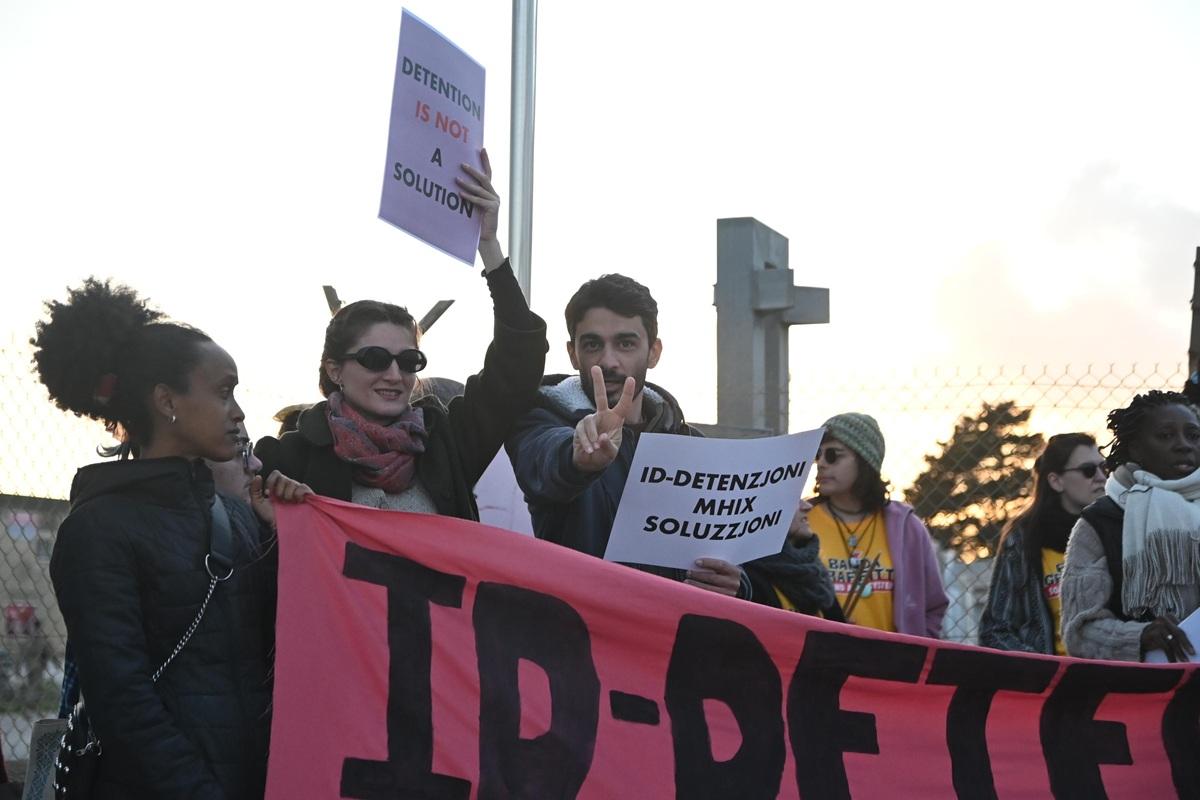 The NGOs called for an end to the practice of detaining people who pose no threat to the community. Photo: Jonathan Borg
Moviment Graffitti activist Christine Cassar referred to Prime Minister Robert Abela’s remarks in parliament earlier this week, when he said that human rights conventions penned 80 years ago need to be reformed to reflect today's realities when it comes to irregular migration.
Abela was addressing calls for clarification over comments in recent days that Malta will be putting a human rights convention reform on the agenda of its upcoming Council of Europe presidency.
“Instead of calling for human rights to be expanded and strengthened, the prime minister is calling for rights to be weakened. This is an alarming sign that we are going backwards instead of progressing,” she said.
The government, Cassar said, could not claim to fight racism while at the same time encouraging rhetoric that normalised discrimination.
She recalled the 2019 murder of Lassana Cisse in nearby Ħal Far, as well as the more recent rounding up of dozens of long-term Ethiopian residents in 2024.
Also in 2024, children as young as three were detained for days at the detention centre while awaiting deportation after being refused entry into Malta along with a Syrian woman.
Cassar insisted that not only was the country gaining nothing from racism, but was also losing out by denying people the chance to contribute to society in a more active way.
'Suffering'
The testimony of a Bangladeshi former detainee was read out: "I came to Malta to live here. I spent 15 months in detention as a 15-year-old. There were only three toilets and two showers and we only had the chance to shower once every four or five days. If someone got sick they never took us to hospital. I can't explain to anyone what the suffering was like."
Regine Psaila, president of African Media Association Malta, who used to visit the detention centre regularly eight years ago to collect testimonies, said "nothing has changed since then".
 Regine Psaila, president of African Media Association speaking at the press conference outside Safi detention centre. Photo: Jonathan Borg
She read out another harrowing testimony from a former detainee: "The riot happend just days before I arrived. I saw people with bullet wounds. There were fights every single day, at least 30 fights, which could start from nothing because of culture clashes or arguments over the TV. There was only one TV for almost 500 people. The guards did not intervene. On a good day they did not tear gas us, they only cut off the electricity."
Calling for compassion, Psaila added: "I hope Malta can be a bit more gentle with people like us."
Mohamed Ali Aguerbi, co-ordinator of Malta Gay Rights Movement, said they "keep receiving calls from lawyers of detainees."
"We are never granted access to the detention centre. Our emails are ignored or rejected with no reason given," he said.
"I want to remind politicians that they stood on stage during Pride, holding flags and making speeches about inclusivity and protection for all. While we are standing here, there are members of our community inside, living in fear not knowing what the future holds for them. We ask for dignity. Detention should be the last resort. We will stand with every marginalised person in our society."
The press conference ended with a minute of silence in solidarity with detainees.