Oldest work of Maltese literature added to prestigious UNESCO heritage list
The poem was among 74 to be added to the list Thursday
The oldest piece of Maltese literature, Pietro Caxaro’s 15th century poem Il-Kantilena has been added to UNESCO's prestigious Memory of the World Register.
Its addition comes more than 11 years after it was first submitted for consideration in March 2014 and marks the second Maltese entry to the list.
The poem was among 74 items of documentary heritage from 72 countries and two international organisations to be inscribed on the UNESCO list Thursday.
Other documents that made it onto the prestigious register this week covered topics such as scientific revolution, women's contribution to history and major milestones of multilateralism.
Written in medieval Maltese, Xideu il-Qada, or Il-Kantilena, was penned by notary Pietro Caxaro, who died in 1485.
It was recorded by his nephew, Brandano, in his notarial register (December 1533 – May 1536) and later discovered in 1966 by Godfrey Wettinger and Fr Mikiel Fsadni, who spent two years studying it before revealing the historic work to the public.
The poem recounts the story of a collapsed house that had been built on unstable ground, which has been interpreted as an allegory for a failed relationship or other doomed endeavour.
While seeming to refer to a biblical parable describing a foolish man who built his house on sand only for it to crumble, the poem appears to respond to the message, repeatedly stating the collapse was not the builder’s fault and that, after a fall, one should rise up and try again.
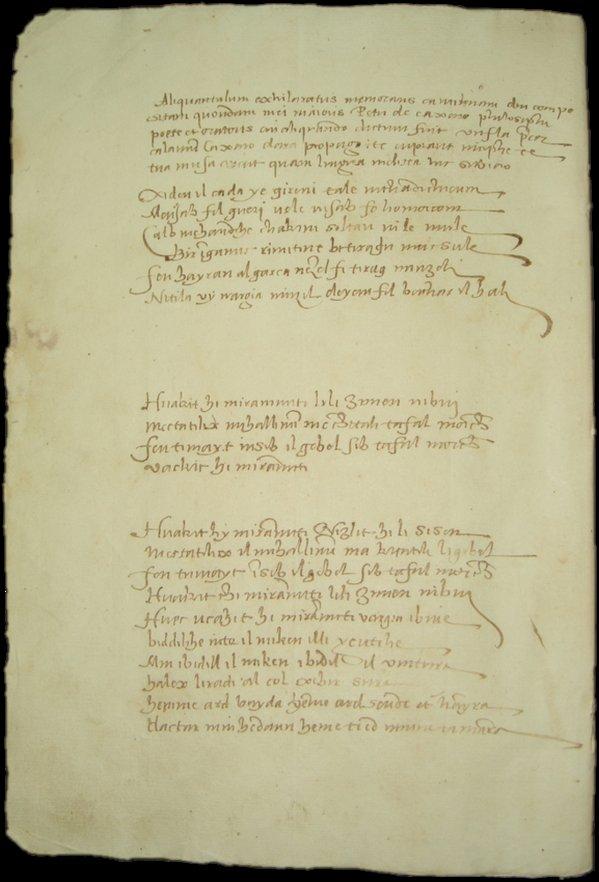 A section of the historic poem. Photo: Owen Bonnici/X.
Though written in Latin script, the poem has provided important insights into the predominantly Arabic nature of the Maltese vocabulary in its poetic form and the social and linguistic development of 15th century Malta, for which little evidence remains.
While the poem has been added to the UNESCO list, the document will remain at its current location at the Notarial Archives in Valletta, with details about it available online at the world heritage website.
Writing on X, Culture Minister Owen Bonnici said the addition of the work to the international list "marks an important milestone for our language and identity”.
In an Instagram post, the National Archives said it was pleased that the application concluded in November 2023 had seen the text added to the list.
The inscribing of Il-Kantilena to the register follows the 2018 addition of the Camocio Maps, a collection of four maps providing a unique narrative of the Great Siege of 1565.
UNESCO describes the maps – three belonging to the cartographic collection at MUŻA and the fourth at Charles University in Prague – as “precious primary sources that act as the visual equivalent to written accounts of this battle”.
Commenting on the recent additions to the memory register, UNESCO director-general Audrey Azouley stressed “Documentary heritage is an essential yet fragile element of the memory of the world,” with the organisation maintaining the register which records the “broadest threads of humanity”.
The register was established in 1992 and aims to promote the preservation of and access to documets of historical high importance, with countries provided with training and funding to help them preserve collections.
Headquartered in Paris, UNESCO (the United Nations Educational, Scientific and Cultural Organization) oversees more than 2,000 World Heritage sites and areas of ecological importance.