Ongoing conservation of Ta’ Liesse cycle of paintings
Twelve paintings portraying the legend of Liesse at the Franciscan convent of Ta’ Ġieżu in Valletta are being restored. Four have been completed, three are undergoing treatment, and sponsors are required to conserve the remaining five.
In 1604, the newly published authorised history of the Order written by Iacomo Bosio, the three-volume Dell’Istoria della Sacra Religione et ill.ma Militia di San Giovanni Gerosolimitano, was to provide much historical material for portrayal on canvas, on walls and in print. One important episode was the account in 1134, of three Hospitaller knights and their part in the Miracle of Our Lady of Liesse.
More recently, attention to the legend was drawn by the 2020 book Ta’ Liesse – Malta’s Waterfront Shrine for Mariners, an initiative undertaken by the maritime business community, to which both present authors contributed an essay each.
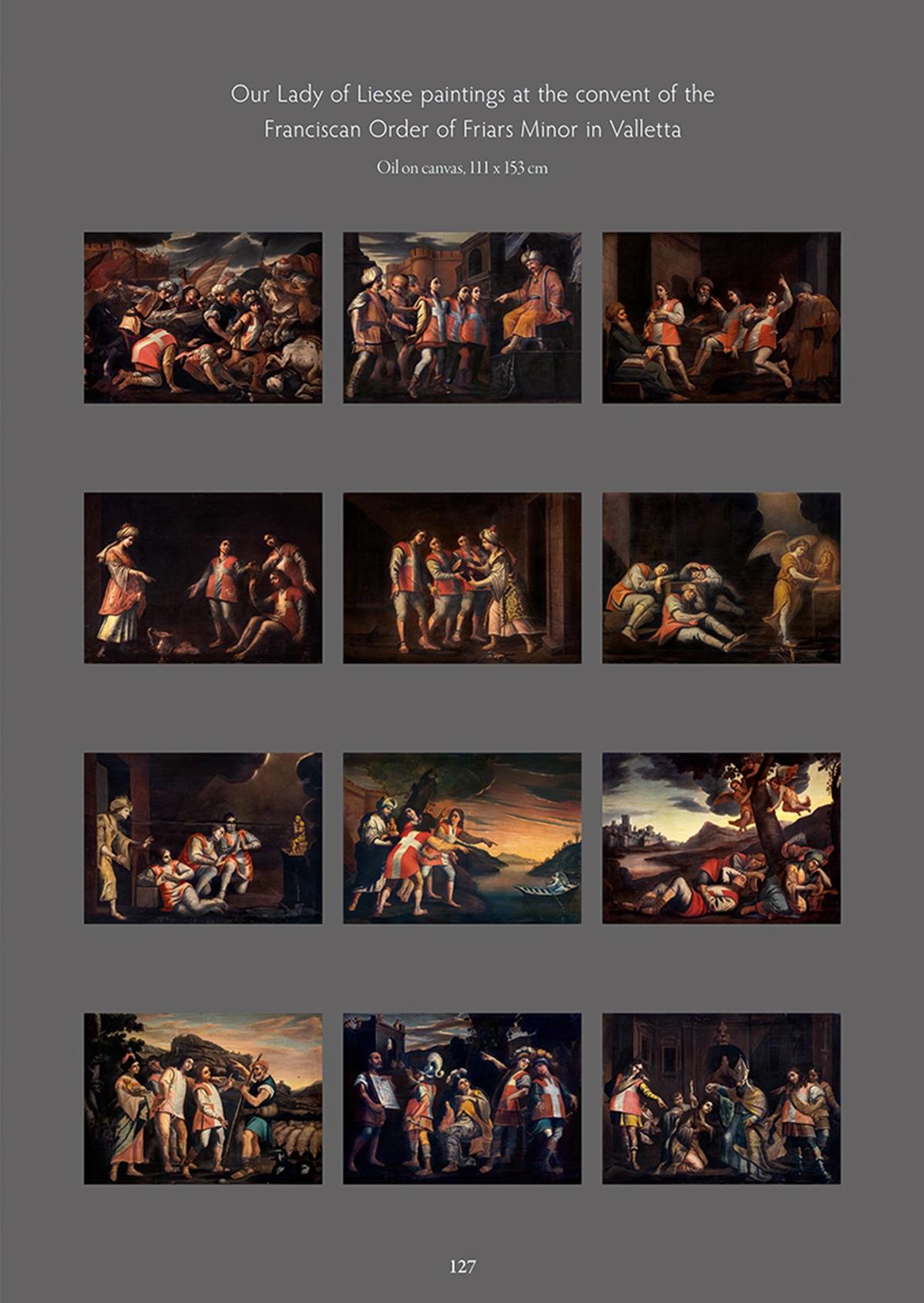 Excerpt from the publication Ta’ Liesse – Malta’s Waterfront Shrine For Mariners (2020), edited by Giovanni Bonello, and showing the cycle of 12 paintings at the convent of the Franciscan Order of Friars Minor in Valletta. Photo: Daniel Cilia
The first known depictions of the Liesse miracle could have been sourced in descriptions that preceded Bosio’s Istoria. Other possible sources are based on the long history of devotion in Picardie, France, where the first shrine to Our Lady of Liesse was built in the 12th century, and was later visited by several royal pilgrims.
In Malta, pictures on the Madonna of Liesse theme accompanied the growth of the devotion among French knights and grand masters, through their ancestral connections with their former homeland. The spogli found in the archives of the Order reveal that paintings on the Legend of Liesse were to be found in more than one Hospitaller inventory of paintings, and not just those belonging to knights from the French langues.
Today, a number of paintings on the legend of Ismeria are found in convents, churches as well as in private collections. One outstanding group of large-format paintings on the theme are found in the convent of the Franciscan Order (Ta’ Ġieżu) in Valletta. These paintings came to public attention in 1949, when all 12 were part of the exhibition titled La Madonna Nell’Arte, organised by the Comitato del Congresso Mariano headed by Cav. Vincenzo Bonello, and displayed at the Old Seminary in Mdina. This group of paintings have now started to undergo much needed conservation undertaken by ASC Conservation Centre Ltd.
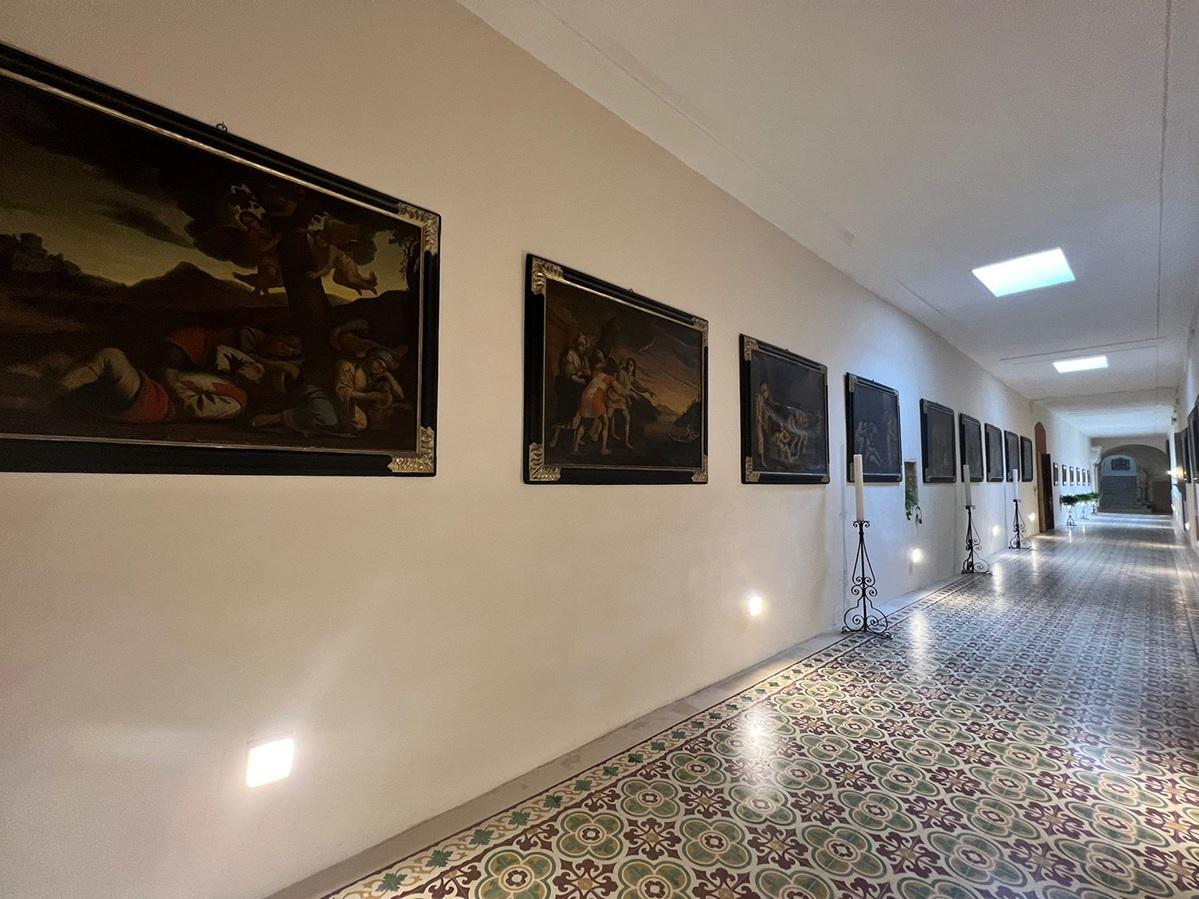 The set of 12 paintings narrating the Legend of Liesse displayed in a hallway at Ta’ Ġieżu convent, Valletta, photographed before the conservation project began. Photo: ASC Conservation Centre Ltd
The first painting portrays the three knights captured in battle, corresponding to Bosio’s description, annotated as Hospitalieri d’ogni intorno circondati, & assediati da gl’Infedeli. The second painting portrays the three knights in chains as they defy the Sultan of Egypt, who demands they recant their faith, annotated by Bosio as Soldano fa ogni sforzo per far rinegare la Fede di Christo à tre Fratelli Cavalieri.
The third painting shows the three knights successfully defending their faith, first against Saracen clerics – Bosio proclaims their virtue with the annotation Sacerdoti, e Morabiti Saracini, nelle dispute de’ Santi Cavalieri superati, e vinti, while the fourth combines two key points in Bosio’s text, Persuasione d’Ismeria and Gran forza della Viva Fede, showing the knights rising above the Sultan’s underhand attempt to weaken their resolve in sending Ismeria, his famously beautiful daughter, to persuade them to recant.
From the fifth painting to the ninth, the subject of each painting is the representation of a miracle; in literary terms, the ‘main body’ of the narrative. In each of these paintings, the artist focused on representing the principal four figures acting in unison, portraying them in complementary poses.
 Photographs (RAK) taken prior to conservation-restoration showing the state of the first four treated paintings. Photos: Manuel Ciantar and Suzanne Ciantar Ferrito o.b.o. ASC Conservation Centre Ltd
These start with Ismeria’s desire to learn more about Our Lady, leading to her request for a statue in her image. The sixth painting portrays the miraculous transportation of the statue as the knights sleep in their cell, while the seventh conveys the surprise and relief expressed by Ismeria and the three knights as they join in prayer to Our Lady of Liesse.
As the knights and Ismeria escape from the stifling gloom of the prison cell, the eighth painting symbolically conveys the new sense of freedom by choosing the break of dawn as the moment of action. The miraculous flight from Egypt to Picardy in France is conveyed momentarily when the four fugitives lie asleep, shown in the ninth painting. With the 10th painting the narrative approaches its historical conclusion, as the knights and Ismeria are told by a shepherd that they are in Picardy, France.
The last two paintings in the series, portraying the Building of the Sanctuary dedicated to Our Lady of Liesse, and Ismería’s Baptism, complete the pictorial account of the legend. Bosio approximates the knights’ actions as worthy of sainthood in his annotation Chiesa della Madonna di Liesse da tre Fratelli e santi Cavalieri edificata.
The last painting is recognisably the 12th by its tableau-like composition against a scenographic setting, in an ensemble that would be reminiscent of a performance in theatre or a miracle play as it draws to its moment of resolution.
 The paintings that have been treated to date, following restoration and remounting into their decorative frames that have also been conserved. Photos: Manuel Ciantar and Suzanne Ciantar Ferrito o.b.o. ASC Conservation Centre Ltd
Conservation treatments
The legend of Liesse, and the devotion tied to Our Lady of Liesse, was not an unexplored subject to co-author Theresa Vella and conservation director Amy Sciberras. The latter had particular interest in this cycle of paintings displayed in the main corridor of the Franciscan friars’ convent (Ta’ Ġieżu) in Valletta, as back in 2016-2017 she had carried out the conservation and restoration of the titular painting adorning the church dedicated to Our Lady of Liesse in Valletta. Thus, a strong connection to the subject and to this legend started to grow.
In 2022, during a visit to the friary, it became evident that this set of 12 paintings portraying the legend of Liesse had suffered damage linked to past water infiltration and neglect. Shortly afterwards, through the efforts of Provincial Minister Fr Ramon Farrugia, OFM, in collaboration with ASC Conservation Centre Ltd, a restoration fundraising campaign was launched, whereby to date, the restoration of four paintings has been completed and another three paintings are undergoing treatment.
Such projects are being made possible through the generous support of firms who invest in Malta’s national and artistic patrimony
Such projects are being made possible through the generous support of firms who invest in Malta’s national and artistic patrimony. Computime Group, the leading patrons of this endeavour, took under their wing the conservation of two paintings out of 12. Other companies and benefactors who have embarked on this venture include AM Mangion Group, The Alfred Mizzi Foundation, Montaldo Insurance Agency Ltd, The Farsons Foundation, Ocean Yield Malta Ltd and Neville Agius.
The paintings being conserved had been lined in the past, but staining at the back of the lined canvases showed that these had been subject to water seepage. In fact, the original canvases had already started to detach from their secondary canvas supports (lining canvases) that were meant to support the original.
Past restorers had lined these paintings as some exhibited major tears and open canvas seams. However, due to the presence of moisture and the aforementioned detachments from the old lining supports, these tears and weak seams had reopened, resulting in pieces of the same canvases acting and reacting separately to the natural climatic seasonal and daily changes. In fact, due to this phenomenon, where the canvas seams had opened completely, thereby resulting in the separate movement of each piece featuring one image, the painted composition in one of the paintings had become misaligned where the seam had opened up.
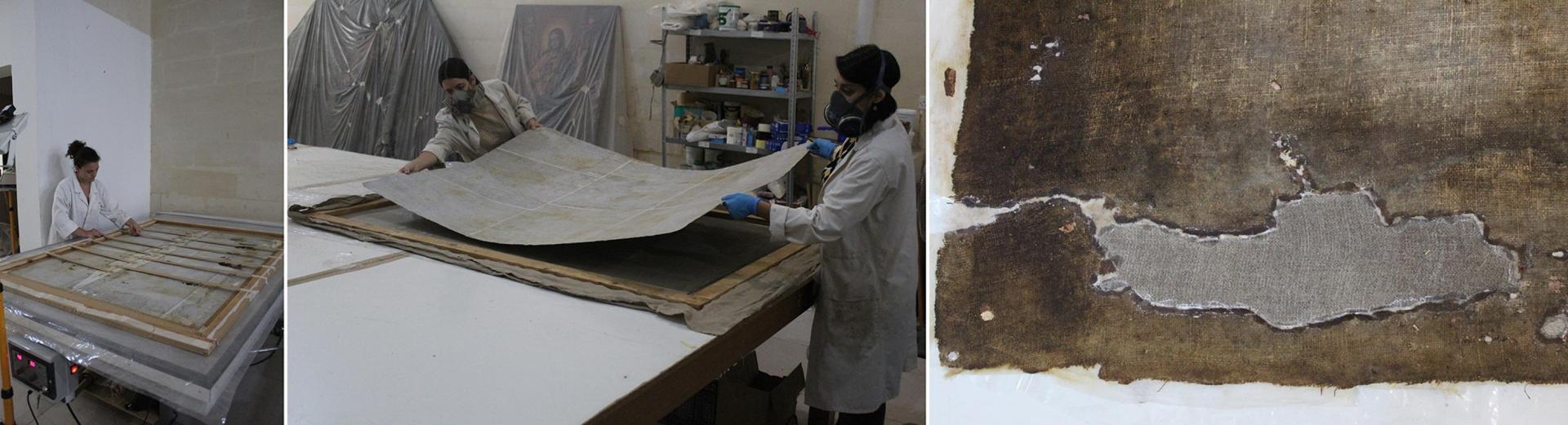 Treatments of the canvas supports aimed at stabilising the latter and at removing deformations as well as distortions. Lacunae found in the original supports were also inlayed using new canvas similar to the original. Photos: ASC Conservation Centre Ltd
Thus, in the latest treatments by ASC Conservation Centre Ltd, after the removal of the lining canvases, the original threads of these separate canvas pieces forming one painting had to be aligned using a very specific technique. The method used involved tensioning the painting on a provisional stretcher frame using strips of acid-free paper attached to the painting (which paint layer had been previously protected using Japanese paper).
These strips of paper were attached from the edge of the tear to the opposite edge of the frame, in alternate directions, 5cm to 8cm apart. The slightly humidified painting under this set-up was placed under suction on a vacuum-pressure table. The strips attached to the edge of the tear were pulled and affixed to the edge of the frame while the painting was humidified and this was then allowed to dry and set in its new position.
This procedure was repeated several times until the gap was closed enough to restore legibility to the previously distorted image. This allowed for the eventual proper tear mending carried out under magnification.
All paintings treated to date needed structural repairs, consolidation treatments and reinforcement of their canvas supports. Their paint layers were also cleaned from aged varnishes and overpaint, whereas the numerous minute losses linked to the presence of past water seepage, were integrated.
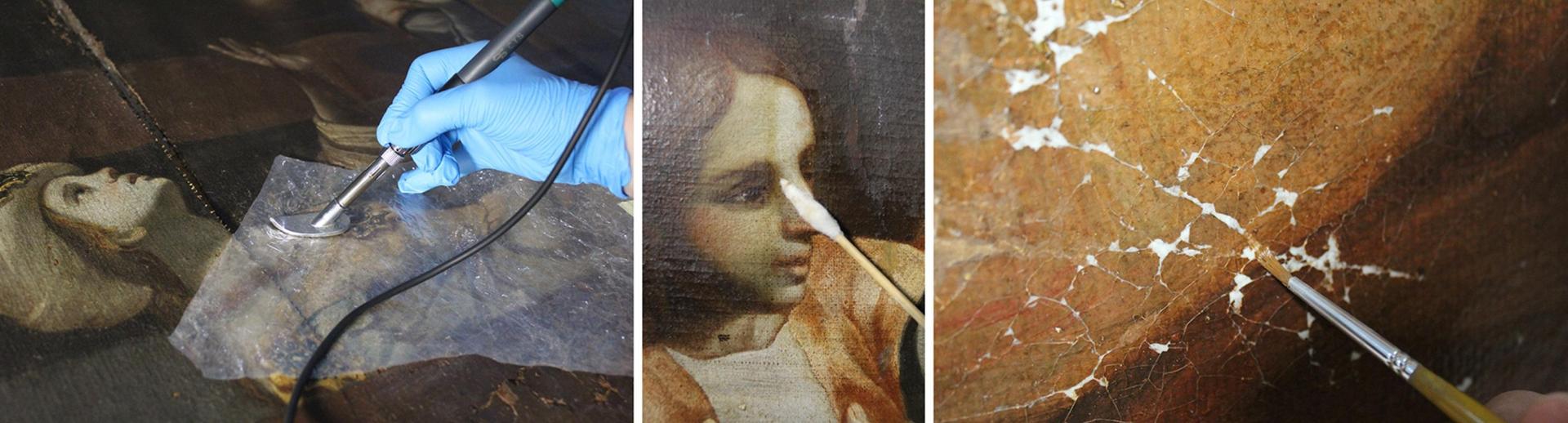 Details showing consolidation treatments of the paint layer, cleaning treatments and chromatic integration, respectively. Photos: ASC Conservation Centre Ltd
Acknowledgements
The authors thank Provincial Minister Fr Ramon Farrugia, OFM, and all the community at Ta’ Ġieżu Convent in Valletta, Computime Group, AM Mangion Group, The Alfred Mizzi Foundation, Montaldo Insurance Agency Ltd, The Farsons Foundation, Ocean Yield Malta Ltd, Neville Agius, as well as Ian Camilleri and Raymond Miller for their input, and the Archdiocese of Malta for being true ambassadors of Malta’s cultural treasures. Any entity or individual interested in contributing to the conservation of the remaining five paintings is welcome to contact the authors on info@amysciberras.com.