Opening doors for 50 years
A legacy cast in a coin
The year 2026 marks a major milestone for the Housing Authority as it celebrates its 50th anniversary. Established in 1976, the Authority has stood at the heart of Malta’s social development, providing access to safe and secure housing to thousands of individuals and families.
Its creation was the culmination of decades of debate and planning. As early as 1955, the Atkinson Report, commissioned to examine Malta’s post-war housing needs, identified the creation of a dedicated housing authority as one of its top recommendations. When the Housing Authority was finally established two decades later, it embedded housing as a core pillar of Malta’s welfare state.
In the post-war period, the authorities focused on addressing acute housing shortages and improving living standards for low-income families. Later, large social housing estates were built, providing thousands of households with a decent accommodation. With the establishment of the Housing Authority, dedicated programmes, such as the Homeownership Scheme (HOS), were launched to help families become homeowners. These programmes strengthened the Maltese tradition of homeownership and transformed the national housing landscape. By the mid-1980s, more families owned their home than rented, for the first time in modern history. This trend has continued unabated into the twenty first century.
As Malta’s economy and society evolved, so too did the Housing Authority’s role. In 1991, it relocated from the Auberge de Bavière to its current offices in Floriana. The amalgamation with the Department of Social Housing and the Department of Housing Construction and Maintenance brought additional responsibilities and required an expansion of the Authority’s operational capacity.
Today, the Housing Authority’s mission reflects a more complex housing environment. While the commitment to support homeownership remains strong, the Authority now plays a far broader role. It allocates social housing, regulates the rental market, manages an expanding range of schemes, and invests in the upkeep of Malta’s social housing stock.
Social housing remains a central pillar of the Authority’s work. The stock has grown significantly through new construction and through partnership initiatives that leases private properties for use as social accommodation. These efforts ensure that stable, affordable housing reaches those most in need.
The Authority administers an extensive portfolio of schemes designed to improve affordability, accessibility and adequacy of housing across different life stages and income brackets. These include rent subsidies, support for tenants in pre-1995 leases, homeownership schemes, assistance for first-time buyers after moving into their homes, and adaptation programmes to make it easier for older persons or those with a disability to continue living independently and with dignity in their homes. More than 15,000 families benefitted from these schemes in 2025 alone.
A major milestone was reached in 2020, when the Housing Authority became the regulator of the private residential rental market in Malta. It now oversees lease registration, compliance, enforcement, and dispute resolution. This regulatory role has strengthened protection for tenants, improved transparency, and brought greater stability to a rental market shaped by rapid economic and demographic changes.
As Malta’s largest landlord, the Housing Authority is also responsible for maintaining and modernising the social housing stock. This includes ongoing maintenance, refurbishment programmes, and major upgrades such as the installation of lifts in older estates—an increasingly important initiative for Malta’s ageing population. Efforts to improve energy efficiency are under way, including plans to use EU funds to upgrade a large share of the existing stock.
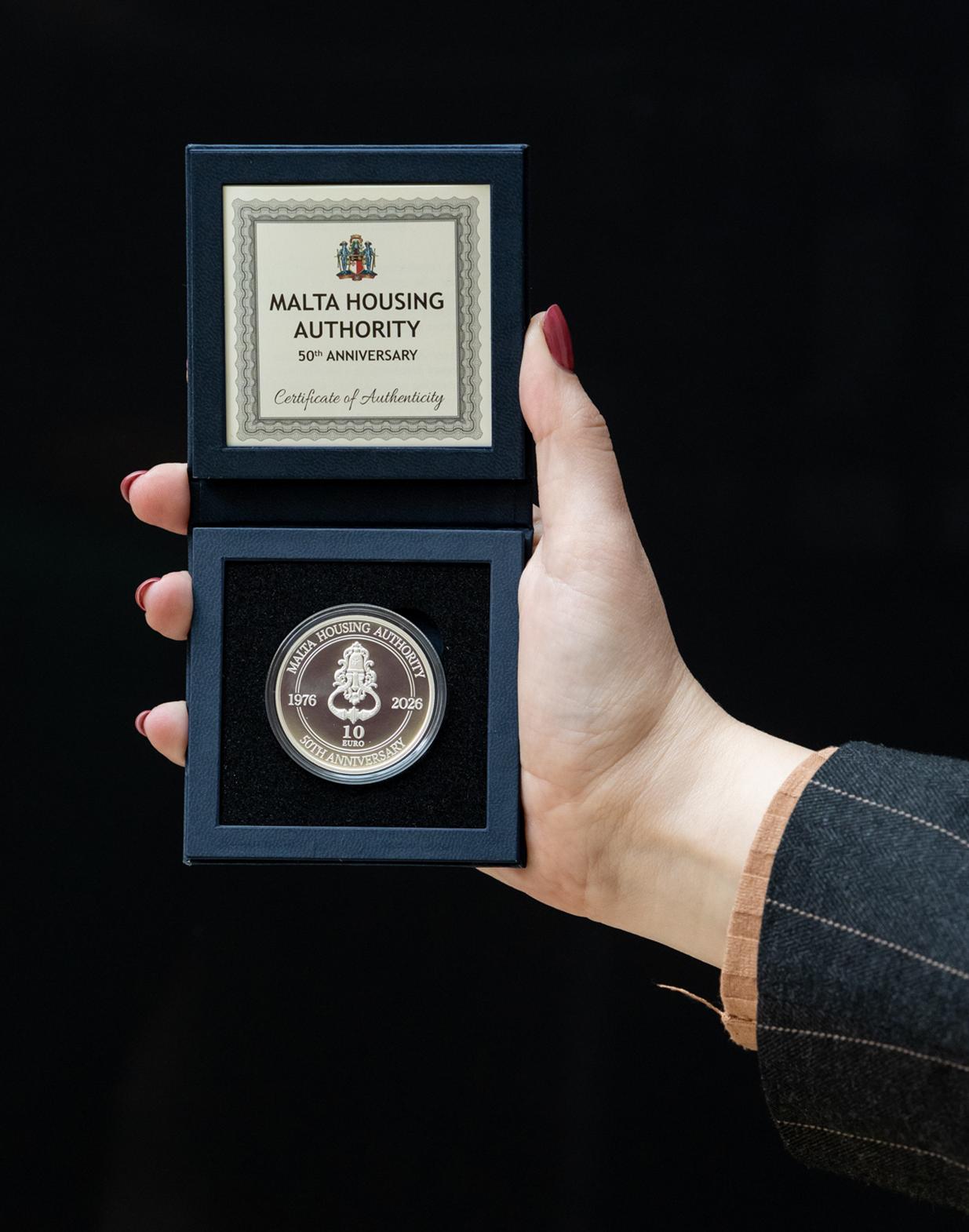
To mark this anniversary, the Housing Authority, in collaboration with the Central Bank of Malta, has launched a commemorative coin. A coin that is not merely a functional object of transaction, but a symbol of continuity. By its very nature, a coin passes from hand to hand and from one generation to the next. In many ways, this offers a fitting parallel to what the Housing Authority has represented over the past fifty years, a presence that has always been there, sometimes visibly - but often working quietly in the background.
The design features the traditional Maltese doorknocker (ħabbata), an iconic symbol deeply rooted in Malta’s architectural and cultural heritage. Far more than a decorative element, it embodies an invitation, a gesture of hospitality that welcomes neighbours, guests, and community into one’s home. Just as a door invites entry, the doorknocker represents the Authority’s open-door approach, its readiness to assist and support individuals and families at every stage of their housing journey.
As the Housing Authority commemorates its 50th anniversary, its founding principles remain rooted in its mission statement: to provide and sustain decent social and affordable housing opportunities, promoting stability and supporting social mobility. Yet its vision is forward-looking, and it continues to explore new ways of addressing emerging challenges, from demographic change to affordability pressures, climate adaptation, and the revitalisation of Malta’s urban fabric.
For fifty years, the Housing Authority has helped build more than houses. It has helped build communities, strengthened families, and supported social inclusion. As it looks ahead, it remains dedicated to ensuring that Malta continues to be a place where everyone has the opportunity to build a stable and dignified life. A place where no one is left behind.
Matthew Zerafa is the CEO of the Housing Authority. Brian Micallef is the Executive Head responsible for Digitalization, Legal and Communications, while Mark Vassallo is Senior Manager in the Policy, PR and Communications Office of the Housing Authority.