Our Lady of Mount Carmel altarpiece in Żurrieq restored
The story behind the Antonio Zammit painting
On July 5, the restored painting of Our Lady of Mount Carmel at Żurrieq parish church was inaugurated during a musico-literary evening.
This article puts this event into context by recounting the wider story behind it – the altar, the artist, the composition and the ultimate restoration which brought it back to its original beauty and dignity for the admiration and veneration of all.
The altar
The altar of Our Lady of Mount Carmel was first documented in January 1630, located on the right-hand side of the nave in the original parish church. When the new church was constructed between 1632 and 1657, the altar retained its original position − where it remains to this day.
The new church was beautiful but austere, as the impoverished village could afford little. Yet, records show the altar already featured a painting set in stone, featuring Our Lady handing the brown scapular to St Simon Stock below her to the right and St Anthony Abbot depicted to her left.
Early in the 20th century, during the ministry of archpriest Emanuel Mifsud, many structural changes were undertaken involving the addition of two bell towers and side aisles, among others. The changes called for new paintings to fit into the new structures, among them, a new altarpiece for the Our Lady of Mount Carmel altar.
The artist
The man selected for the task was Antonio Zammit, a native of Żurrieq. He studied sculpture under master sculptor Vincenzo Cardona and grew up working alongside his father Carmelo. Carmelo was a sculptor but also a musician and, for many years, the director of the Queen Victoria Band Society.
Antonio, like his father, was something of an all-rounder and had set his heart on producing a painted work of art. It was this ambition which led him to execute, with inspired mastery, the painting which today watches over Our Lady of Mount Carmel altar in the Żurrieq parish church.
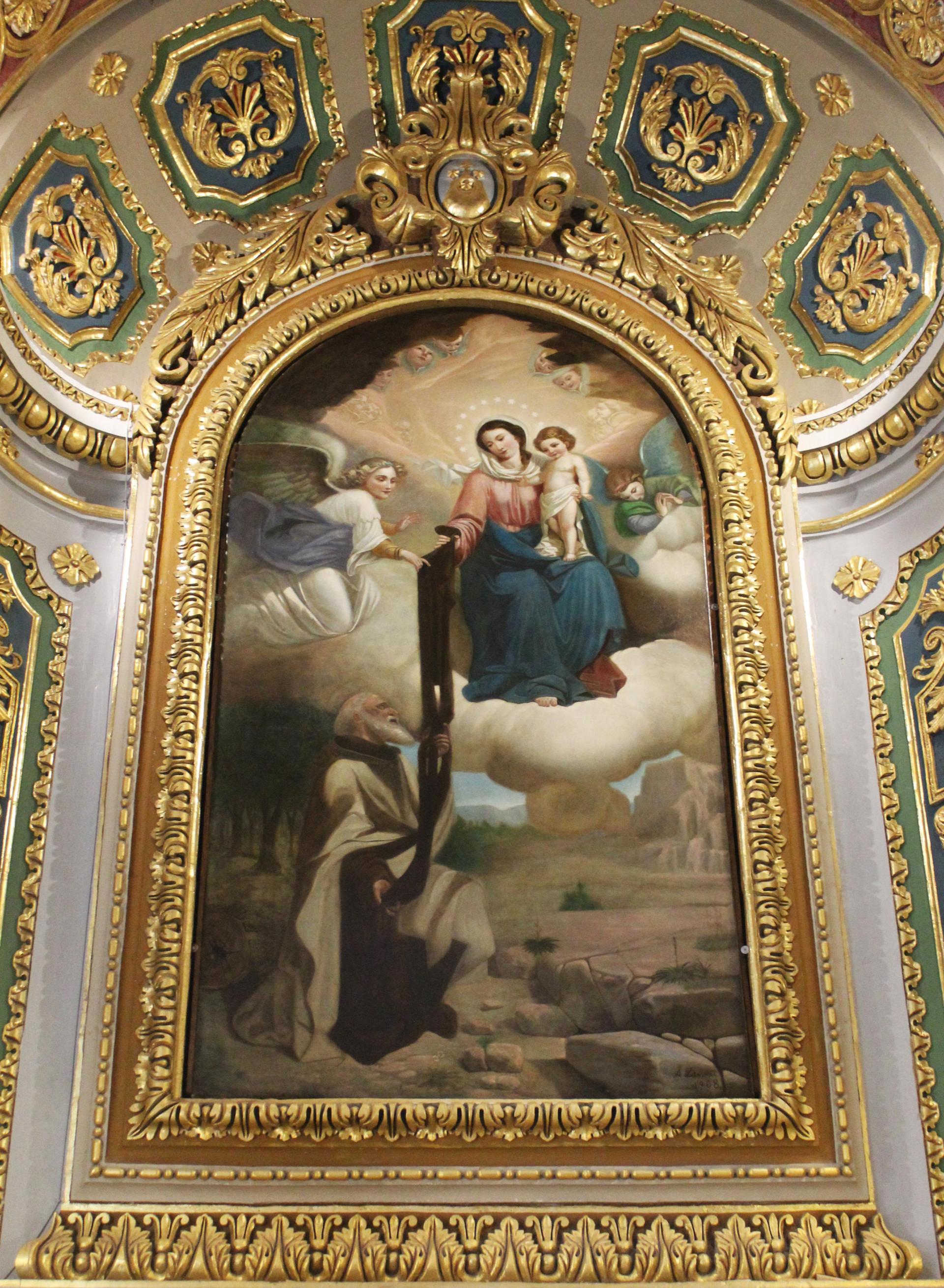 The conserved painting after it was installed back in its niche. Photo: Fratellanza tal-Madonna tal-Karmnu A.D. 1801 Żurrieq
It turned out to be his magnum opus, the achievement which etched his name in the artistic scene of early 20th-century Malta. And for Antonio, it was one of a kind – according to Alfred Camilleri in his book Il-Kariżma Karmelitana fiż-Żurrieq, he rarely ever again found work as an artist. His output after 1908 was mainly that of a statuarian, such as the statues of St Joseph and the Virgin Mary nestling in two niches in the facade of Christ the King parish church in Paola, and of St Anne and St Joachim on either side of the bell tower of Gudja’s Annunciation church. Antonio also created many charming niches which unto this day continue to adorn village streets.
Bred from childhood in the Carmelite tradition, Antonio was a great Marian devotee. He was a confratello in the Fratellanza tal-Madonna tal-Karmnu. He always wore Our Lady’s scapular and Camilleri relates how Antonio would work with a large flannel version hanging from his neck even in the dead heat of August.
The composition
The painting is vertically composed with a rounded top, the typical format for an altarpiece, and has two discernible dimensions – the celestial and the terrestrial.
On the one hand, Mary and the Christ Child appear enthroned on a cloud surrounded by angels and cherubs. Mary, with a halo of 12 stars, holds the brown scapular and is shown lowering it towards St Simon Stock kneeling at her feet. On the other hand, a sparse landscape with cliffs rising in the background emerges beneath a dense formation of cloud.
The iconography abounds with Marian references. The Council of Trent (1545-1563) reaffirmed Marian devotion as a central tenet of the Catholic faith against the radical objections of the Protestant Reformation. The brown scapular came to symbolise this devotion in medieval Europe. It became popular as a visual representation in a context of radical reforms within the Carmelite religious Order itself – from hermits praying in solitude in the Holy Land, the Order’s members transited into friars with active apostolic roles among people in Europe.
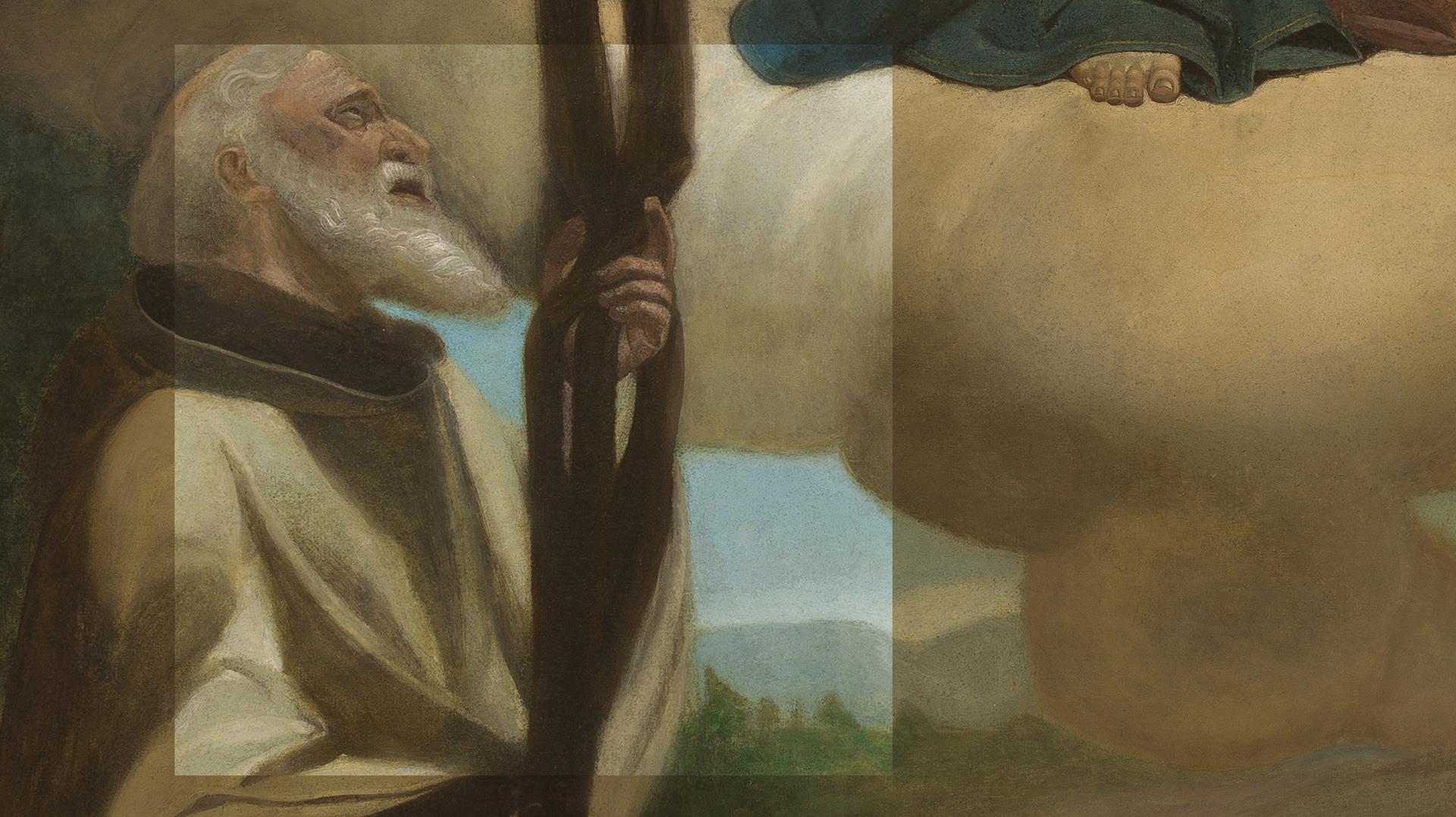 Details showing the cleaning process which involved the thinning down of a very thick and darkened layer of commercial varnish. Photo: Manuel Ciantar and Suzanne Ciantar Ferrito/ASC Conservation Centre Ltd
St Simon Stock is the only canonised British Carmelite saint. He was prior-general of the Order in the mid-13th century at the time of the transition. He was instrumental in raising the level of the Order’s services such as teaching and preaching to God’s people. His global fame, however, rests on him as a visionary of the brown scapular.
According to tradition, Our Lady of Mount Carmel appeared to him and promised salvation and special protection to all those who wore the scapular as a sign of their devotion. His feast day is May 16, just as Our Lady of Mount Carmel’s falls on July 16.
Another visual reference is the nature of the earthly register in Zammit’s painting: with its scattered vegetation and rocky terrain, it is strongly reminiscent of Mount Carmel and the Holy Land, the birthplace of the Carmelite Order.
The restoration
Work started towards the end of September 2024, under the direction of Amy Sciberras and her team of conservators at ASC Conservation Centre Ltd.
Throughout many decades, the painting had been subjected to a succession of unprofessional cleaning and other interventions and had suffered greatly. Significant areas in the lower half of the composition had been lost and painted over. In fact, most of the Żrieraq, aged 50+, gazing at the uncovered painting on July 5, had only glimpsed dark shadows of the rocks and trees in the lower part, nor had they ever seen the signature “A. Zammit 1908” in the right-hand corner.
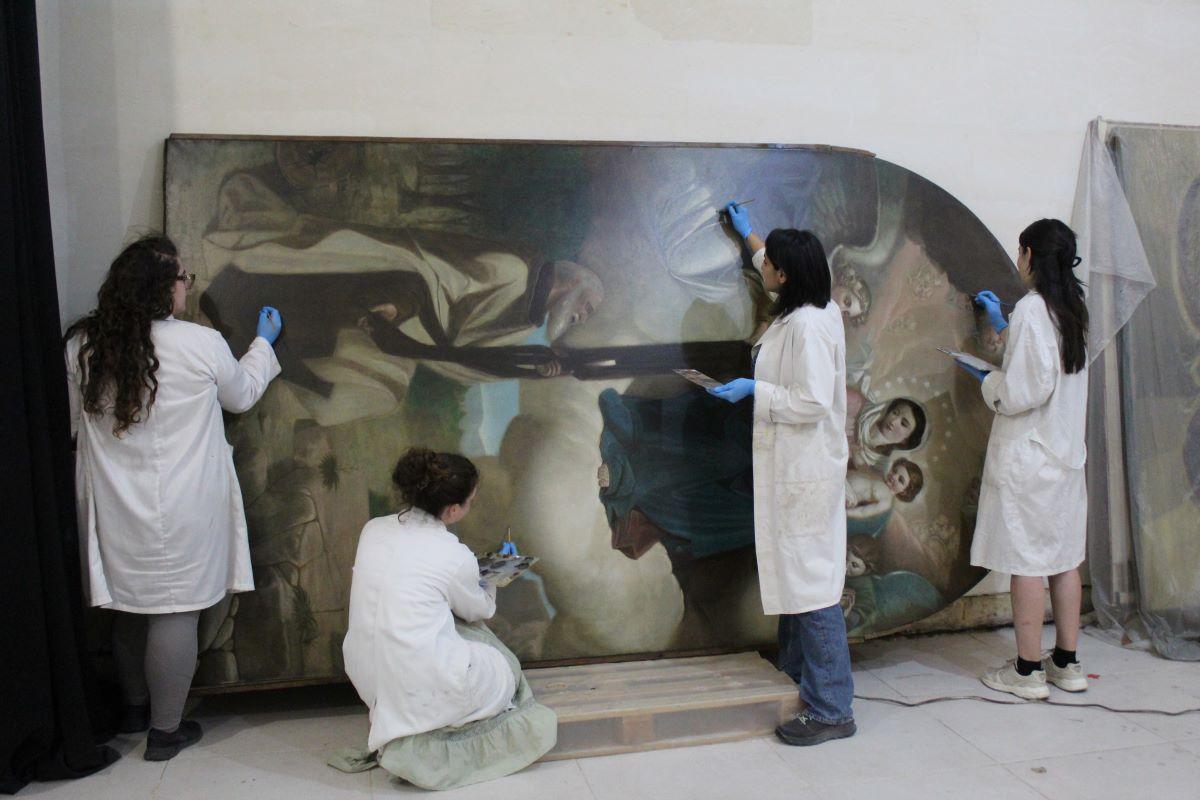 The conservators together with director Amy Sciberras, during the final phases of chromatic integration. Photo: ASC Conservation Centre Ltd
Moreover, a very thick layer of commercial varnish applied by past restorers had darkened over time, muting all the vibrant tonalities. This layer was aggressive and chemically stronger than the underlying paint layer, thus presenting the ASC laboratory team with a delicate challenge that called up their whole repertoire of cleaning techniques.
The periphery of the canvas exhibited several lacunae as well as structural problems related to the nature of the canvas itself. The final phases of the conservation and restoration involved mainly the chromatic integration of various stains and of numerous dark dots which came to the fore when the varnish layer was thinned and removed, and which were treated painstakingly one by one.
A final professional coating was applied to protect the paint layer from agents of deterioration such as dust and other pollutants.
The conservation and restoration project was commissioned by the Fratellanza tal-Madonna tal-Karmnu AD 1801 under the direction of the confraternity rector Francis Farrugia, with the support of Żurrieq archpriest Daniel Cardona. It was funded by the Malta Arts Council.
Reflections
People – the village people and visitors alike – never cease to marvel at the richness and quantity of decorative art present in the parish church of St Catherine in Żurrieq.
This article was about Antonio Zammit’s labour of love but the church is a repository of several paintings by baroque artist Mattia Preti, among them the important titular painting depicting the martyrdom of St Catherine. Besides these, there are many examples of delicate silverware, sculpture, carved church furniture and embroidered ecclesiastical vestments.
It is tempting to view all this as a manifestation of art and faith since it is a fact that, in Catholic countries such as Malta, art and faith cannot be divorced one from the other. But the truth is more complex –works of art in our churches form part of a multi-layered narrative that transcends art and our Catholic beliefs, reaching into the shared soul of the village or town and the social/cultural path it has travelled throughout the centuries.
This article is dedicated to all the people of Żurrieq but especially to the Żrieraq who emigrated in their hundreds to Australia, the US, Canada and the UK during the second half of the 20th century. I also dedicate it to my late father Publius, who loved the Queen of Carmel every minute of his 93 years on earth.
Catherine Vella is a Marian devotee and part-time parish researcher. She works in the private sector.