Who erased the author? Inside an 1811 Maltese manuscript of bizarre tricks
A weird and amusing 19th-century manuscript provides instructions on some very odd things indeed
The Victorian doyen of Maltese jurists, Sir Adriano Dingli (1817-1900), left piles of significant papers when he died, a number of which the National Archives now house for safe keeping.
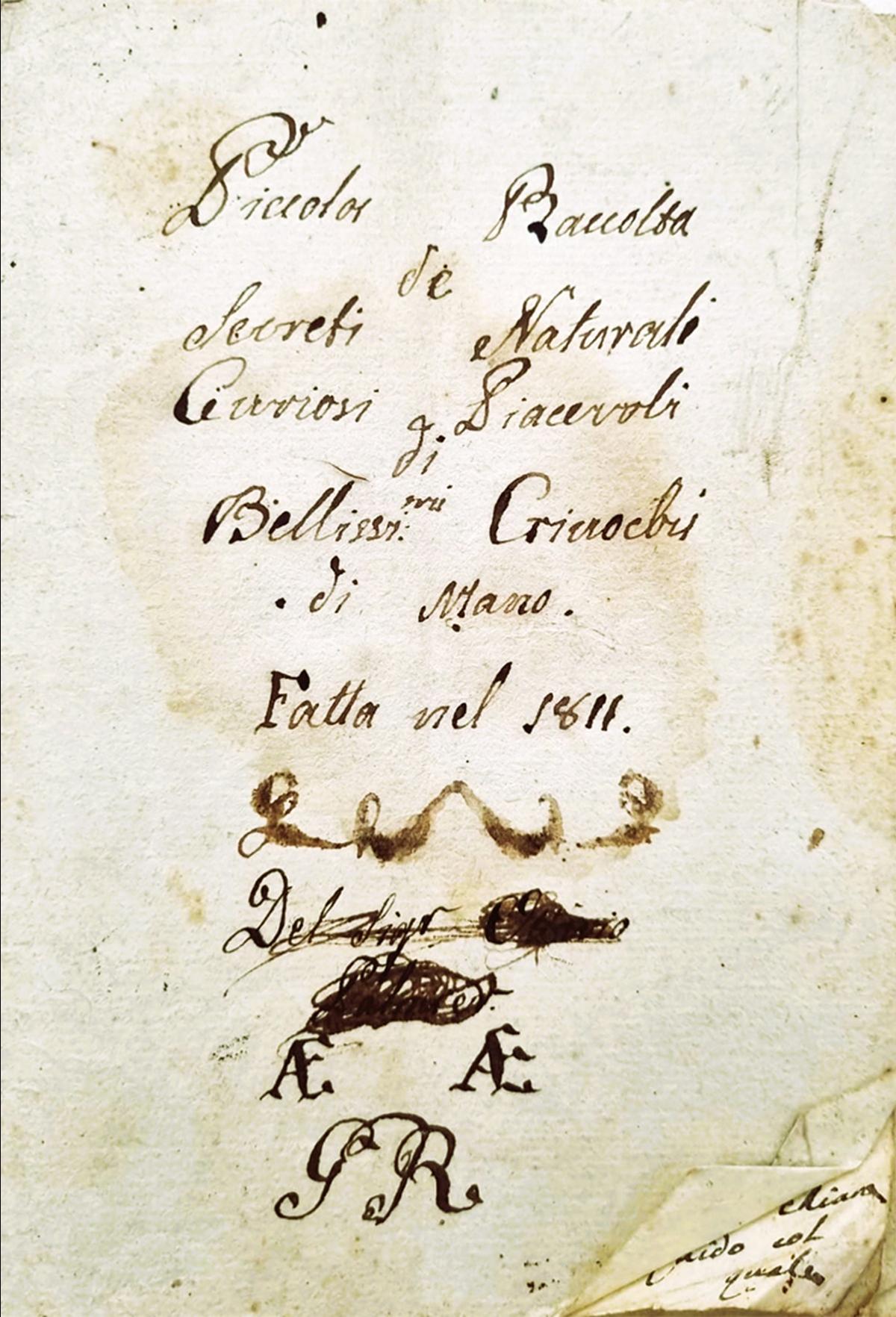 Frontispiece of the Palmier 1811 manuscript.
Among them is an early manuscript dealing with lightweight matters that fits rather awkwardly with the other ponderous matters which indented deep footprints on the juridical and political destinies of our nation. They would, wouldn’t they, seeing that for years Dingli ruled as supremo in lawmaking, an éminence grise the ones in the know acknowledged as the de facto governor of the island.
This manuscript included in the Dingli archive carries the name Piccola raccolta/de/secreti naturali/curiosi e piacevoli/bellissimi giuochi/di mano/fatta nel 1811. (A small collection of natural secrets, curious and pleasant, and of amazing sleights of hand, compiled in 1811). The name of the author follows the title: del Signor….
Someone long ago, however, inked over the name heavily, but I believe it is still possible to decipher half of it: the surname seems to be Palmier. The forename, on the other hand, proves illegible.
Who was the early 19th-century author who brought these curiosities together? Why was his name erased, apparently vindictively, from the frontispiece?
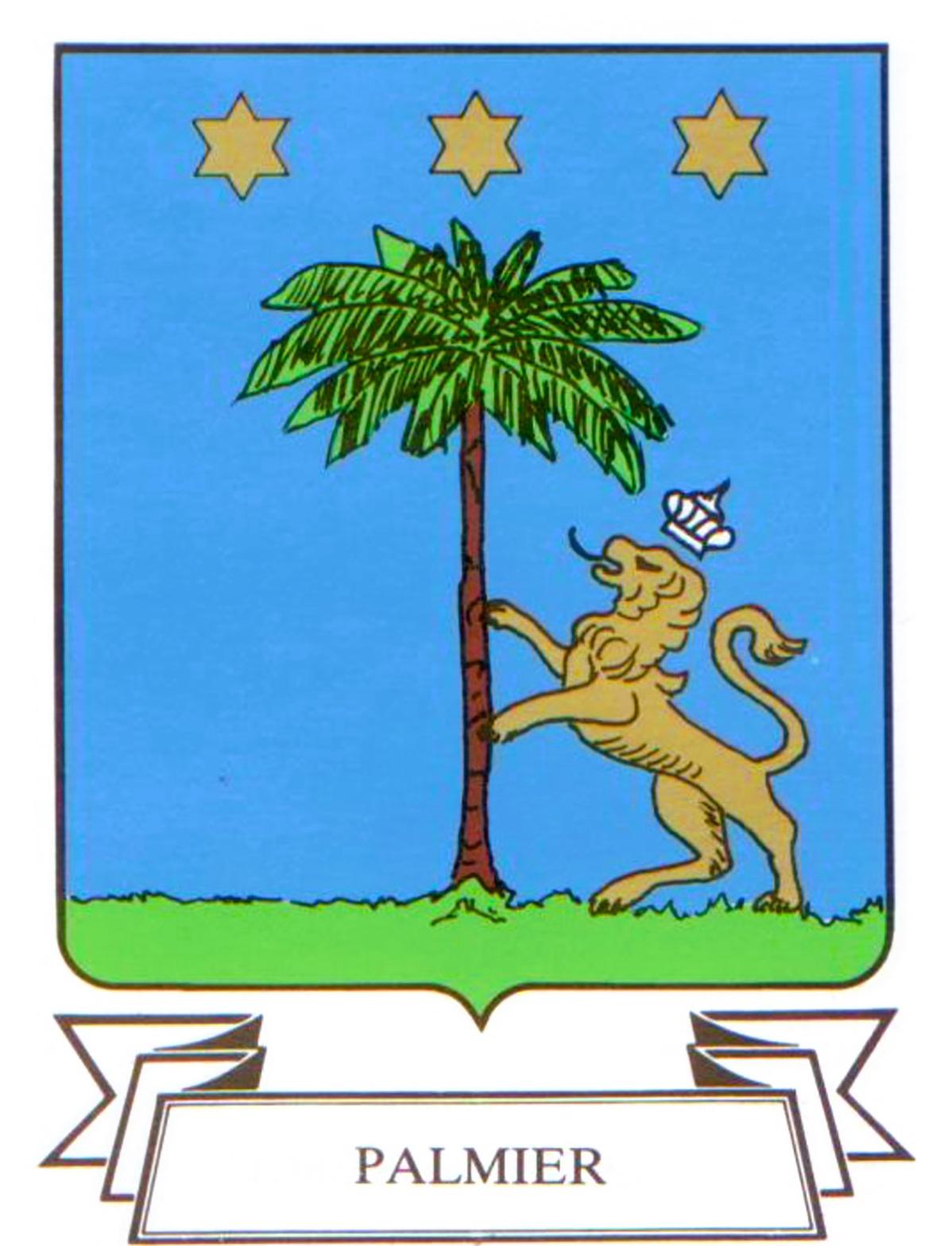 The Palmier coat of arms, courtesy of Charles A. Gauci.
Palmier does not happen to be a common family name in Malta. The first time I came across it links with a doctor of laws, born c. 1756, who graduated in 1778, and who Grand Master De Rohan appointed as Avvocato Fiscale (criminal prosecutor) for Gozo – Dr Carlo Emmanuele Palmier. He married Anna Pace from Gozo in 1795 and they had three children.
During the short French interlude, on June 25, 1798, General Vaubois promoted Dr Palmier to Justice of the Peace for the Rabat municipality of Gozo. But on the liberation of Gozo from Napoleon’s forces, in 1801 we find Dr Palmier as criminal prosecutor of Gozo (fiscale della Curia Gubernatoriale), a jurat and dubbed Patrizio Gozitano.
The year 1801 must have been particularly frantic for Palmier as Gozo’s attorney general. He first issued a far-reaching bando – an official proclamation – touching on many areas of criminality: widespread gambling addiction, heretical blasphemy and children carrying arms in public. He subsequently comments (favourably) about the reintroduction of the berlina – presumably abolished in the French interregnum.
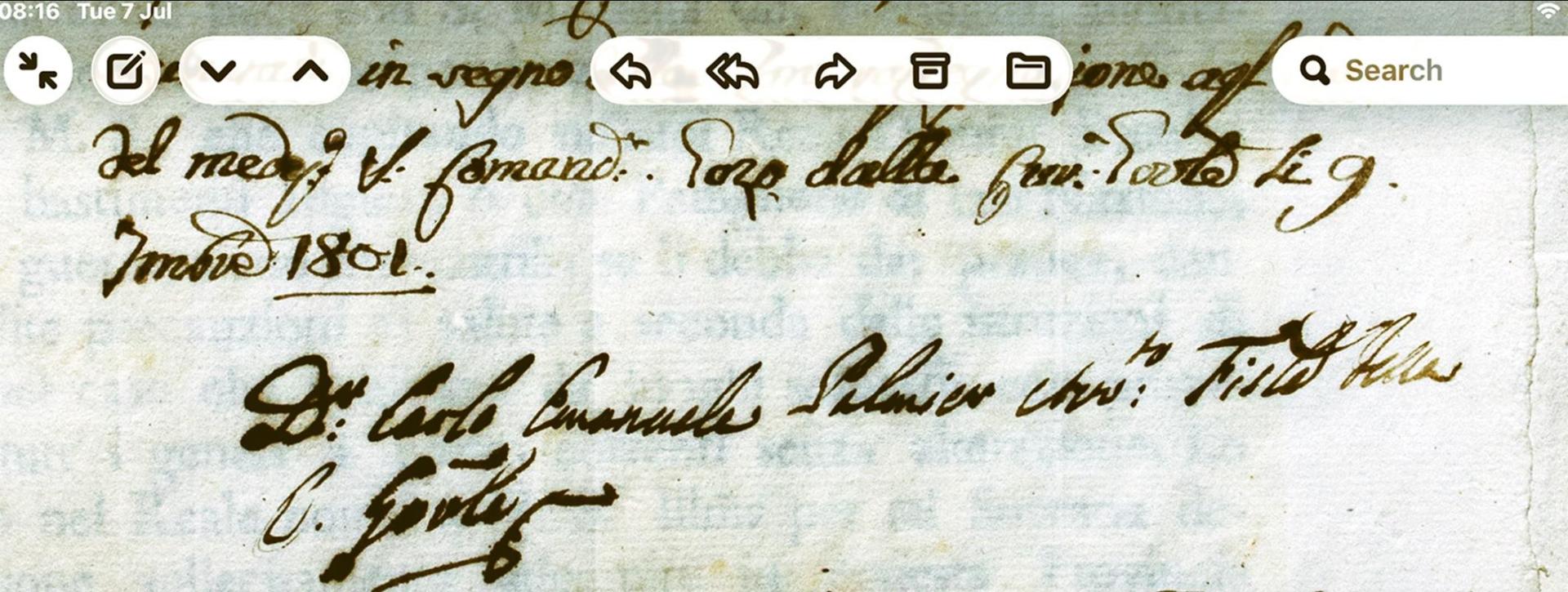 Signature of Dr Carlo Emanuele Palmier, 1801.
The humiliation of the pillory consisted in tying delinquents to a column in a central, public place, for the populace to outrage and pelt them to their hearts’ content. He records the old pillar of shame was placed on the ascent to the Citadel, but the new one had been built in “the loggia of the courthouse in the Tocco” where the public has better access. The fiscale also issued another bando to regulate the alarming increase of thefts and burglaries.
Dr Palmier occupied various official positions – president of the Gozo Hospital for Men in 1806 and, concurrently, judge of the Gozo Criminal and Civil Court. On December 1, 1818, after the reform of the court system, the British government appointed Palmier Magistrate of Judicial Police for Gozo and Comino.
I assume, entirely intuitively, our Palmier to be a collateral or descendant of Dr Carlo Emmanuele.
How did this manuscript booklet end in Sir Adriano Dingli’s possession?
Palmier’s piccola raccolta follows in the wake of a genre popular in Italy. There, printed libri de’ secreti, whether meravigliosi or otherwise, flourished as they appealed to an inquisitive, perhaps unsophisticated, readership.
A pioneer in Malta could have been Michele Mercieca (Marceca), a confectioner who in 1748 wrote a substantial manuscript Libro de’ secreti (book of secrets) in Italian that dealt with curiosities, inventions, recipes, unknown trivia and tricks, mostly about confectionary and food. This work remained a manuscript up to the year 2011, when a Sicilian publisher came to know of it and had printed it.
Maltese scholars had assumed Marceca to be Maltese, but various lexical giveaways would indicate a Sicilian origin, possibly from Modica, though it seems likely that Marceca had settled and worked in Malta.
Palmier divided our piccola raccolta (small collection) in 10 numbered sections, some subdivided in separate paragraphs and themes. The handwriting does not add any cohesion to this work. At least three different calligraphies suggest various authors collaborating with one ‘editor’, perhaps at different times. If I had to resort to one word to qualify the contents, I would hesitate between ‘amusing’ and ‘weird’.
How else would you describe the instructions on how to make an egg jump out of a plate? Easy. Take an empty eggshell, place two live cockroaches inside it and mask the hole. Put the egg back on the plate and watch it hop out.
Or how to break a bottle of wine midair and leave the contents sticking to a beam. Follow carefully: take the bladder of a pig and force it into an empty bottle. Fill the bladder with wine and tie the opening with transparent string. Stick the string closely to the beam and shatter the bottle. The wine will appear glued to the ceiling.
To make fire spring out of water, fill an eggshell with powdered sulphur and quicklime. Throw it in the water and it will burst into flames.
And to read at night in the dark? Smear your face with bats’ blood. Presumably it has fluorescent properties.
To make a wine glass remain attached to the lips of the drinker – melt gum-arabic in vinegar and brush it round the rim of the glass.
How to make brass look like silver? Mix mercury and red clay with saliva and let it dry. Powder the mixture, rub the dust over the brass with your fingers and it will take on a silver sheen.
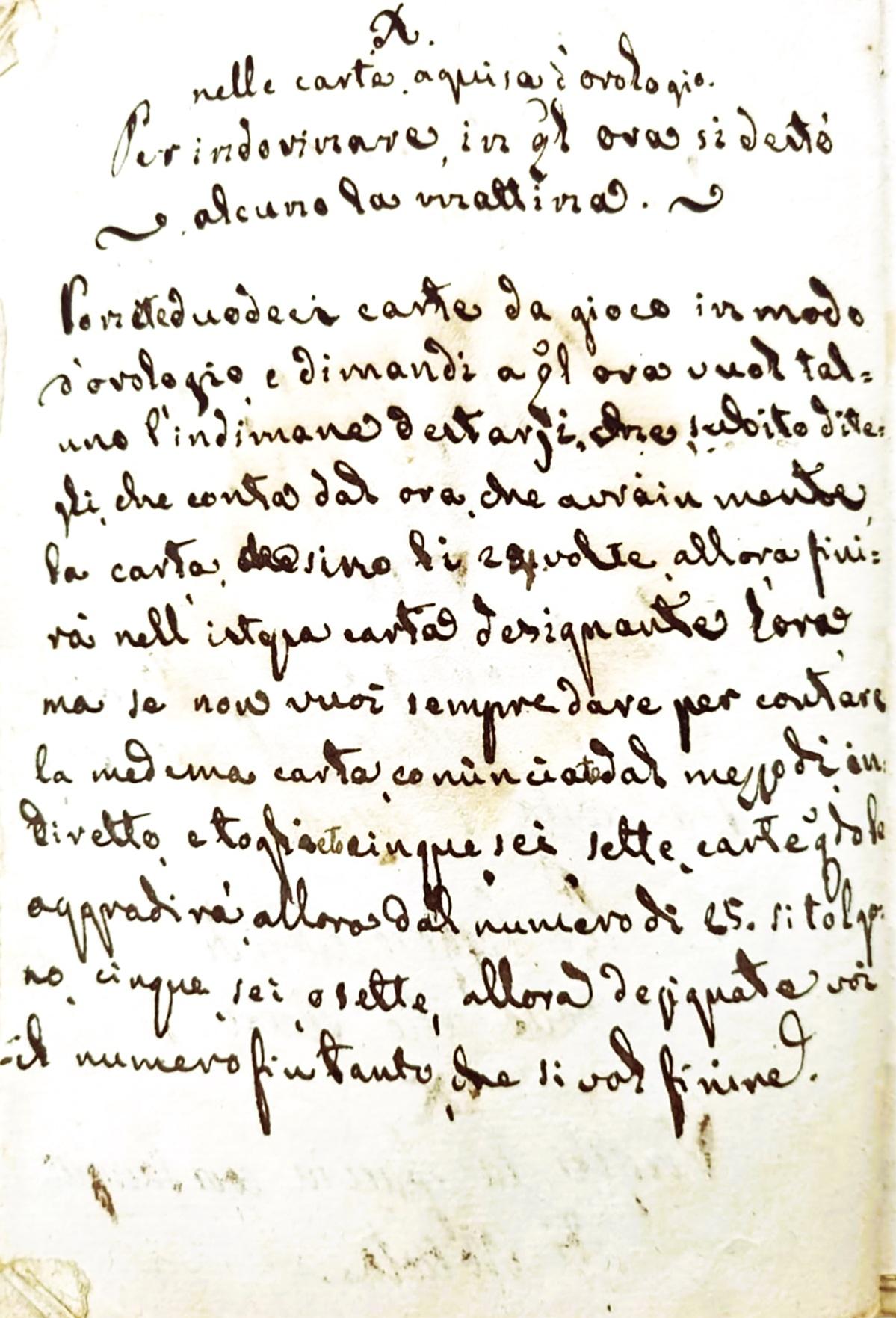 The last page of the Palmier manuscript in one of the several handwritings.
A number of instructions deal with invisible writing – a subject never too alien to an age paranoid about spying, privacy and encryption. Write the message in lemon juice on white paper and let it dry until the writing disappears. Those who want to read it have only to scatter hot ashes on the paper and the message will reappear.
Again, to hide a message inside an egg, dissolve alum in vinegar and write with the mixture on the surface of the shell. Dry the writing in sole gagliardo (strong sun) and then soak the egg for two days in salty water. Cook the egg until hard-boiled. When shelled, the writing will have penetrated and appeared on the hard white surface of the egg.
If you dissolve rock-alum (potassium aluminium sulphate) in water, and write with it on paper, the writing will disappear. But when you immerse that paper in water, the writing reemerges.
In the nature of trickery – how to make quince fruit grow out of proportion – di meravigliosa grandezza. Insert rape (or turnip) seeds inside the quince and seal the hole with wax. After a time, the fruit will augment noticeably in size.
Want to cook a tender chicken without fire? Just fill it with aquavit (brandy, grappa, etc) and leave it for some time.
How to catch birds with your hands? Soak wheat in wine sediment (feccia di vino) and the juice of acuta (?) and leave it for the birds to peck. They will get drunk and lose the strength to fly.
You want to see broad beans (fave) grow in one hour? Soak the broad beans in hot oil for nine days and then let them dry. Plant them, and in 60 minutes they will sprout to the height of una spanna (22cm).
The frontispiece promises amazing sleight of hand (bellissimi giuochi di mano – conjuring tricks). I found little of that.
Perhaps some might just qualify, like how to make people appear beheaded, or a card game that predicts the right time, or how to make eggs levitate, or how a raven painted on a wall can be made to sing, or how to ensure a fish in a frying pan flips on its own, or how to empty a room of all its air, and how to catch fish successfully without exertion. This, and quite a lot more.
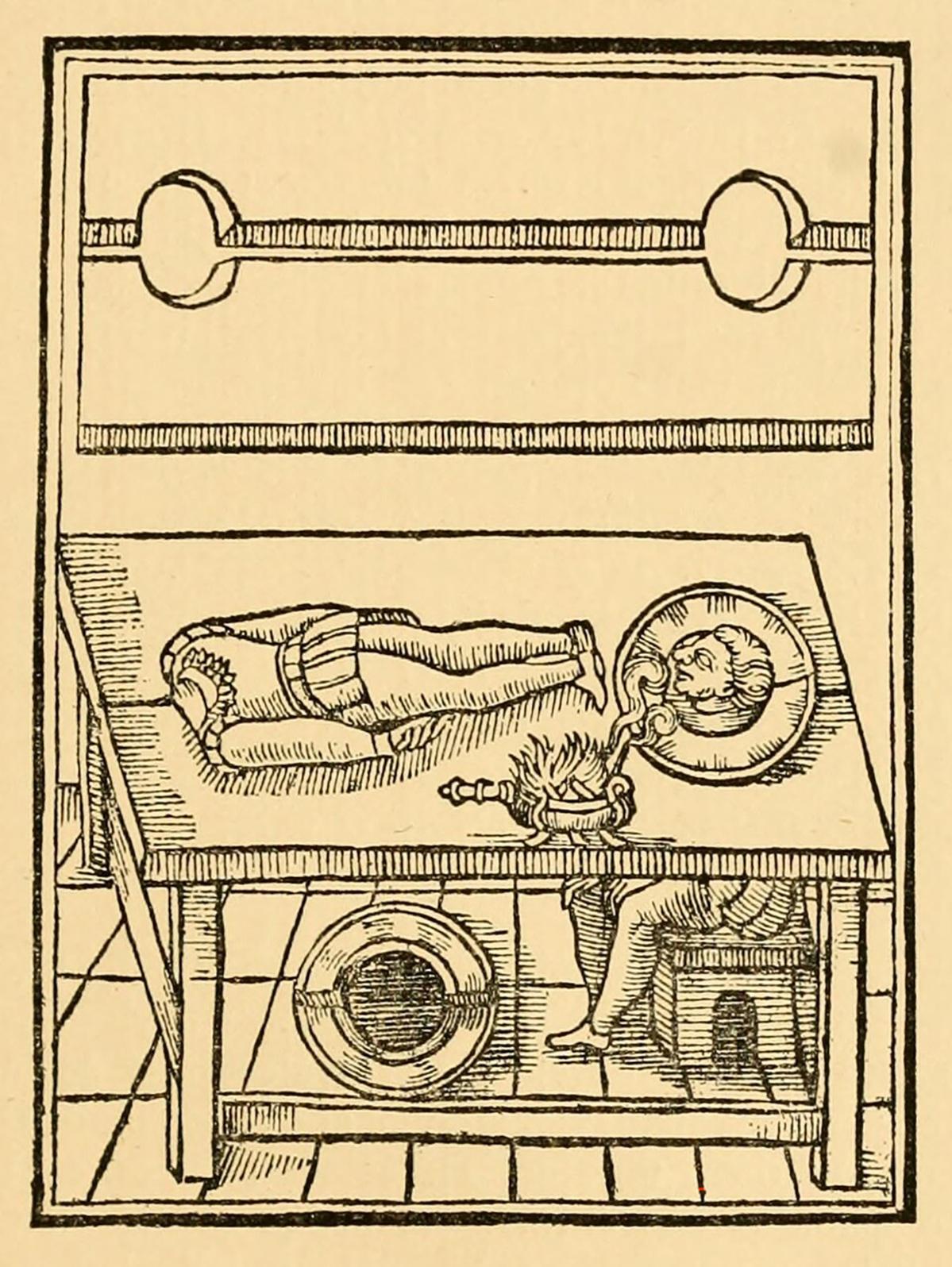 Illustration from a 16th-century magician’s manual showing a beheading illusion.
Health warning: I assume no responsibility for the success or harmlessness of any of these tricks, over 200 years old.
This little handbook appeared at a time when chemical experiments by leading scientists throughout Europe had taken over popular imagination and had become subjects of parlour gossip. It could be considered the golden age of chemistry – the time the giants shone: Lavoisier, Dalton, Gay-Lussac, Volta, Avogadro to mention some that come to mind. No surprise that homegrown wizards tried to give a voice to micro chemistry.
Some questions about this piccola raccolta remain unanswered.
Who was the early 19th-century author who brought these curiosities together?
Why was his name erased, apparently vindictively, from the frontispiece?
How did this manuscript booklet end in Sir Adriano Dingli’s possession?
Why did he find it worth archiving?
Acknowledgements
My heartfelt thanks to Mark A. Sammut Sassi, who generously brought this manuscript to my notice; to Mgr Joseph Bezzina, the National Archives, Judge Lorraine Schembri Orland and Theresa Vella for their input and assistance.