Peter Agius sees no contradiction in his 'Temu tax' position
PN MEP says his seemingly contradictory positions are in fact consistent
Nationalist MEP Peter Agius said his lobbying against an upcoming €3 EU levy on cheap Chinese imports does not contradict his previous pledges to protect local businesses from unfair internet giants.
The levy, which comes into force next week, is intended to protect EU businesses against unfair competition from companies like Shein and Temu in third countries like China, and Agius has previously spoken about how unfair such a market can be on EU and Maltese businesses.
So when, last week, the Nationalist MEP sent a letter to European Commission president Ursula von der Leyen telling her the levy was a bad idea, it felt like he was somewhat going against his previous pledges in favour of businesses.
But when contacted by Times of Malta he said his stance remained consistent. “I’m in favour of helping Maltese businesses. That’s all. I didn’t come out against the levy to protect Shein or Temu but to protect consumers who will now have to bear the brunt of the new tax,” he said.
“The Chinese giants are subjecting unfair competition on our small businesses, true, but throwing in a levy on their exports is now merely punishing our consumers.”
‘Don’t just tax consumers, make businesses stronger’
Last October Agius worked on a European Parliament resolution which, in his own words in a Facebook post, would “protect SMEs and self-employed individuals who must compete in an unjust market with internet giants like Shein and Temu”.
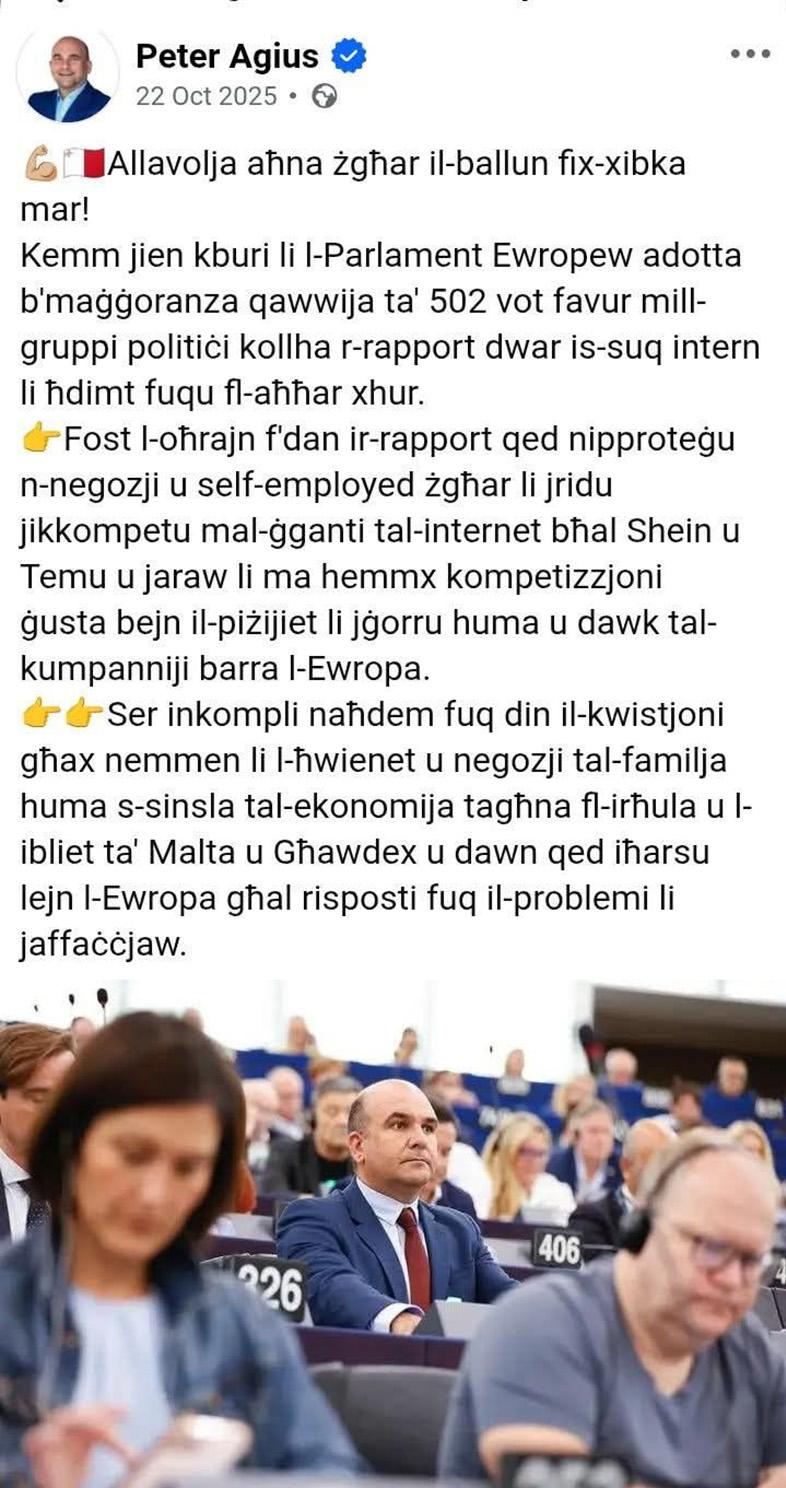 In a Facebook post last October, Agius said a European Parliament resolution he worked on would ‘protect SMEs from giants like Shein and Temu’.
But, as the EU prepares to roll out the levy next week, Agius sent the urgent letter to Von der Leyen on Friday, warning her that the incoming €3 fee will hit ordinary Maltese consumers hard and risk fuelling Euroscepticism.
He told Times of Malta the solution to foreign dominance is not to penalise consumers with a blunt tax but to empower local and European businesses so they can compete on price and logistics.
It is not about eliminating the foreign players, he argued, but about strengthening the local ones.
“Last October, I was a rapporteur for an EPP resolution to protect European workers from third-country competition. The resolution is altogether different to my letter to Von der Leyen. It’s about defending European businesses from the international giants,” Agius said, adding that the €3 levy was a decision by the European Commission and the European Council and that the European Parliament was not involved in it.
“In my letter to Von der Leyen, I told her the levy would not address the real causes and would not help the people and businesses we want to help.”
The only people who’ll benefit from it are the customs authorities and not the consumers and businesses, he added.
A hit for Maltese shoppers
The levy, set to take effect on July 1, targets low-value online purchases direct from third countries.
In his letter to Von der Leyen, Agius said approximately 95,000 Maltese citizens – nearly 20% of the population – live on the brink of poverty and rely heavily on these cheap platforms to get by.
He estimated that the introduction of the €3 fee will cost Maltese consumers €15 million annually, based on an estimated two million packages entering the country each year.
He argued that the EU is penalising island consumers without offering them a viable European alternative. While Chinese giants often provide free or highly subsidised shipping, purchasing goods from mainland Europe incurs exorbitant freight costs, he said.
“A 500g package to Malta costs €26 from Germany and €32 from Italy, compared to just €6.50 from Shenzhen, China,” he told Von der Leyen.
“Before introducing this levy, did we consider how to ease shipping costs within Europe?”
He also suggested establishing centralised transport and postal hubs to help European SMEs ship their goods competitively.
The controversial ‘Temu tax’
The controversial levy is essentially the EU eliminating its long-standing €150 duty-free exemption to close a tax loophole heavily exploited by ultra-cheap companies.
Under the old system, packages declared below the €150 threshold entered the bloc completely free of customs duties, prompting e-commerce giants to split large orders or undervalue shipments to bypass taxes entirely.
This created what European retailers condemned as an uneven playing field because local businesses importing goods in bulk face strict corporate taxes, labour laws and standard customs duties that foreign e-commerce platforms managed to circumvent.