The philosopher-priest who argued for the right to take your time
Fr Peter Serracino Inglott, who died in March 2012, would have been 90 this month
Before ‘always on’ became many people’s default setting, Fr Peter Serracino Inglott was warning that a society addicted to frenzy would lose the time to judge what it was becoming.
That diagnosis hovered over a memorial lecture held close to the anniversary of the priest-philosopher’s death in March 2012 and ahead of what would have been his 90th birthday in April.
Serracino Inglott, a former rector of the University of Malta, was an intellectual with an instinct for consensus in a political culture that increasingly rewards division.
The lecture, titled ‘Time is Scarce but Values are Priceless – 21st-Century Challenges for the Economy, Society and Culture’, was delivered by economist Marisa Xuereb, former president of the Malta Chamber of Commerce.
She built her argument around a deceptively simple idea that Serracino Inglott proposed in 2008: that people should have a “right to take your time”.
Public frenzy
He had been asked then whether Maltese society was driving towards economic development at the expense of social and human values. The danger, he replied, might be subtler. The axis of development, he argued, was shifting towards information and communications technology and the transformation it produced was not just economic but social and human. Yet, he suggested, there was a right missing from the standard catalogues of human rights: time itself.
It was a provocation against what he called the principle of “frenzy”, which he described as the feeling that everything must be faster, more efficient, more compressed. The speed of the electronic age, he warned, was leaving people dissatisfied. “It is all happening too fast for us to be comfortable with it,” he said at the time.
Nearly two decades later, Xuereb told the audience how change has accelerated exponentially and “we are not just uncomfortable about it but completely overwhelmed by it”. She spoke of the importance of being “intentional about work beyond mundane processes and life beyond work”.
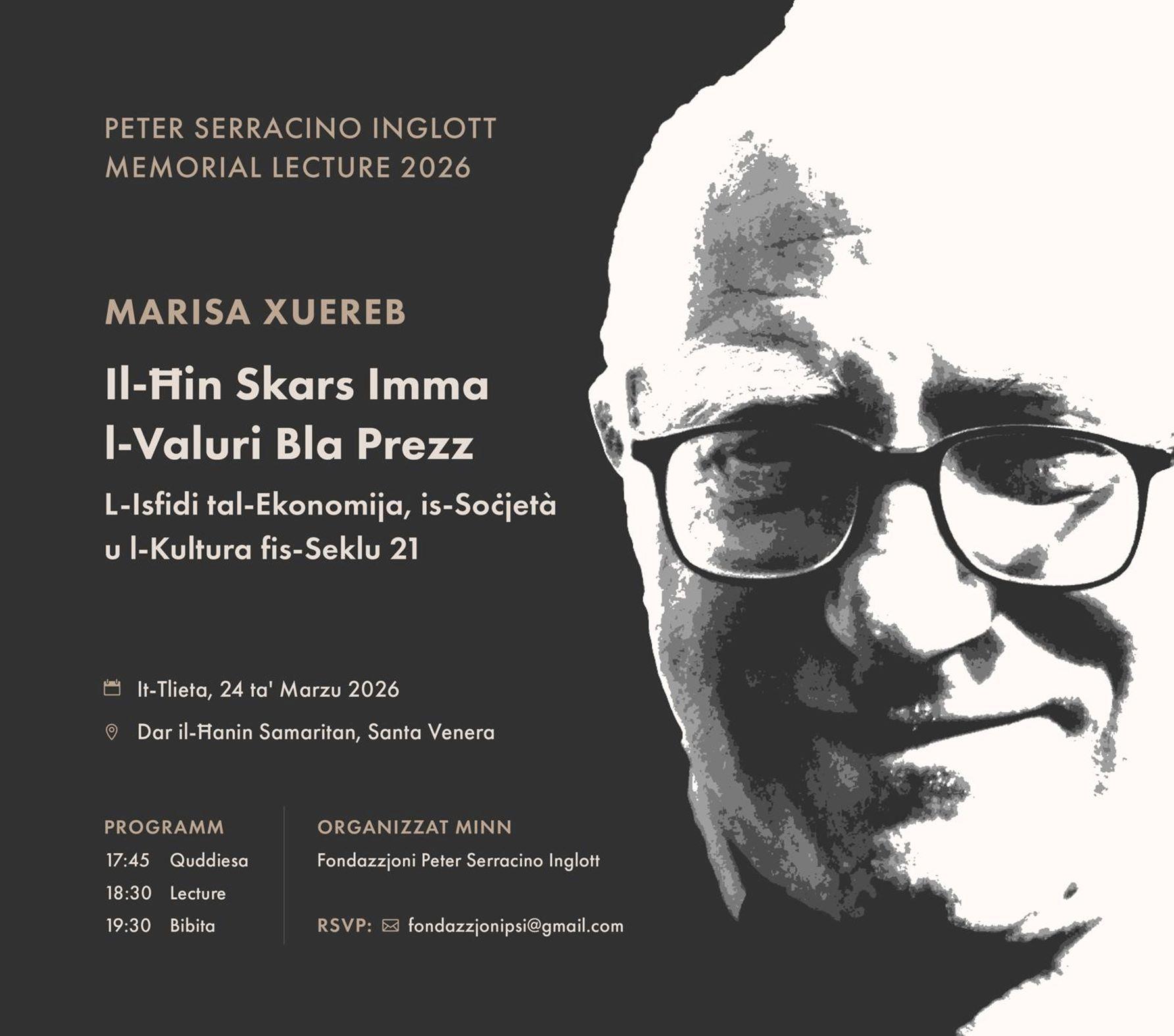 The poster promoting the memorial lecture.
The question is whether a society that is constantly rushing can still make sound judgements about things like development, politics and the kind of country it wants to be.
Xuereb, who spent much of her career in German manufacturing, said people need time away from work to build the experiences that make sound judgement possible in an increasingly complex world. “Time is scarce but values are priceless,” she said.
Bridging divides
Beyond the theme of time, Xuereb also examined Serracino Inglott’s attitude towards public life. She described Serracino Inglott as a “notorious consensus builder”, who showed how principled leadership can bridge divides in a small, highly polarised state.
Time is scarce but values are priceless
“Maybe that is why, today, we miss minds like his, that could spare us some of the pain and futility of much of the partisan political discourse we are exposed to on a daily basis.”
Serracino Inglott, she added, was also suspicious of the fashionable retreat from politics. He believed in active engagement, advocating a model of informed, ethical and networked political participation, rather than passive disengagement, Xuereb said.
His engagement in governance and policy was uncommon for an intellectual, even more so for a priest, with his role of political adviser at times generating controversy.
But for those who choose not to engage in politics, to the extent of not even voting in elections because they were disillusioned, his message was clear, Xuereb said. “Political disengagement is not a strategy; it is a challenge to be addressed through ethical education, dialogue and networked cooperation,” she said.
Political noise
Xuereb questioned how this can be done in a busy life. How do citizens find time to engage with issues that are not “bread and butter” today but will shape their quality of life tomorrow? How do they think about the future and talk about politics rather than staying trapped in “trivial partisan gossip”? And how, amid misinformation overload, do they make ethical judgements when the lines between development and exploitation, business and corruption, meritocracy and entitlement, appear increasingly blurred?
Serracino Inglott had called the emerging era an “intelligence revolution”, driven by human communication, networks and knowledge sharing.
“But when we look at the world today, energy and material capital seem to be dictating everything,” Xuereb noted.
“Locally, we pretend it is business as usual; that we are well-insulated against potentially catastrophic global disruptions.”
This complacency, she argued, is reinforced by a warped belief that the country is too small to change the world’s fortunes but bold enough to imagine it can ride out the consequences in “delusional bliss”.
AI Pressure
This was not what the intelligence revolution should look like, she said, referring to today’s artificial intelligence revolution that has come in its stead.
“It is critical that we retain the human in the loop; that we engage with AI and challenge it rather than avoid it, so that the experiences it learns from do not drift too far away from human understanding,” Xuereb advised.
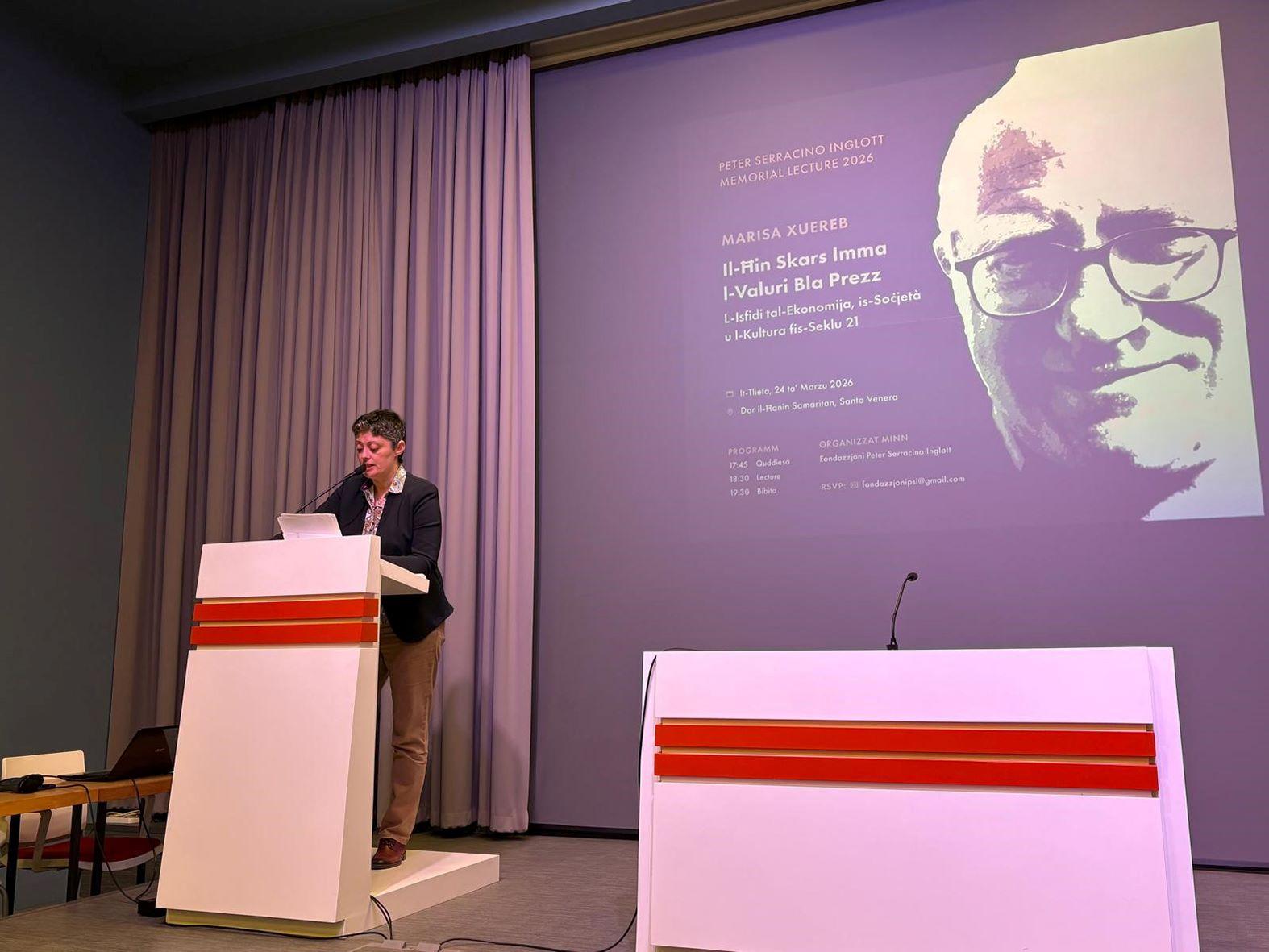 Marisa Xuereb delivering her lecture ahead of the anniversary of the death of Fr Peter Serracino Inglott.
Against the two “tectonic shifts” of the moment – the breakdown of the rules-based international order and AI – she argued Malta needed dialogue.
“We cannot continue pretending we are not part of a troubled world forever. We need to engage beyond making a wish list of what Malta should look like in 2050. And a key to that is how we value time and what use we make of it,” Xuereb said.
In a 1969 article, Serracino Inglott argued that the growing importance of “free time” reflected a basic truth: the worker is not mere;y a worker but a person whose life must be considered as a whole. Xuereb, who has advocated for a five-hour working day, says cutting working hours is not enough on its own.
“The journey towards a better quality of life is not just about shorter working hours. It is also about lifelong learning, in its broadest meaning” – the learning that is required to be able to make good use of free time, she elaborated.
It is critical that we retain the human in the loop
“This is more challenging because it involves making value judgements; developing an appreciation for artistic or sport pursuits that often underpin leisurely social interaction; having an interest in learning not only what is useful to earn a better living but also what contributes to a more engaging life.
“If not for anything else, out of pure jealousy of our time, we should be all out to free ourselves of repetitive tasks and use our time for higher-value activities, even if that requires learning new skills at an older age.”
In a January 2008 Times of Malta interview, Serracino Inglott mused that the previous year had brought economic prosperity but also a widespread sense of dissatisfaction.
“There seems to be a fairly universal desire for some sort of change but only a very dim perception of exactly what sort of change is wanted,” he had said.
If that statement struck a chord in 2008, what would it do now, Xuereb asked.
“Eighteen years later, we are more affluent. The rampant disregard for the environment indicates that, at least, some of us have accepted the primacy of the economy. And that dim perception of the sort of change we want is even dimmer,” Xuereb continued.
“We are, by and large, afraid of what it could cost in terms of the potential trade-offs between material affluence and what we conveniently call well-being, without being able to define it well enough to decouple it from GDP,” she said.