Pigeons were given contraceptive pills. It worked, report concludes
The initiative was nevertheless discontinued due to a lack of financial support
A two-year trial using contraceptive-laced feed cut the feral pigeon population by around 30%, a pest control report has found.
Between October 2021 and August 2023, 45 automatic feeding tanks were installed in 35 localities across Malta and Gozo, targeting areas with high pigeon concentrations.
The tanks had an automated hopper system designed to distribute the right amount of medical feed at specific times of the day.
The project was carried out by the Local Councils Association and pest control expert Arnold Sciberras, with the main aim of reducing the feral birds’ population without resorting to more cruel means, such as shooting the birds dead.
Pigeons have often been reported as a pest in many localities, with residents reporting them and their droppings to be a nuisance.
In the 31-page report, published in August 2023 but only released now, Sciberras said that although an exact figure was hard to establish due to bird movements, the rough estimate resulted in most areas saw a noticeable decline in pigeon populations.
“It was interesting to note that in many sampled areas, the pigeon population experienced a small reduction,” the report reads.
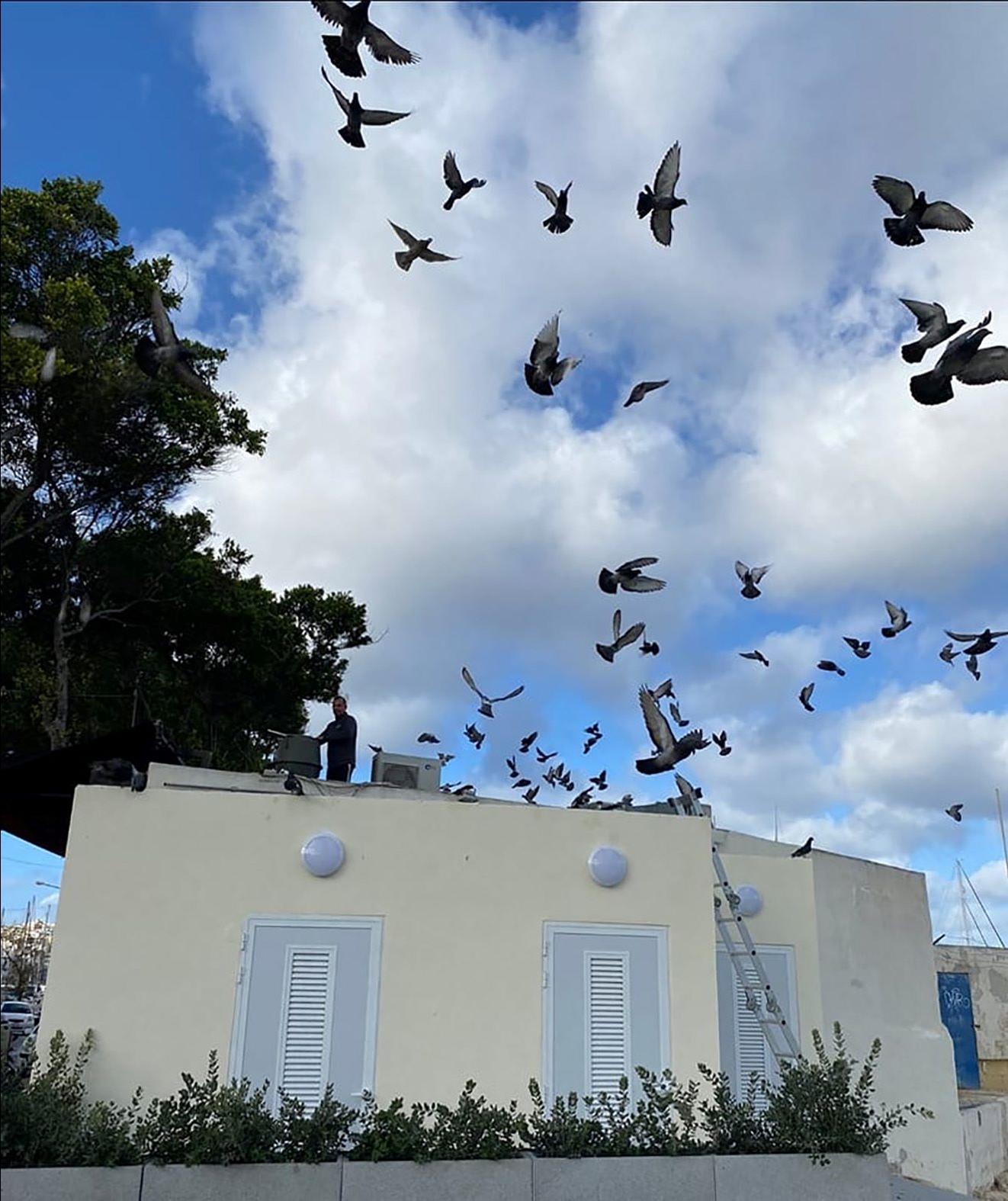 A photo of one of the tanks for the contraceptive feed project in 2023. Photo: Facebook
Sciberras explained how the pigeon populations were sampled using a “point-counts” method, where technicians would conduct 360-degree scans within a 30-metre radius, while counting individual pigeons in the radius.
In Ħamrun, the population fell from 300 to 201 pigeons, while in Floriana, numbers dropped from 820 to 625.
Rabat and Balzan saw smaller declines. In Rabat, the survey shows a drop from 380 to 360, while samples from Balzan’s pjazza saw a drop from 280 to 250.
In cases where the pigeon population increased, Sciberras attributed the growth to tourists frequenting the area and potentially feeding the pigeons or leaving food residue, which would attract a larger pigeon population to the area.
Project halted due to insufficient funding
Throughout the report, Sciberras stressed that for the project to be successful and see a decline in pigeon populations, the project must be consistent and implemented long term.
Yet, the project was not extended beyond its original timeframe due to insufficient funding, the president of the Local Councils’ Association, Mario Fava, said.
He explained that the €360,000 project was funded by the Department for Local Government, which was to cover the project’s operational and management costs.
“No additional financial resources were made available after the conclusion of the initial two-year funding period, rendering the project’s continuation unfeasible,” Fava told Times of Malta.
Fava said the association has continued to raise and discuss the issue of pigeon population management on a regular basis, and to identify effective and sustainable solutions.
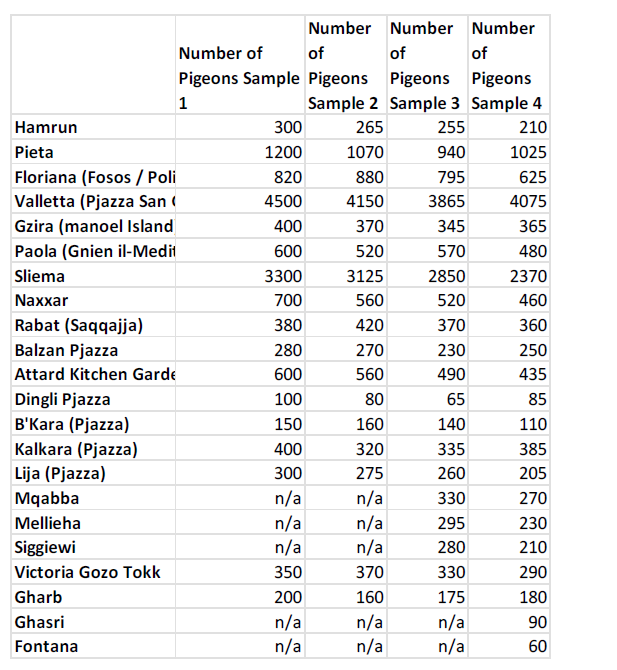 A table surveying the pigeon population in different localities.
He said local councils have received complaints from residents regarding the inconvenience and nuisance caused by the increasing pigeon population.
When asked whether he believes the project should be re-introduced, Fava said discussions should be held with the contractor to ensure the adopted approach is both effective and comprehensive, and hotspots are identified and addressed.
“While this may lead to higher costs, it is essential to take into account the impact of rising prices and ensure that the investment delivers tangible and long-term results,” he added.
Sciberras told Times of Malta that while the project stopped three years ago, he continued keeping a rough estimate of the pigeon population and expects the population to return to around a quarter of a million pigeons within six months.
“We have seen an increase in people ordering pigeon repellents, such as spikes or gels, to place on their buildings,” he said.
“There are also a handful of localities that were involved in the project who have continued to invest privately in the reproductive feed.”
In December, animal activists raised the alarm that the contraceptive feed project failed as it was poorly implemented and that the government allegedly has now turned to culling to control the feral bird population. Questions have been sent to the authorities.