Watch: Over 20 killed as skyscraper crumbles after quake rocks Thailand, Myanmar
Dozens of workers trapped as state of emergency declared
Updated 2.50pm
A powerful earthquake killed more than 20 people across Myanmar and Thailand on Friday, toppling buildings and bridges and trapping over 80 workers in an under-construction skyscraper in Bangkok.
The shallow 7.7-magnitude tremor hit northwest of the city of Sagaing in central Myanmar, and was followed minutes later by a 6.4-magnitude aftershock.
The quake's devastation prompted a rare request for international aid from Myanmar's isolated military junta, which has lost swathes of territory to armed groups.
A state of emergency was declared across the six worst-affected regions after the quake, which the World Health Organization described as a "very, very big threat to life and health".
"About 20 people" were confirmed dead at a hospital in the capital Naypyidaw, a doctor told AFP on condition of anonymity.
Across the border in Thailand, three people were confirmed dead in the collapse of a skyscraper, with 81 more missing and believed trapped in the twisted metal and rubble of the under-construction building.
The quake's worst impacts appeared to be in Myanmar. Hundreds of casualties arrived at a hospital in Naypyidaw where the emergency department entrance had collapsed on a car.
A hospital official ushered journalists away from the area as medics treated patients outside, saying: "this is a mass casualty area."
"I haven't seen (anything) like this before. We are trying to handle the situation. I'm so exhausted now," a doctor told AFP.
AFP reporters saw junta chief Min Aung Hlaing arrive at the hospital as the ruling military called for foreign help.
"We want the international community to give humanitarian aid as soon as possible," junta spokesman Zaw Min Tun told AFP at the hospital.
The rare plea from the junta raises the prospect that damage and casualties may be on a large scale, with Myanmar's medical system and infrastructure ravaged by four years of civil war.
As night fell, AFP journalists saw rescuers trying to extract a mother and son from the ruins of a collapsed building in the capital.
Both were seriously injured but rescuers were unable to reach them, a Red Cross worker told AFP.
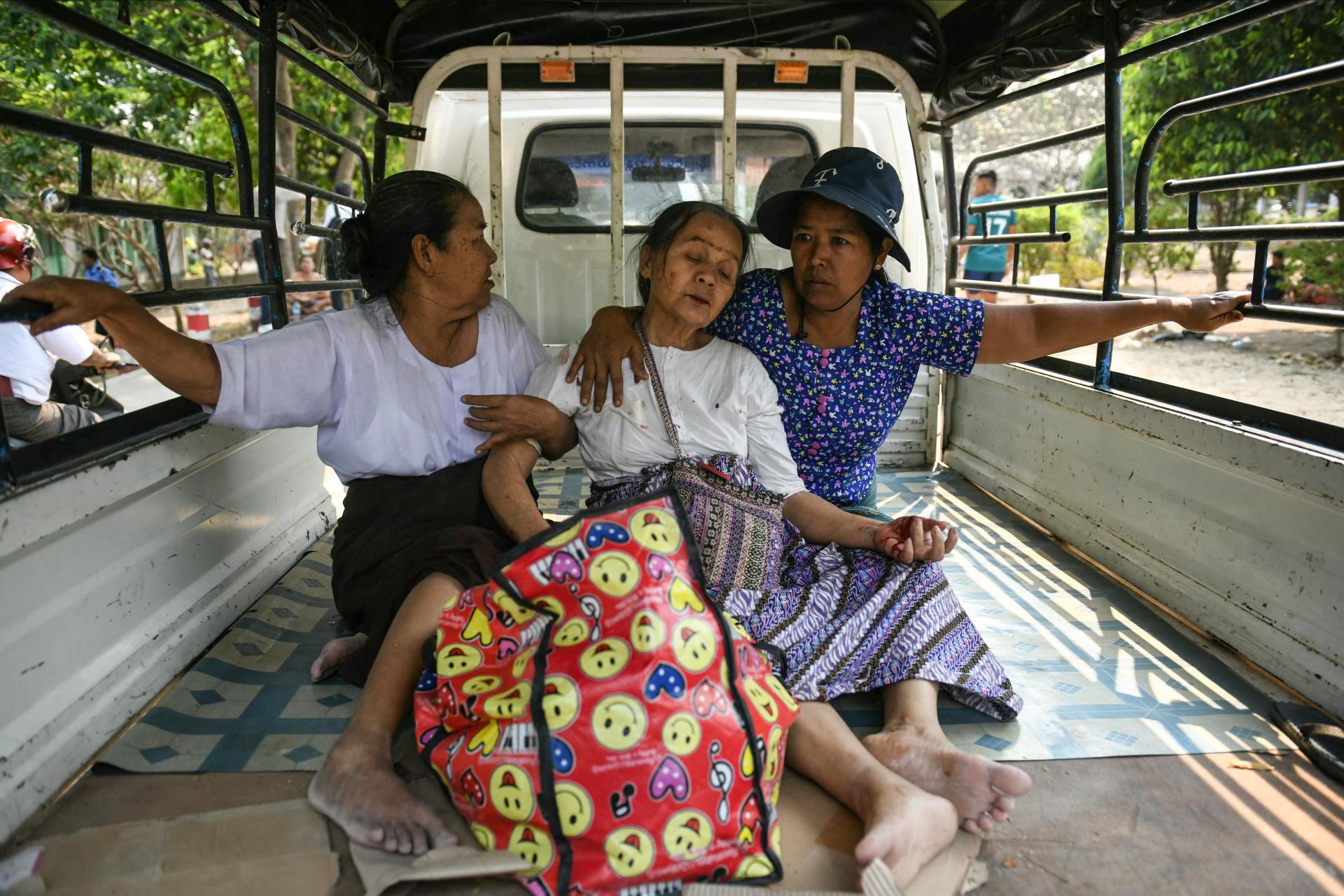 A survivor reacts as she is brought in the back of a lorry to a hospital in Naypyidaw. Photo: AFP
The hospital was a "mass casualty area" after the quake, officials said.
An ambulance made its way between vehicles, a paramedic shouting "cars, move aside so the ambulance can get through."
At the 1,000-bed hospital, the wounded were being treated in the street outside, intravenous drips hanging from their gurneys.
Some writhed in pain, others lay still as relatives sought to comfort them.
The tremors send people into the streets across both countries.
"I heard it and I was sleeping in the house, I ran as far as I could in my pyjamas out of the building," Duangjai, a resident of the popular northern Thailand tourist city Chiang Mai, told AFP.
Sai, a 76-year-old Chiang Mai resident, was working at a minimart when the shop started the shake.
"I quickly rushed out of the shop along with other customers," he said.
"This is the strongest tremor I’ve experienced in my life."
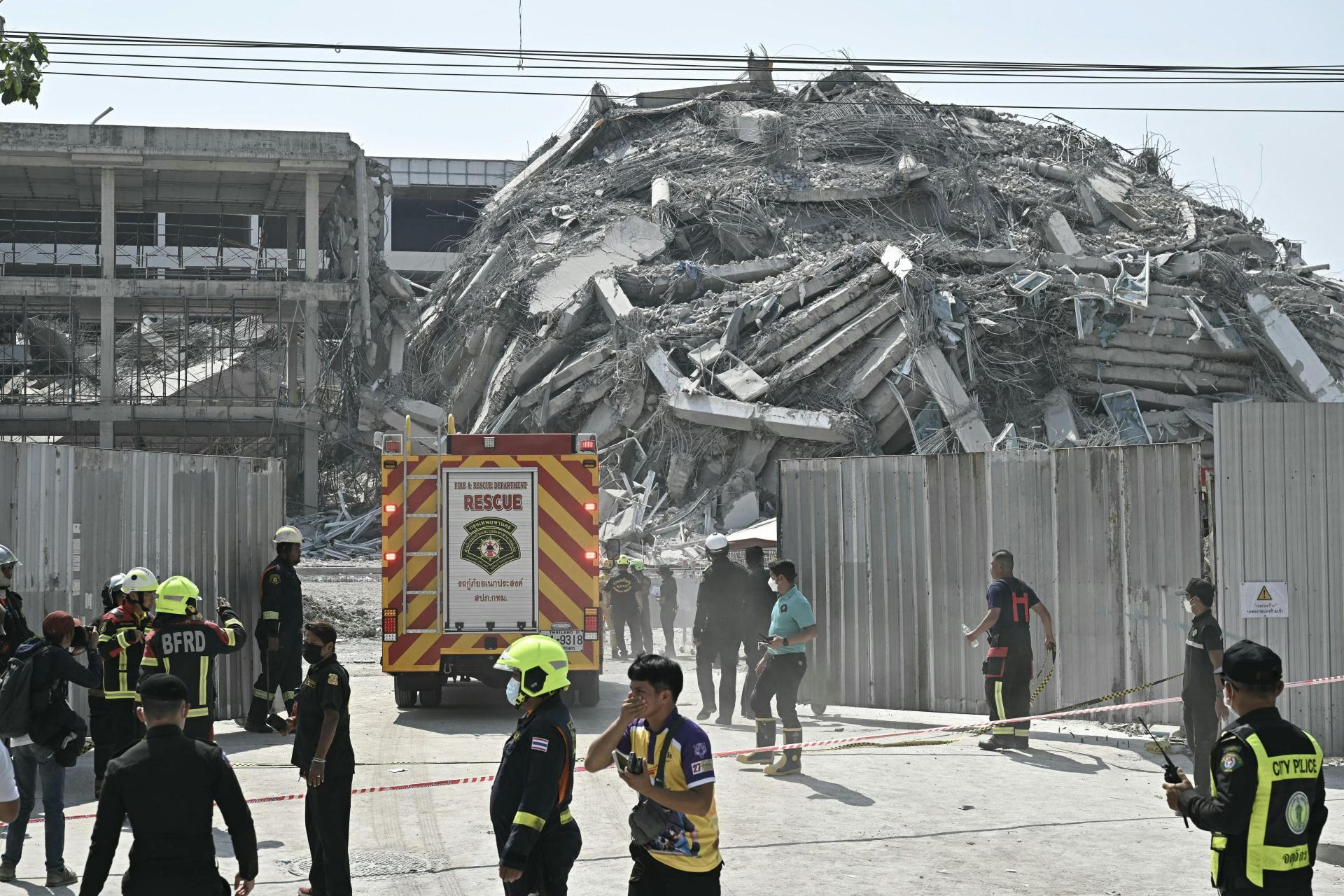 Rescue teams arrive at a construction site where a building collapsed in Bangkok. Photo: AFP
Buildings damaged
The quake forced the suspension of some metro and light rail services in Bangkok, where Thai Prime Minister Paetongtarn Shinawatra declared a state of emergency.
Earlier, she said she had interrupted an official visit to the southern island of Phuket to hold an "urgent meeting" after the quake, according to a post on X.
Tremors were also felt in China's southwest Yunnan province, according to Beijing's quake agency, which said the jolt measured 7.9 in magnitude.
Earthquakes are relatively common in Myanmar, where six strong quakes of 7.0 magnitude or more struck between 1930 and 1956 near the Sagaing Fault, which runs north to south through the centre of the country, according to the USGS.
A powerful 6.8-magnitude earthquake in the ancient capital Bagan in central Myanmar killed three people in 2016, also toppling spires and crumbling temple walls at the tourist destination.
The breakneck pace of development in Myanmar's cities, combined with crumbling infrastructure and poor urban planning, has also made the country's most populous areas vulnerable to earthquakes and other disasters, experts say.
The impoverished Southeast Asian nation has a strained medical system, especially in its rural states.