Artists, activists call on Malta to suspend Eurovision participation over Israel
Protesters say music cannot be politically neutral
Several hundred people, led by the President Emeritus Marie Louise Coleiro Preca, marched through Valletta on Saturday, calling on the government to suspend Malta from the Eurovision Song Contest as long as Israel remains a participant.
The protest, which started outside Parliament and ended at the Culture Ministry, forms part of the campaign Malta: No Music for Genocide. The campaign follows the European Broadcasting Union’s decision to allow Israel to compete in this year’s contest.
Among the demonstrators were activists, artists and members of the public who argued that music and culture cannot remain politically neutral in the face of war.
Protesters marched through the capital, chanting “no music for genocide”, “Boycott Israel” and “Boycott Eurovision”.
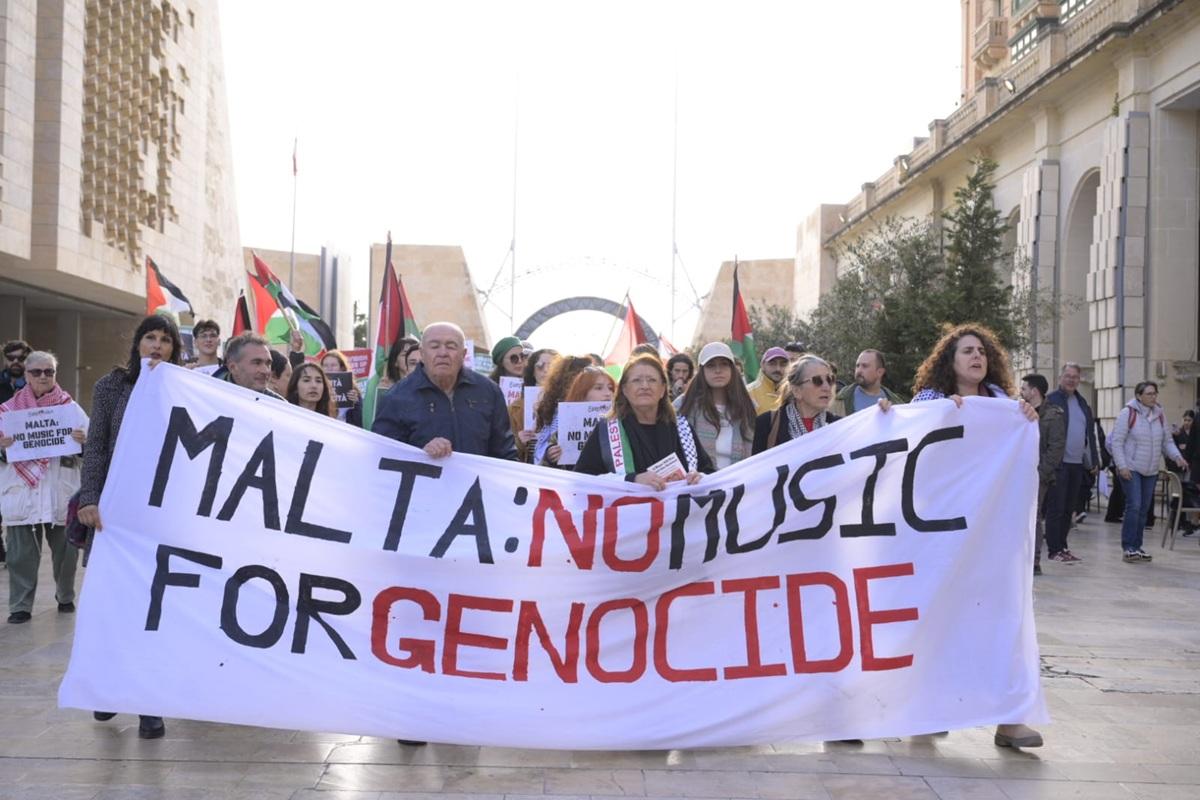 The protest started outside parliament and continued through Valletta ending outside the Culture Ministry. Photo: Matthew Mirabelli
Iceland, Ireland, the Netherlands, Slovenia and Spain have all opted not to participate in the 2026 edition of the Eurovision Song Contest being held in Vienna in May in protest against the inclusion of Israel in the context of the war in Gaza.
Culture Minister Owen Bonnici has gone on record saying that Malta should not withdraw from the competition, and encouraged what he described as a "culture of dialoge" instead.
Speaking outside the Culture Ministry, Moviment Graffiti’s Andre Callus insisted "we cannot be silent as Maltese, and we cannot be silent as human beings.”
He added that the value of music is that it brings people together. "And while we have valued Eurovision in the past, it is precisely because of that value that we now have an opportunity and obligation not to take part in this celebration of genocide.”
Joanna Jebaili from Lebanese Advocates said the movement stood for justice. “We do not fight hate, we fight injustice, occupation and settlers,” she said.
“We do not permit for bloody hands to be washed.”
Jebaili said protesters were mobilising not only for Palestine but also for Lebanon, describing ongoing raids there despite a ceasefire.
In recent days, Israeli air strikes have reportedly killed at least 10 people in Lebanon. Israel’s military said it targeted sites belonging to Hezbollah. According to the BBC, Israel has carried out near-daily strikes on Lebanon.
Maria Galea, president of the Malta Entertainment Industry and Arts Association (MEIA), criticised what she described as institutional silence. She said public funds allocated for Eurovision participation could instead be redirected towards long-term support for Maltese music.
“Culture isn’t just productions, content and spectacles but also space for values, positions and choices. Our responsibility doesn’t end at the creation of the work but how and where it is shown and what message is being sent from it,” Galea said.
She added that “art should never be used to hide violence.”
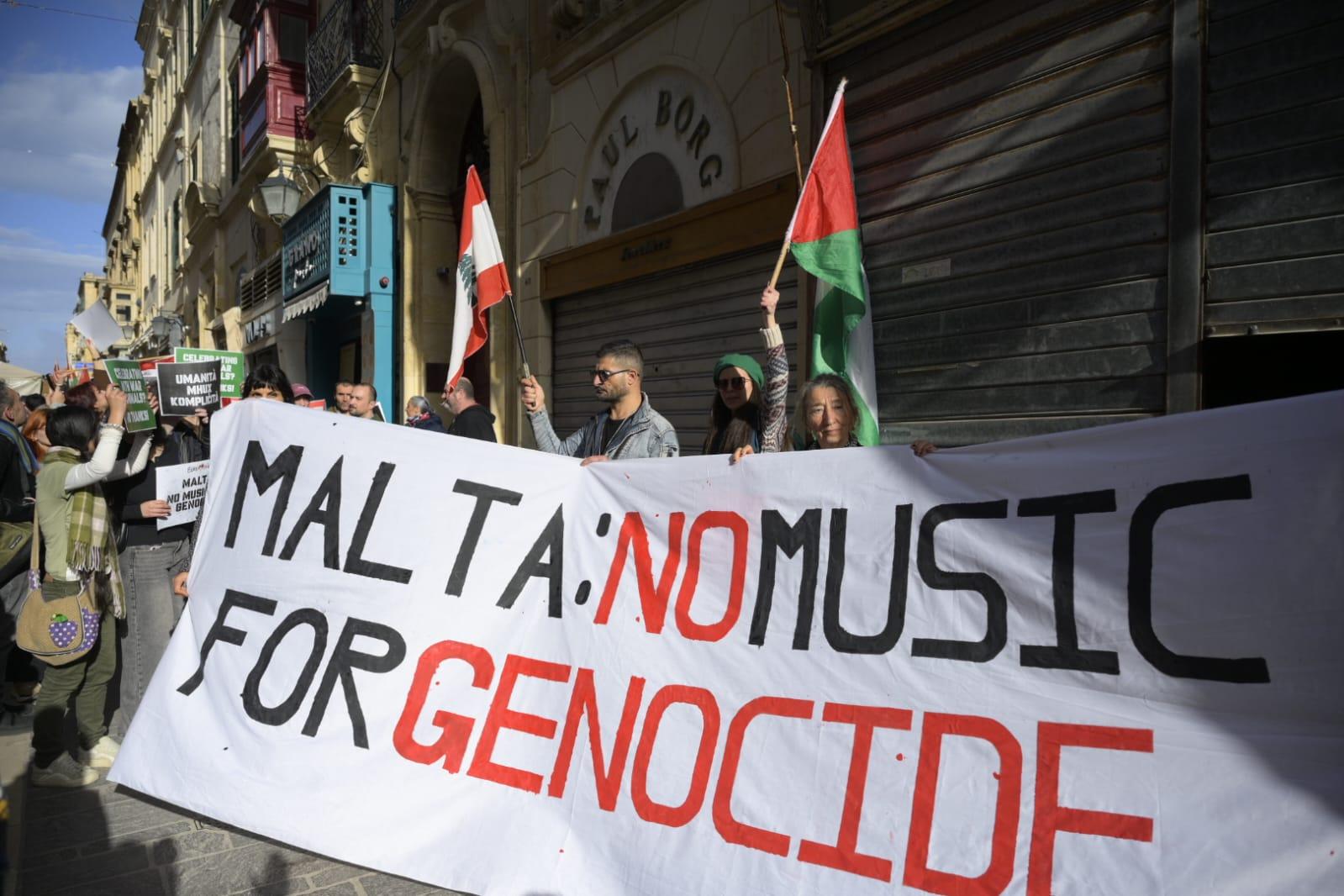 Protestors on their way to the culture ministry. Photo: Matthew Mirabelli
Amy Marie Abela from Moviment Graffitti addressed criticism that politics should be kept out of art.
“For the people working on this campaign, it never even crossed our minds to separate politics from art,” Abela said.
"This is because we know that artistic expression is bound to the conditions of life and of the society to which a person belongs.”
Responding to critics, she read the poem “If I must Die” by Refaat Alareer, a poet and professor of English at the Islamic University of Gaza who was killed by Israel two years ago for his artistic activism.
“The reality is that Israel is systematically destroying the Palestinian people. Maltese artists deserve better than a context that is being stained with Palestinian blood which Israel is shedding,” Abela continued.
David Zammit from Ġustizzja għall-Palestina said Eurovision was created "to unite and promote peace, but now it is being used to normalise genocide and the violations to international law. Music should never be used to promote genocide, apartheid and ethnic cleansing.”
Zammit also noted that Russia did not compete in the competition after invading Ukraine, arguing that the same principle had not been applied to Israel.
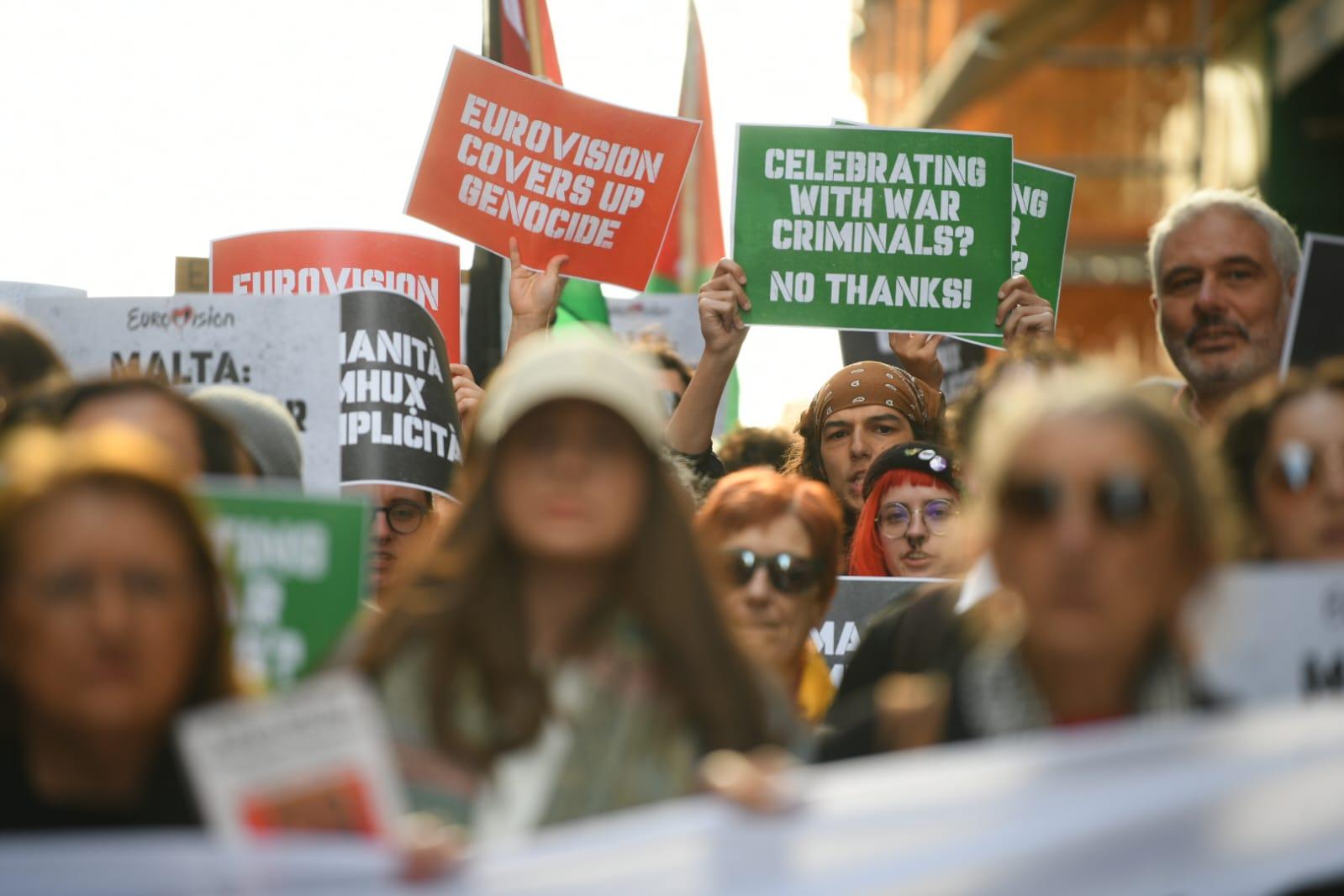 Demonstrators holding placards as they made their way through the capital Photo: Matthew Mirabelli
Artist Angele Galea questioned how much the ceasefire is holding as she described speaking this week to a Palestinian film director whose family members had been killed and whose studio had been destroyed. She said he had to go to a hospital to access the internet.
“It’s like we can’t see and don’t know that genocide is happening. Did we forget that we are the same people who said, ‘Yes, I am Maltese!’? We can never accept this whitewashing, as if Palestinians deserved to be eliminated. We don’t accept that.”
On Friday, the respected medical journal The Lancet Global Health estimated that 75,200 Palestinians were killed in Gaza between October 7, 2023 and January 5, 2025. Women, children and the elderly comprised around 56 per cent of the deaths.