Religions and our common humanity: ‘Nostra aetate’, 60 years on
Through the document, the Second Vatican Council offered to take a closer and appreciative look at non-Christian religions
After almost three-quarters of a century, the reception and implementation of the Second Vatican Council are still a work in progress.
Nostra aetate (‘In our time’), published on October 28, 1965, certainly deserves all the attention it received. This document was a ‘Declaration on the Relation of the Church to Non-Christian Religions’.
Strategically, it stressed the anthropological rather than the doctrinal, seeking to be empathetic in mood rather than analytic. Systematic theologians would be quick to underline the residual tension between dialogue and orthodoxy.
Pastorally sensitive and unexcited by polemic, the Council offered to take a closer and appreciative look at non-Christian religions. Atheist philosopher Tim Crane recently defended the value of religious belief for the intrinsically human goods that most religions have to offer, whether through “refined concepts” or “mystical and ascetical” attempts to address the deepest longings of our mind.
Like Crane, the Council would strongly disagree with the blanket shunning of all religions by the “new atheists” who branded theistic belief as nothing but “delusion”.
In its anthropology, the document is not incompatible with William James’s classic The Varieties of Religious Experience, which advocated a pluralistic and non-essentialist account of religion.
Although not quite a precursor to Karen Armstrong, who said that “there is no universal way to define religion”, Nostra aetate confidently asserted that, “the Catholic Church rejects nothing that is true and holy in these religions”.
A philosophical frequency was preferred, instead, which opened up new pastoral and ethical avenues facilitating the confident and hopeful rapprochement embraced by all the popes since the Council.
The first part of the document advocated a universal embracing of “dialogue, collaboration, prudence and love” as the proper Christian approach to all other religions.
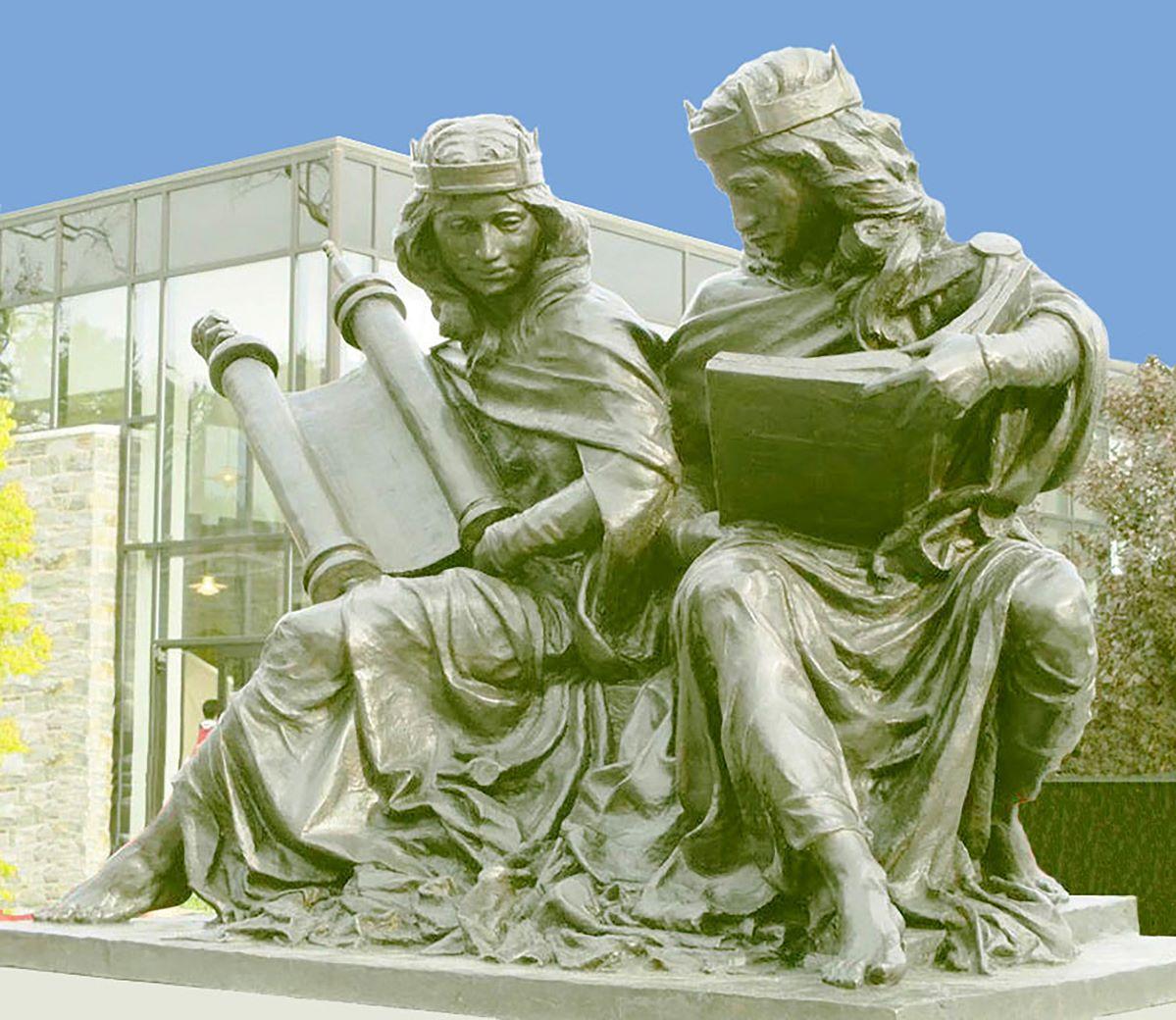 Synagoga and Ecclesia in Our Time (2015), a sculpture by Joshua Koffman at the Jesuit-run St Joseph's University, Philadelphia, commemorating Nostra aetate. Photo: Calimeronte/Wikimedia Commons
An eagerness to pave the way for interreligious dialogue can be seen from a reluctance to cast the question within the framework of salvation (also known as soteriology), knowing that, on that topic − central to Christianity − most of the other religious systems are largely silent. This new approach left the door ajar to allow for a renewed and, at times, rediscovered theological understanding of whether and how other religions could also be redemptive.
Decades later, Cardinal Walter Kasper would declare the toughest hurdle in Jewish-Christian relations in recent decades to have been that of the Shoah. The unspeakable crimes committed against the Jewish people in the previous century would thus not only force a radical rethink on interreligious dialogue but also indelibly shape the way Christians viewed their “elder brothers” in the faith.
A cool Gospel citation reminds us that “Jerusalem did not recognise the time of her visitation” but the declaration also underlined St Paul’s declaration to the Romans that God’s fidelity towards the Jewish people as the privileged elect would never be rescinded.
In 1959, Pope St John XXIII had already removed the defamatory petition “pro perfidis Iudaeis” from the Good Friday universal prayers. An entire paragraph of the document now insisted that it would be a grave error to attribute the death of Jesus to the Jewish people as a whole, both then and now.
Nostra aetate signalled a fresh beginning in Jewish-Christian relations
Please note that the Council of Trent had already stated that Christians are also implicated in the passion of Jesus whenever they wilfully turn their backs on their Lord and Saviour.
Nostra aetate signalled a fresh beginning in Jewish-Christian relations. Decades of hopeful exchange followed, leading to a paradigm shift in the ecclesiastical politic. The document paved the way for Pope St John Paul II’s uncompromising defence of the common humanity that we all share, declaring any form of religious hate unacceptable.
The catastrophic scandal that was the Shoah was only exacerbated by the fact that the neo-pagan regime that perpetrated it was met with insufficient opposition from the predominantly Christian culture that might have prevented it in the first place.
Questions on many different fronts abound. For instance, the vertiginous changes that now make it increasingly difficult for us to distinguish between the virtual and the real and where, for many of us, the virtual has in fact become more real. The radically digitalised way in which we live out our personal and social lives seems to flatten out the desire for transcendence.
In the face of the most pressing questions asked throughout the history of philosophy and theology, it would be a mistake to presume such questions could be easily resolved by the empirical sciences.
A persisting question is that there seems to be no adequate Christian theology of Judaism, although Christians are encouraged to acknowledge their roots in the one ‘People of God’. The language of supersessionism has largely been discarded, while declarations such as the 1998 letter ‘We Remember: A Reflection on the Shoah’ offered much healing following centuries of distrust. Nevertheless, while Nostra aetate, together with the teaching of Lumen Gentium, brought a momentous change in Jewish-Christian relations, the history of that relationship is complex and defies facile disambiguation.
At the turn of the second millennium, the Catholic Church still felt the need to publish Dominus Iesus in order to remind its faithful of where their core priorities should be. That declaration was signed by the same man who later, as Pope Benedict XVI, would pioneer a theology that still recognised and honoured the unique vocation and mission of Israel, “the taproot of the Christian faith”.
A distinction would be made between religious belief and theological faith, the former being a natural, the latter a supernatural quality. Alas, the excitement of that important debate, dampened by an uncritical religious relativism, needs to be revived within a pastoral as well as academic setting.
Sketchy and dense as Nostra aetate may have been, it certainly lit a fire somewhere that still promises to sustain the hounding search of the human soul and the creative ways in which some responses to that longing may be properly discerned.
Fr Christopher Caruana, OP, is a visiting lecturer at the University of Malta.