Revised 40-storey Paceville tower ‘will overshadow Swieqi homes’
Developers are hoping to increase the height from 33 to 40 floors
A proposed 40-floor tower in Paceville will cast morning shadows on homes in Swieqi and Paceville and cause “irreversible” changes to panoramic views from other parts of the island, according to a new environmental impact assessment.
The report, prepared by consulting firm @econsulting, updates a previous impact assessment into two development applications linked to the project, approved in 2022 and 2023.
Since then, project developer Paul Xuereb has applied to enlarge the project’s footprint and raise the tower’s height from its previously approved 33 floors to 40 storeys (PA 4313/25), triggering a new impact assessment.
Aside from the increased footprint, the new plans reveal how the tower’s aesthetics have also been completely revisited. Gone is the idiosyncratic perforated facade that some had likened to a honeycomb or a cheese grater, with a more conventional design now in its place.
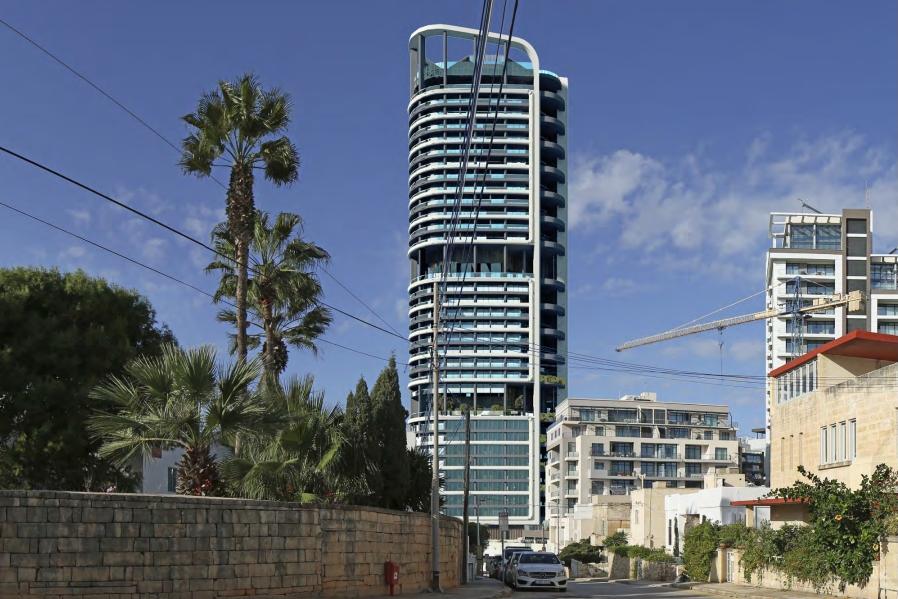 A photomontage of the proposed tower. Photo: @econsulting
Following the impact assessment, the Environment and Resources Authority will have to decide whether to greenlight the revised project.
The tower on Triq Santu Wistin and Triq Elija Zammit is set to include residential apartments, a hotel with rooftop bar, as well as office space and commercial outlets. It will also feature an open piazza at ground level.
The impact assessment outlines how the tower’s shadow will affect residents at different times of the year.
Swieqi residential areas will be impacted between dawn and 10am from March to September and those in Paceville will see shadows between 9am and noon in March and September, the report says.
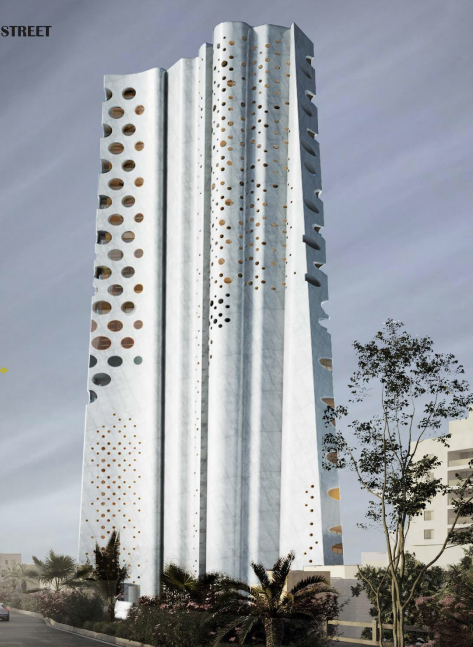 The original tower’s idiosyncratic honeycomb aesthetic had raised eyebrows when the project was first proposed. Image: PX Lettings
Other areas in the vicinity, such as commercial and hospitality establishments in Triq Santu Wistin, will be affected between 10am and 1pm throughout the year. Those to the east of the tower will experience shadows from 3pm throughout the year.
The shadow will also briefly reach St George’s Bay in December, the report says.
Nevertheless, the report describes the impact on residential areas as “low given the limited temporal duration”, noting that some commercial and hospitality outlets will face “moderate” impacts.
The report also shows that the tower will be visible from scenic viewpoints across the island. The proposed increase in the tower’s height means that its top two floors will now be visible from Għargħur’s Għaxqet l-Għajn (Top of the World) and the Kalkara belvedere, causing a “moderate to major” visual impact from the latter site.
The tower will be “an additional detail on the skyline” from some other viewpoints, standing alongside several other towers already built in the area, the report suggests.
Planning Authority documentation shows that the revised project’s increased height and footprint also drew the attention of the superintendence of cultural heritage, which requested an updated visual study before declaring itself on the project.
The report lists other potentially adverse impacts, including higher light pollution and an initially “moderate” increase in PM10 pollutants, recommending measures to mitigate impacts.
However, the report also outlines a series of beneficial impacts brought by the project. Most prominently, the report outlines improved land use, with the project set to “make efficient use of the site while increasing the extent of accessible public spaces that promote pedestrian traffic”.
The project will also have a positive impact on the area’s traffic management, once Infrastructure Malta’s plans for a new junction in the area are completed, according to the assessment.
The development is also considered to have a positive impact on the area’s biodiversity, given that it is expected to eradicate invasive and alien plants currently on the site.