Rise and fall of Centro Militare ‘G’, the Royal Italian Army’s ‘Maltese unit’
This special centre for volunteer soldiers set up from May to September 1942 in anticipation of the planned Axis invasion of Malta, which was subsequently aborted
Order no. 118 of the Regio Esercito (Royal Italian Army), issued on March 9, 1942, stated that 30 personnel gathered for a required operation, without saying what it was for. Their preparation and training was to be reported by Capitano Armando Pantaleo of the Servizio Informazioni Esercito (SIE).
The operation’s aim became clearer on May 5, 1942, with the establishment of a ‘centre’ for volunteer soldiers to take part in the planned Axis invasion of Malta. The centre was set up in the Italian municipality of Soriano nel Cimino, in the Viterbo province in Lazio, where there were already 15 servicemen from various branches of the Italian armed forces.
The volunteers were to be equipped like ordinary Italian soldiers. In fact, several orders were issued to procure clothing, equipment and weapons for them, which were to be sent to the centre’s command base at Albergo San Giorgio in Soriano al Cimino, to be distributed to the volunteers.
The volunteers were to receive military training of the rank of ordinary Italian soldiers, besides good food rations. It was proposed to pay each volunteer 10 Italian lire during their stay at Soriano al Cimino and 25 Italian lire while they remained in service within the centre.
Seven days later, on May 12, 1942, the centre was officially named Centro Militare ‘G’. There was no fixed number of officers and troops, and by June 11, 1942, there were 36 men in the unit.
However, as the unit still did not have uniforms, an urgent call was made to authorise the provision of 60 sets of material of different lengths to produce the necessary uniforms. On the same day, another order was issued for the delivery of a shirt, a pair of trousers, and a side-cap, in different sizes, for the centre’s personnel. These uniform items had to be sent to the Viterbo military district by June 15.
On July 27, ‘Operazione C3’ – the proposed Axis invasion of Malta – was officially scrapped, with the Italians finally accepting it was no longer feasible
The centre was to be under the command of the SIE, led by Colonello Edmondo De Renzi, and supported by Capitano Cavaliere Lamberto Negri, of the Stato Maggiore (general staff).
A document lists the following names and ranks of the members of Centro Militare ‘G’, and the in most cases, the units they formerly formed part of: Capitano Francesco Negri; Tenente Camillo Bonanno, formerly Comando Superiore Forze Armate della Grecia; Tenente Oscar Consiglio; Capo Manipolo Liberto Manlio, ex-MVSN; Capo Manipolo Medico Alberto de Caro, ex-MILMART, Roma; Capo Manipolo Alberto Scerri Cerro; Capo Manipolo Paolo Chetcuti (father Ignazio), ex-92a Legione Camicie Nere, Firenze; Sottotenente Vincenzo La Rosa, ex-Stato Maggiore dell’Regio Esercito − Servizio Informazioni Esercito (SMRE – SIE); Sottotenente Cardenio Botti, ex-SMRE – SIE; Sottotenente Giovanni Mazzone, ex-SMRE – SIE; Sottotenente Archimede Izzi, ex-240 Autoreparto Misto P.M.85 (A.S.); Sottotenente Salvatore Consoli, ex-Deposito 24 Regimento Fanteria Gradisca d’Isonzo; Sottotenente Giuseppe Mazzola, ex-Comando Difese Territoriale Albania, Posta Militare 22A; and Sottotenente Medico Mario Cherubino, ex-840 O.C. – P.M.70.A (Albania).
Stefano Fabei, who has written extensively about foreign volunteers in the Regio Esercito during World War II, lists more members in this Italian-raised Maltese unit in his book La Legione Straniera di Mussolini. These include Sergente Franco Liberto, Enrico D’Ancona, Salvatore Marletta, Renato Strati, Guerino Giuffrida, Giuseppe Reitano, Francesco Merola, Giuseppe Marsala, Salvatore Marsala, Carmelo Marsala, Pietro Consiglio, Palermo Navarra, Benzoni, Mulé, Tiralongo, Pardo and Fucile. The last five members were listed without their Christian name.
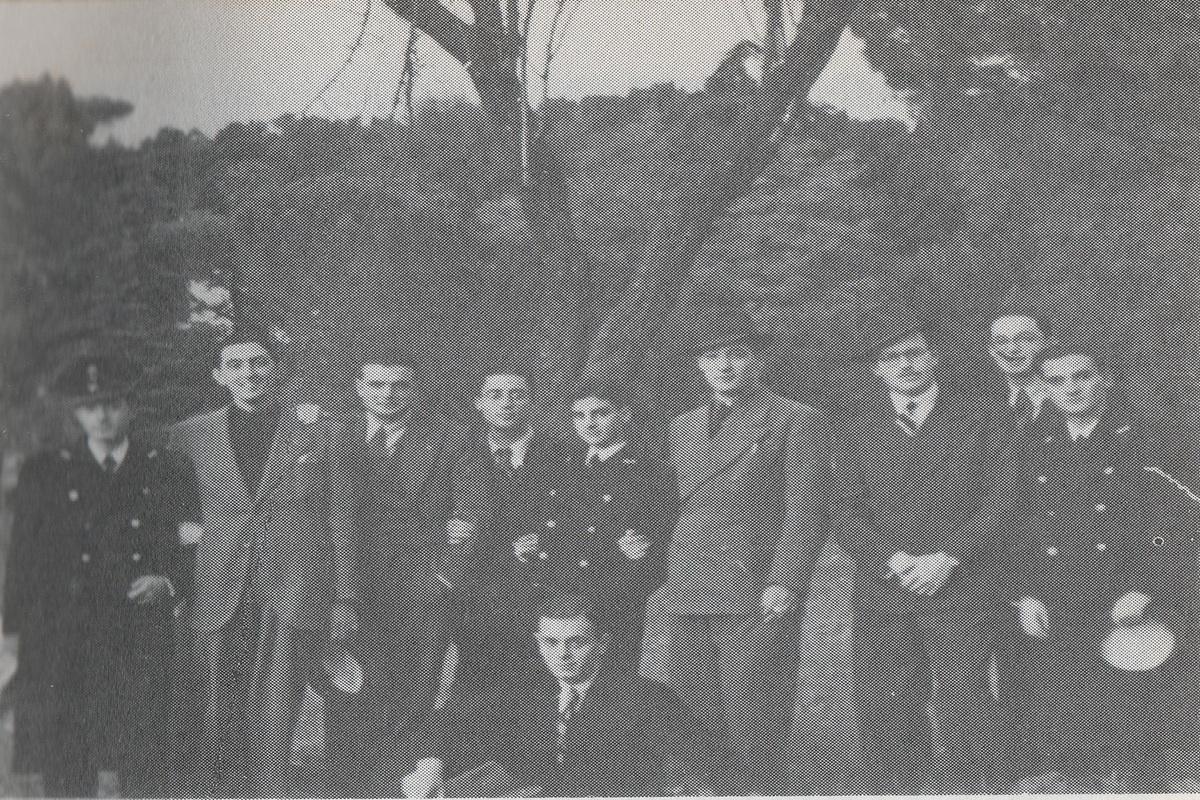 At the public park of Pincio, Rome (from left): Camillo Bonanno, Carmelo Leone Ganado, Carmelo Borg Pisani, Willie Apap (seated) and V. Diacono, with unidentified individuals. Photo: Laurence Mizzi, Għal Ħolma ta’ Ħajtu
The Maltese volunteers in the centre were to be trained as interpreters and guides. The centre also drafted an essential Italo-Maltese vocabulary for the soldiers assigned to the landing.
The training was conducted by Capitano Cardenio Botti, an Italian music teacher who had been in Malta from 1923, and had directed the La Vallette Philharmonic Society. However, he had been expelled from the island in 1933 for his fascist sympathies. Botti was supported by the sottotenenti Giovanni Mazzone and Vincenzo La Rosa.
In addition to the volunteers’ physical preparation with long marches and gymnastic exercises, the training consisted mainly in the study of the geography of the Maltese archipelago. Using a large model, the personnel trained to memorise various itineraries relying only on orography and reference points such as religious buildings and structures of particular importance.
On July 17, another Maltese volunteer, Oscar Consiglio, joined the centre at Viterbo. However, he did not remain there long because an urgent order was issued for his transfer by air to North Africa on August 21 due to his knowledge of the English language and the urgent need of an interpreter. On August 26, another order was issued for Sottotenente Archimede Izzi to also be transferred to North Africa.
However, on July 27, ‘Operazione C3’ – the proposed Axis invasion of Malta – was officially scrapped, with the Italians finally accepting it was no longer feasible.
On August 20, 1942, a few days after the arrival in Malta of the Operation Pedestal convoy (August 15), an order was issued for the Centro Militare ‘G’ to be disbanded. This was carried out by the end of the month. On September 4, Giuseppe Mazzola was recalled to Albania.
Many of the personnel returned to their original units, but others, such as Camillo Bonanno and Giovanni Mazzone, were assigned to the counter-espionage office of the Servizio Informazioni Militare (SIM) and later to the Servizio Informazione Difensive (SID).

Charles Debono is a senior researcher at the National War Museum.