Saharan dust to linger until Friday, affecting air quality across Malta
People with respiratory conditions advised to stay indoors
Updated 5.30pm
The Saharan dust is expected to linger in the air throughout the week, negatively impacting air quality, particularly for people with respiratory conditions such as asthma.
A spokesperson for the Meteorological Office explained that the Saharan dust, which is making the air feel murky and dusty, moved into the Central Mediterranean region on Saturday and is expected to persist until Friday.
“Currently, we have an area of low pressure over Algeria and extending to Sicily and it is gradually moving eastwards. This has brought about the hazy conditions due to dust suspended in the air and 'blood rain' [a phenomenon where rain appears reddish due to dust particles]. Instability will persist throughout the week, with rain or showers – occasionally thundery – expected," the Met office said.
But a change in airmass will bring about good visibility and the resulting precipitation will eventually wash away the dust accumulated lately. The dust should clear the central Mediterranean by Friday, it said.
The Envionment and Resources Authority said Malta was experiencing a "significant" amount of Saharan dust leading to increased PM10 and PM2.5 levels - fine particulate matter.
Respiratory concerns
This weather is of particular concern to people who suffer from respiratory conditions. The Saharan sand is considered to be a PM10 pollutant - particulate matter smaller than 10 micrometres in size.
Over the past days, the air quality index on the website of the Environment and Resources Authority showed that the air quality in the five monitoring stations was ‘poor’ or ‘very poor’ and this was ‘due to PM10 pollutants’.
Respiratory physician Prof. Stephen Montefort said that this high level of sand dust in the air affects people with conditions like asthma.
“Although sand is mostly made of relatively big particles that do not penetrate deeply into the lungs - but can get lodged in the nose or upper airways - they can still cause irritative issues in asthmatics’ airways," he said.
"These particles can carry allergens as well as viruses and bacteria. People who suffer from respiratory conditions, such as asthma, should be careful and try to stay indoors as much as possible and, once outside, can use protection such as masks. It is also imperative that they continue to use their usual inhalers,” he said.
Even people who do not suffer from asthma, he added, could be adversely affected by these sandy conditions.
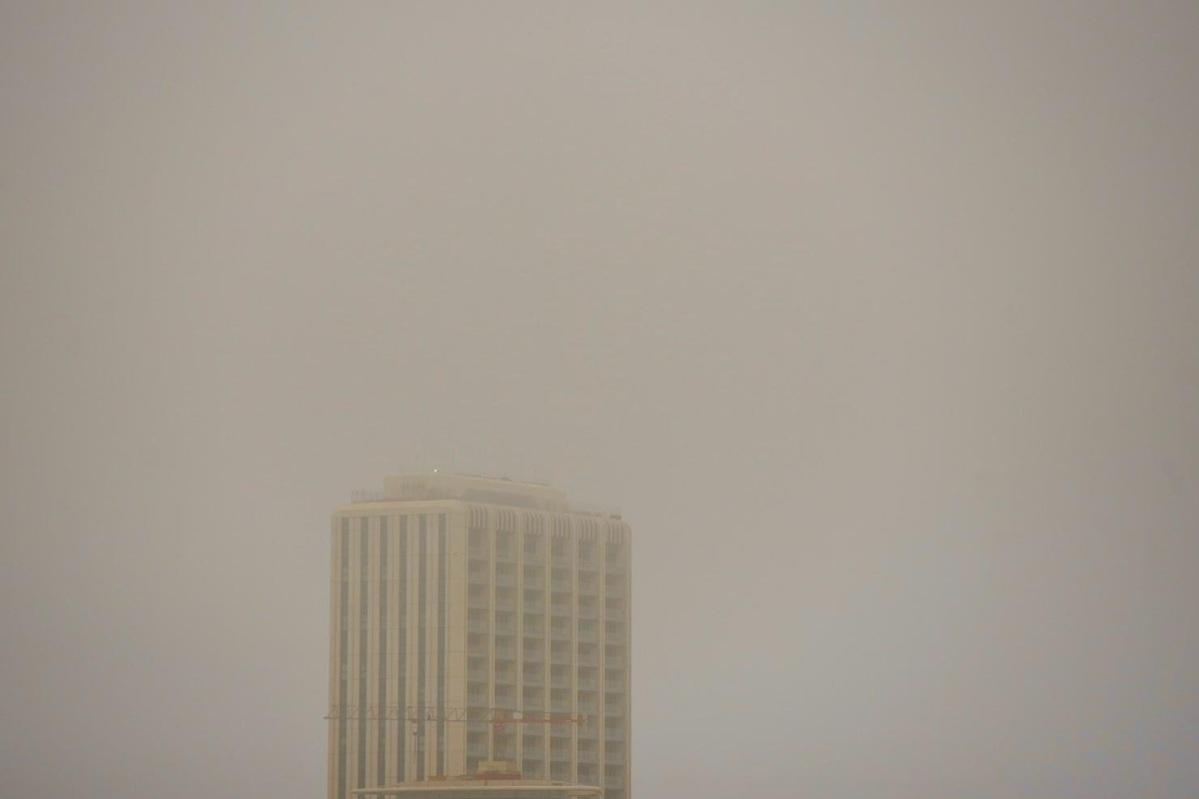 Hazy air engulfs Mercury Towers as Saharan dust is expected to linger for the rest of the week. Photo: Chris Sant Fournier
Strong wind warning ahead
Meanwhile, the Met Office added that, so far, 41.2mm of rain had been measured in March, with the norm for March standing at 39.7 mm. The temperature norms for March are a maximum of 17.4°C and a minimum of 10.9°C.
“From today up until this coming Monday, the air temperature will be close to the norm with the minimum temperature being a few degrees above average,” the Met Office said. Strong wind warnings – from a west-northwest direction - are expected to be issued from Wednesday to Saturday and possibly on Monday.