Saharan dust muddies Malta's springtime skies; air quality hits dangerous levels
Weather depression extending across Mediterranean sends air quality plummeting
A dense cloud of Saharan dust settled over Malta on Monday, turning skies a hazy grey and sending air quality indexes plummeting.
The suspension of dust, a regular meteorological event in the central Mediterranean and carried by strong southerly winds, also reduced overall visibility across the Maltese islands.
Air quality monitors maintained by the Environment and Resources Authority (ERA) flagged extremely high PM10 levels starting from overnight. PM10 readings measure volumes of coarse airborne particles in the air.
Local air quality tracker arja.mt, which compares ERA readings to World Health Organisation recommended limits, warned of “extremely poor” air quality across Malta and Gozo, with readings for both PM10 and finer PM2.5 particles above global guidelines.
In Żejtun, for instance, PM10 readings were more than 12 times higher the WHO recommended limit. In Attard, PM10 readings reached 14 times the WHO average.
The 'Xlokk' effect
The intense haze is the result of specific atmospheric conditions pulling vast quantities of sand directly from the Sahara Desert.
Speaking to Times of Malta, the Meteorological Office confirmed the event is being driven by a weather depression over Sardinia, which extends down to Libya and is slowly moving northeastwards.
"Due to this, the weather is currently hazy due to dust in suspension being advected from the Sahara," a Met Office spokesperson said.
While the thick layer of atmospheric dust visibly reduces the amount of direct solar radiation reaching the ground, the Met Office explained that the suspended particles also trap heat, creating a localised warming effect across the islands.
Air temperatures are forecast to remain warm, fluctuating between highs of 23°C and lows of 14°C throughout the week.
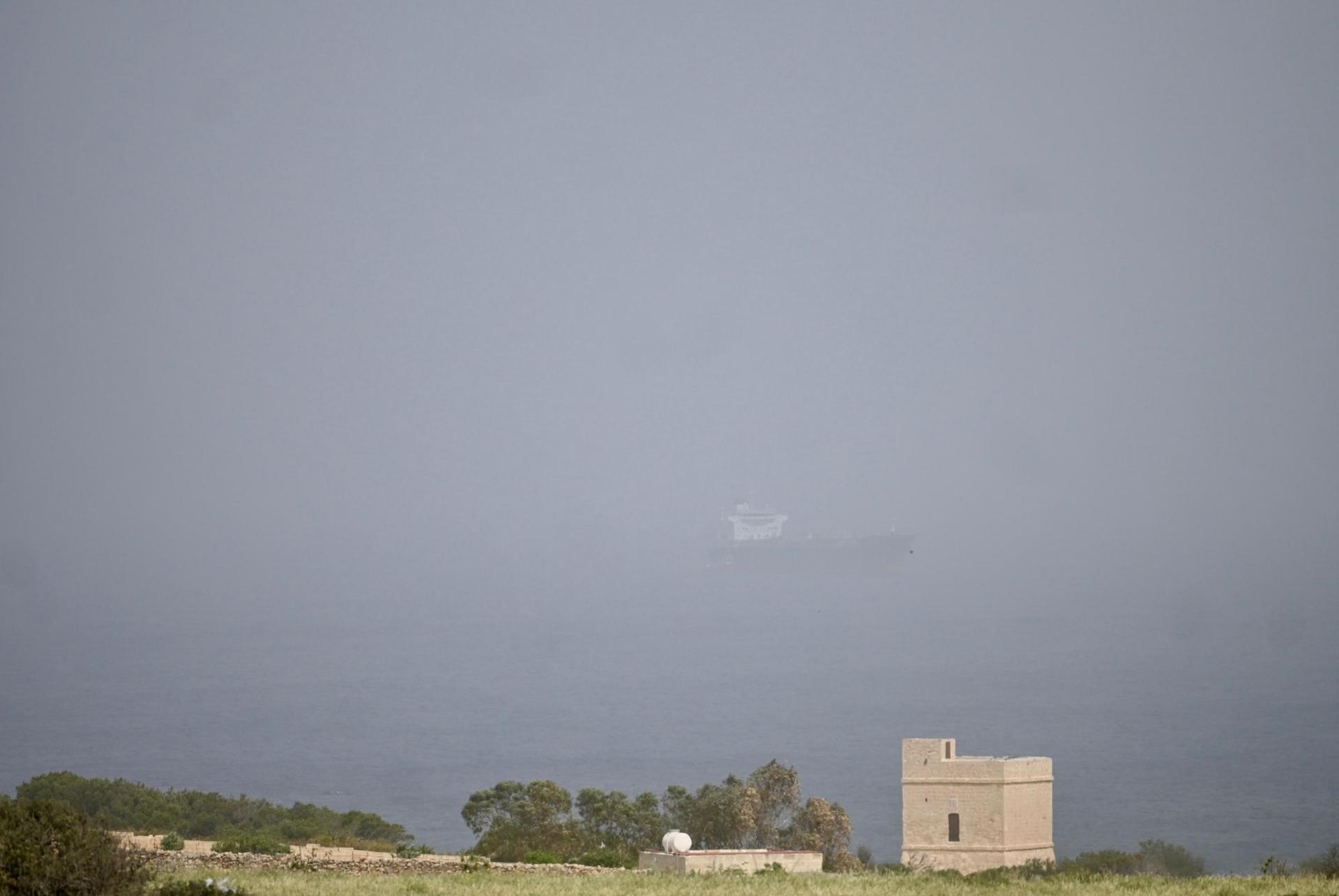 A tanker can be faintly seen out at sea through dust-filled skies. Photo: Jonathan Borg
As winds sweep across the Sahara, they lift millions of tonnes of tiny sand and mineral dust thousands of metres into the troposphere. Upper-level winds then carry this particulate matter hundreds of kilometres north, across the Mediterranean Sea.
When rain washes those particles downwards, the result is the so-called ‘blood rain’ that leaves floors, windows and vehicles looking muddied. If there is no rain, those particles remain suspended in the air and cause the hazy effects seen on Monday.
Effects
The primary concern during such weather events is on public health.
Microscopic PM10 and PM2.5 particles are small enough to enter the respiratory system and can be especially problematic for those suffering conditions such as asthma or bronchitis.
PM10 are inhalable particles with a diameter of 10 micrometres, and are seven times smaller in diameter than a single human hair. PM2.5 measures particles that are even smaller than that.
Studies have indicated that more than half of all PM10 and around a third of all PM2.5 particles detected in Malta come from natural weather events like Saharan dust. Construction, traffic and event fireworks events are other significant contributors.
Beyond health, the dust brings practical disruptions: solar panels become less efficient as they coated in dust and mariners and plane pilots must contend with reduced visibility as they operate ships and planes.
Forecast
While the haze impacted Monday morning’s weather, the Met Office expects conditions to improve by later in the day.
The southerly winds driving the dust, currently blowing at force following a day of strong winds on Sunday, are forecast to shift. By Tuesday, a lighter northeasterly breeze (force 2 to 3) is expected to clear the air, eventually becoming an east-northeasterly force 3 to 4 wind.
For the remainder of the week, skies are expected to remain mainly cloudy, with showers possible on Tuesday and Thursday.