Santa Marija ta’ Doni: Restoring a hidden jewel in Rabat’s heart
This small church is being restored as a spiritual and cultural centre for the Maltese Lieutenancy of the Equestrian Order of the Holy Sepulchre of Jerusalem
Throughout the bi-millennial history of Christianity, the faithful have always venerated the Blessed Virgin Mary as God’s most precious gift to his people: the humble Mother of the Faithful People of God, in whose womb the eternal son took flesh and through whose “yes” the door of salvation was opened to all.
The Church’s most recent teaching has reminded us that Mary is not a rival to Christ, still less a second redeemer, but the most perfect expression of what Christ’s grace can accomplish in a human life: the first of the redeemed, the first disciple and Our Mother in the order of grace.
This balance between Christ’s unique mediation and Mary’s maternal cooperation is beautifully reflected throughout the very fabric of Malta, in the churches, chapels, altars and street shrines that honour the Virgin Mother in every corner of these islands, which have always considered her their special patron.
This immemorial devotion can be traced as much on the rock face of the Mellieħa sanctuary, or in the icon attributed to St Luke in the Mdina cathedral, as in the small church of Santa Marija ta’ Doni, “in suburbio Civitatis Notabilis” as the pastoral visitations describe it, that is, on the main thoroughfare that from Notabile’s Greek Gate leads to the Pauline Grotto in the heart of Rabat.
There, the inscription on the main altar hails Mary as the bearer of the ‘dona caelestica’ – the heavenly gifts – not as their source, but as the mother who receives every grace from her son and, with a mother’s tenderness, presents the prayers, wounds and hopes of the faithful back to him.
In this simple yet profound expression of popular devotion, we glimpse exactly what the Church wishes to safeguard today: a Marian piety that is deeply loved by God’s people, firmly centred on Christ and conscious that every “gift” associated with Mary is, in the end, a gift that flows from the heart of Jesus through the hands of his mother.
A church dedicated to the Assumption of the Virgin has stood on this site for centuries. In his pastoral visitation of 1575, shortly after the Council of Trent, Mgr Pietro Dusina found the original structure in a poor state of repair. Yet, significantly, he chose not to profane it, a decision that attests to the enduring devotion attached to this sacred place.
Strategically positioned along the road linking Mdina to the heart of Rabat, the church has long held a visible and symbolic presence within the urban fabric
The present church was erected during the magistracy of Grand Master Nicolas Cotoner (1663-1680), next to an earlier profaned church dedicated to the Martyrdom of St John the Baptist, whose icon was translated to Ta’ Doni, and whose feast day kept being celebrated through first vespers and sung mass in the said church.
Among its benefactors were the Bailiff Fra Antonio Saura de Marterugno, who donated damask hangings for the feast of the Assumption, and Canon Antino Famucelli, who gifted a marble statue of the Virgin Mary.
Elegant in proportion despite its modest scale, Santa Marija ta’ Doni is today especially striking for its interior decoration, which is entirely enveloped in intricate rococo-style painted ornamentation.
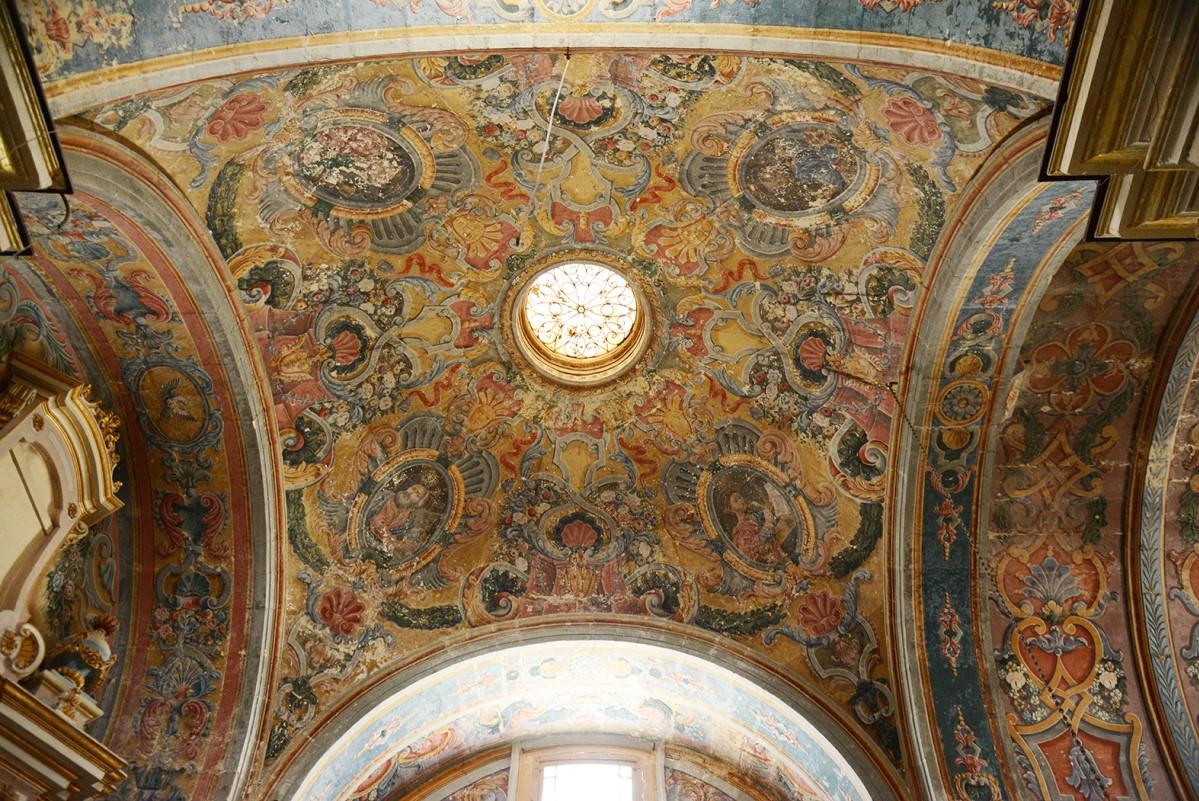 General views of the vault with lunettes prior to the start of conservation works, depicting the four Evangelists.
As already noted, strategically positioned along the road linking Mdina to the heart of Rabat, the church has long held a visible and symbolic presence within the urban fabric. Numerous pastoral visitations carried out throughout the 17th and 18th centuries consistently describe the church – referred to as Beatae Mariae Virginis Donorum – in similar terms, emphasising its beauty and devotional importance.
Notably, Archbishop Paul Alpheran de Bussan records in his visitation of 1744-1751 that the walls and vault around the altar were being painted in vivid colours, through the devotion of the faithful, although the decoration was not yet complete. By his subsequent visitation of 1751-1756, these painted decorations were described as finished, confirming the completion of the decorative cycle.
A major historical milestone was marked on June 4, 2020, when the church entered a new chapter in its long history. On that day, custody of Santa Marija ta’ Doni was entrusted to the Maltese Lieutenancy of the Equestrian Order of the Holy Sepulchre of Jerusalem.
This important development was made possible through the support of Archbishop Charles J. Scicluna, grand prior of the Order, following a request by the Lieutenant for Malta, Ambassador Roberto Buontempo.
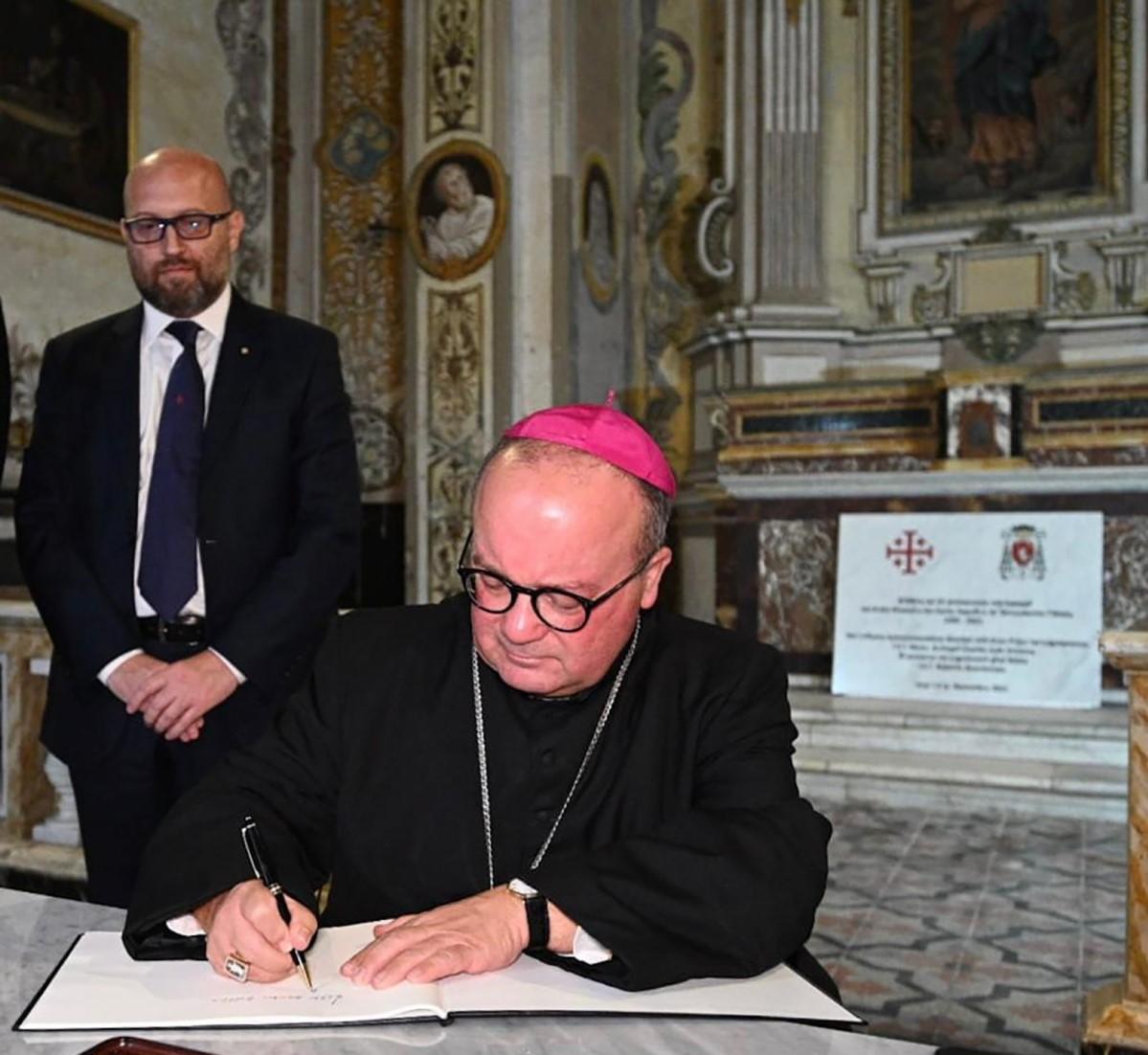 Archbishop Charles Scicluna signing the commemorative book on the occasion of the 25th anniversary of the presence in Malta of the Equestrian Order of the Holy Sepulchre of Jerusalem. Looking on is Ambassador Roberto Buontempo, Lieutenant of the Order.
Buontempo’s vision extended well beyond the practical need for a designated place of worship. He envisaged Santa Marija ta’ Doni as a spiritual and cultural centre for the lieutenancy: a church deeply rooted in Marian devotion, yet open to reflection, formation and encounter.
Central to this vision was the conviction that the church should not merely be preserved as a historical monument, but revitalised as a living space of prayer, capable of bearing witness to the Order’s mission of faith, charity and service, particularly in support of the Christian presence in the Holy Land.
The careful conservation and restoration of the church and its painted decoration was, therefore, conceived as an essential step in restoring dignity to the building, allowing its spiritual message and artistic heritage to speak once more with clarity and depth.
Today, the church is being restored to serve as the spiritual home of the Order in Malta, in continuity with its centuries-old devotional character and renewed in light of its contemporary ecclesial mission.
In 2025, the Maltese lieutenancy secured funding through the Office of the Deputy Prime Minister and the Ministry of Foreign Affairs and Tourism to undertake a comprehensive conservation and restoration project of the church’s wall paintings, though a funding from the Malta Tourism Authority.
The project was entrusted to established Maltese company Atelier del Restauro Ltd and is being carried out under the direction of conservator Valentina Lupo, with conservator Simona Careccia as head of site, supported by a specialised team of conservators.
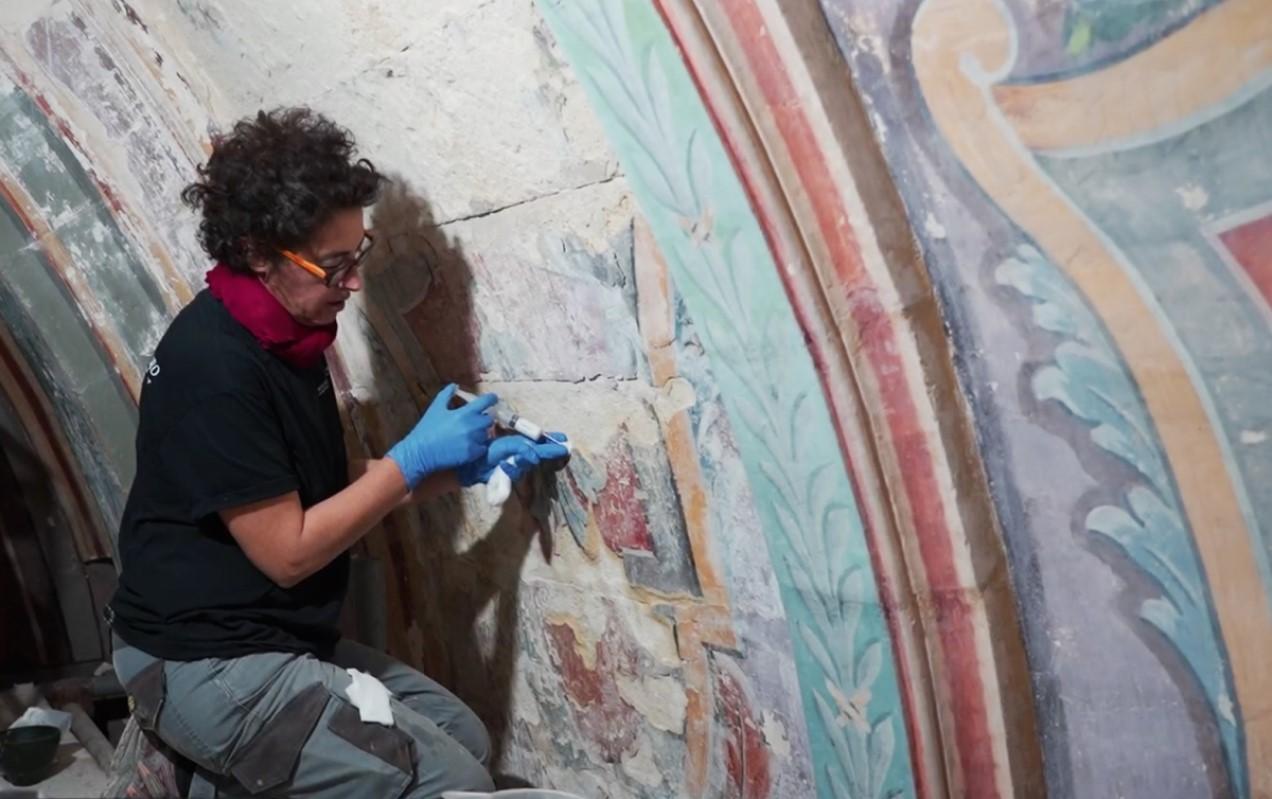 Head site conservator Simona Careccia during the grouting intervention on the barrel-vaulted ceiling.
Architectural oversight for the project is provided by architect Glorianne Vassallo Cardona. Works started in September 2025, beginning with the vaulted ceiling, and are being conducted alongside a scientific study in collaboration with the Diagnostic Science Laboratories of Heritage Malta.
The current state of conservation reflects the cumulative impact of time, environment and history. The wall paintings, executed using mixed techniques and the original possibly datable to the second half of the 17th century, have suffered from seismic events, rainwater infiltration, rising damp, past restorations and prolonged abandonment during the early 20th century.
During World War II, the church was used as a shelter and place of refuge, an improvised function that further accelerated deterioration. High humidity levels have led to the formation of soluble salts, biological growth and widespread detachment of plaster and paint layers.
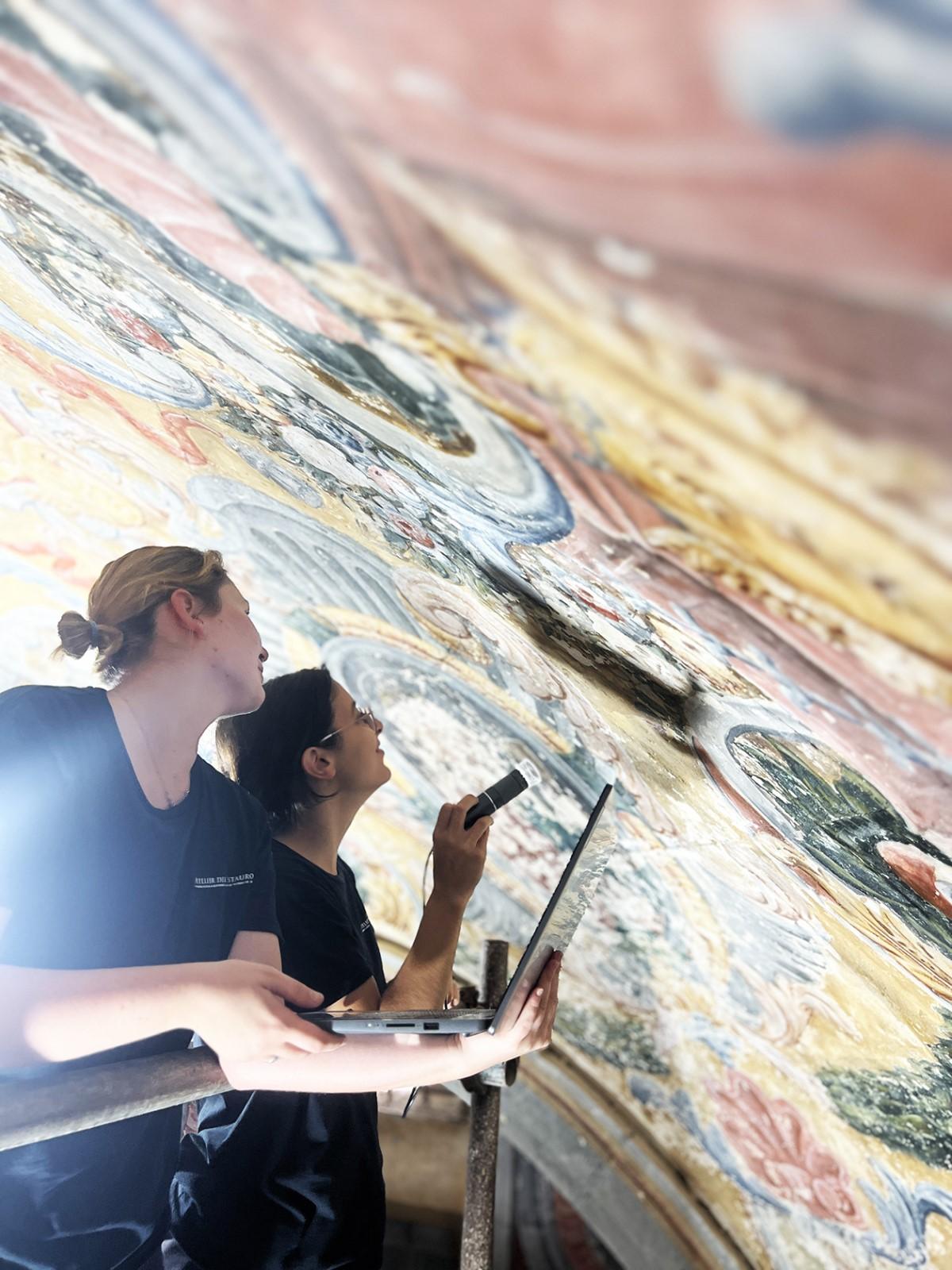 Conservators Annachiara Sottili and Darya Khloptseva carrying out surface investigations of the pictorial layer using a portable microscope.
Scientific investigations have also shed light on previous restoration campaigns. Signatures and dates discovered on the walls attest to interventions carried out in 1887 – likely following the earthquake of 1886 – as well as further works in 1910 and a later undocumented intervention in 2015.
While these past restorations were undertaken with devotional intent, the materials employed, particularly non-breathable fixatives and oil-based overpaintings, have inadvertently contributed to long-term damage by trapping moisture and mould.
Further investigation has revealed that the lower sections of the church’s interior were extensively overpainted during past interventions, likely as part of efforts to “refresh” the decoration or to mask areas of deterioration. These later layers have effectively concealed the original painted surfaces.
One of the central aims of the current conservation project is, therefore, the careful and controlled removal of these overpaints, in order to uncover and study the earliest surviving paint layers beneath.
A series of cleaning tests has already been carried out in selected areas, producing particularly promising results. Beneath the later coatings, a rich and unexpected palette has emerged, revealing a multitude of colours and decorative motifs, possibly dating to the 18th century, which had remained entirely hidden for generations.
The ongoing conservation aims to stabilise the painted surfaces, consolidate fragile areas, reduce the salts and recover the legibility of the decorative cycles while respecting the original materials and techniques.
Guided by the ethics of conservation, the project seeks not merely to repair damage, but to safeguard an irreplaceable expression of history and the community devotion in Rabat, found in one of the very few local churches whose interior is entirely enveloped in painted decoration, from the lower walls to the vault above.
When completed, the restoration of Santa Marija ta’ Doni will allow this jewel of Rabat to be fully appreciated once more – not only as a place of worship, but as a living witness to Malta’s spiritual and artistic heritage, entrusted anew to future generations.
This ambitious project would not have been possible without the vision and commitment of Ambassador Roberto Buontempo, the support of the Maltese Lieutenancy of the Equestrian Order of the Holy Sepulchre, the guidance of Archbishop Charles Scicluna, and the essential backing of the Office of the Deputy Prime Minister and the Ministry of Foreign Affairs and Tourism.