Save our shores: Luxe Islands
How policy and lax monitoring shaped Malta’s drive to supercharge its maritime industries
The allure of the superyacht as a status symbol endures, at least among those who can afford one.
Cruise liners, on the other hand, offer a comparatively accessible slice of seaborne luxury - and while European port cities have also shown increasing levels of intolerance for their gigantic emissions, Malta chooses to welcome both industries with open arms.
The government is committed to boosting its maritime industry and expanding both its shipping registries and ship servicing capabilities.
While Malta holds Europe’s biggest shipping registry, the largest superyacht registry in the world, and soaring passenger numbers in the cruiseliner industry, the impact of those policies is being felt by the communities that live in close proximity.
Coastal communities in Malta face pressure from vessels and the infrastructure designed to cater for them, which radically alters the flow of day-to-day life.
This is compounded by lax enforcement on multiple fronts, with Malta’s generous tax regime for commercial vessels and weak oversight over sanctioned Russian superyachts cited as examples of how the system gives too much breathing room to bad actors.
In the course of our investigative project titled Save our Shores, we spoke to dozens of people from across the Maltese islands.
The project is an initiative created and implemented by Friends of the Earth Malta backed by Amphora Media and funded by The Minor Foundation for Major Challenges.
To understand problems faced by these communities and determine whether factual research supports their assertions, we obtained comprehensive datasets that illustrate the scale of these issues.
The Southern Harbour’s great burden
Nobody in Malta faces a more disproportionate health impact from the luxury maritime industry than the residents of Malta’s Southern Harbour region.
For decades, the residents of the 14 localities in the Southern Harbour have had to contend with an active shipyard on their doorstep, dense urban spaces which trap emissions and heat in a vicious cycle, and a general lack of open green areas for people to enjoy.
Data from the Ministry of Health, which analyses the number of inhaler dispenses in each region of Malta and the rate of hospital discharges with asthma as the primary or secondary diagnosis, suggest that the towns and villages around the Southern Harbour region are adversely affected.
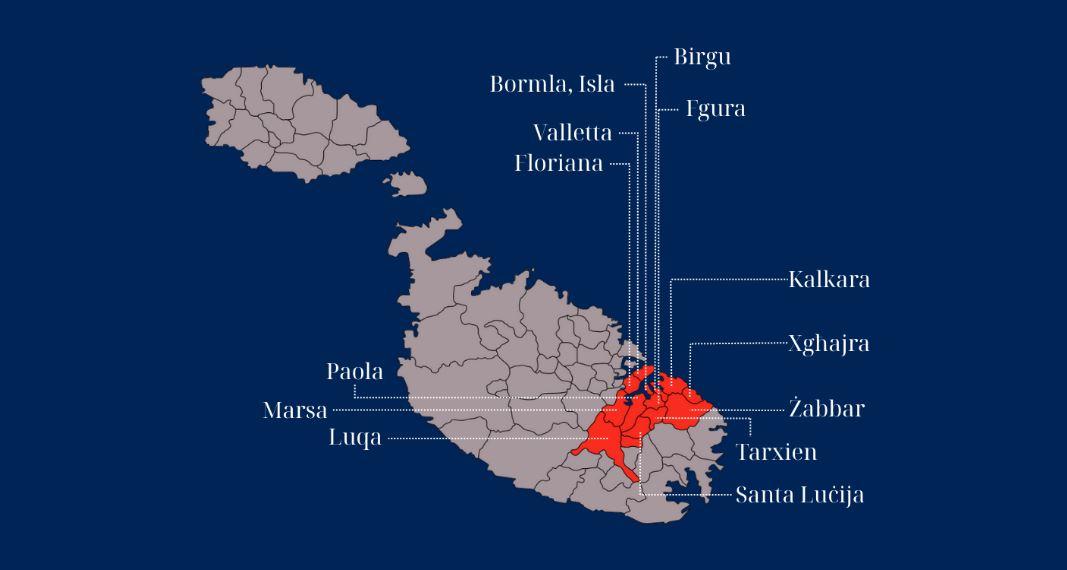 The southern harbour region is marked in red.
The data included three types of inhalers, known formally as oral bronchodilators: beclometasone and budesonide, both used for the prevention of respiratory problems and to treat inflammation in the lungs, and salbutamol, which is used to treat acute asthma attacks and wheezing.
In all three data sets, individuals from the Southern Harbour proved to be the worst-affected cohort between 2018 and 2024.
While incessant traffic and the widespread proliferation of active construction sites across Malta and Gozo also factor into the high rates of respiratory illnesses suffered in the Southern Harbour region, the consistency of high rates of inhaler use is unique to the area.
It is also worth mentioning that the same region reports other notable contributing factors to the prevalence of respiratory illnesses in the district.
One such factor is tobacco use. The Family Ministry’s Alcohol, Tobacco, and Drug Use survey from 2023 found that around 50% of respondents in the Southern Harbour reported using tobacco in their lifetime, 4.3 percentage points higher than the second-highest region.
The same survey notes that lifetime use of both prescription and recreational drugs was particularly elevated in the Southern Harbour.
21.4% of respondents in the Southern Harbour said they made use of prescription drugs, 2.5 percentage points higher than the next region.
As for the use of drugs such as cocaine, heroin, and methamphetamines, the Southern Harbour reports second at 0.7%, beaten only by the Northern Harbour region at 0.9%.
A recent meta-study, which is basically a study that reviews a large number of other academic papers, also shows a significant link between low-income households and asthma rates.
Within the context of the Southern Harbour’s historical socio-economic disadvantage, it only makes sense for the government to develop a primary healthcare hub in Paola.
The new regional hospital began to operate three years late after a legal dispute over poor workmanship led to an additional €1.7 million in emergency works.
Hard numbers
An analysis of data from the Environment and Resources Authority’s (ERA) air quality monitoring stations, which track different types of pollutants, across Malta and Gozo reveals a more widespread problem with air pollution.
ERA, in accordance with World Health Organisation (WHO) air quality guidelines, keeps track of fine particle pollutants like PM2.5 and dust-sized particles like PM10 as well as fuel combustion pollutants like nitrogen dioxide (NO2), ozone (O3), sulphur dioxide (SO2), and carbon monoxide (CO).
Between 2020 and 2024, WHO limits for PM2.5, PM10, and NO2 were exceeded consistently across stations in Msida, Attard, Senglea, Żejtun, and St Paul’s Bay.
The mobile monitoring station in Senglea, a town in proximity to the Grand Harbour’s highly active waterways, was removed from its location in October 2024. The ERA claimed that the station’s deployment was always meant to be part of a time-bound study, though it did not share the results of its research.
Addicted to money
Malta’s maritime industry is highly lucrative. Growing ship registries, profits generated in ship servicing, and rising cruise-liner passengers all contribute to ballooning economic growth statistics, making the sector especially attractive to politicians seeking to burnish their economic credentials with voters.
In the context of emissions generated by the Maltese economy, the country’s highly active shipping industry is effectively shielded from responsibility by not being linked with Malta’s national obligations to reduce emissions.
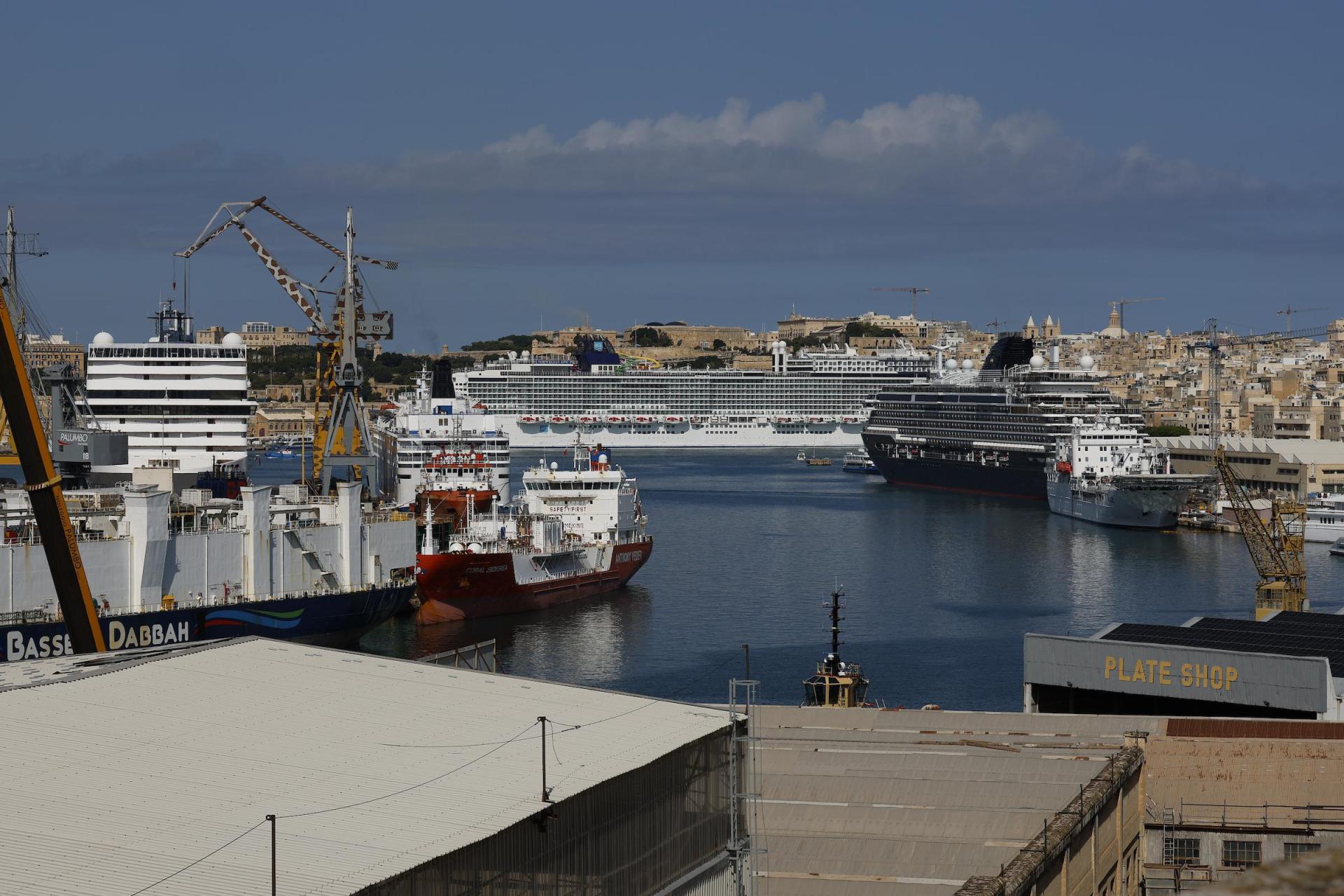 Ships and cruise liners docked inside the Grand Harbour. Photo: Darrin Zammit Lupi
In the Southern Harbour region, we spoke to representatives from Azzjoni: Tuna Artna Lura (ATAL), a group of residents and activists who are based in Cottonera, two GPs based in Senglea, Residenti Beltin, a group of residents based in Valletta, and the independent mayor of Floriana, Nigel Holland.
Joseph Tonna, an outspoken doctor who worked in Senglea for over 40 years, was one of the first to publicly flag the abnormally high amounts of inhalers that were being prescribed in his hometown.
After reviewing the research published in the investigation, Tonna agreed with the conclusions of our analysis, referring to the shipyard in Cottonera as “the only variable that could justify the Southern Harbour’s consistently high rate” of respiratory issues.
Ever mindful of his loyal patients, Tonna now passed the torch to fellow GP Jean Paul Camilleri, a doctor whom he had personally mentored. Tonna speaks highly of his younger colleague.
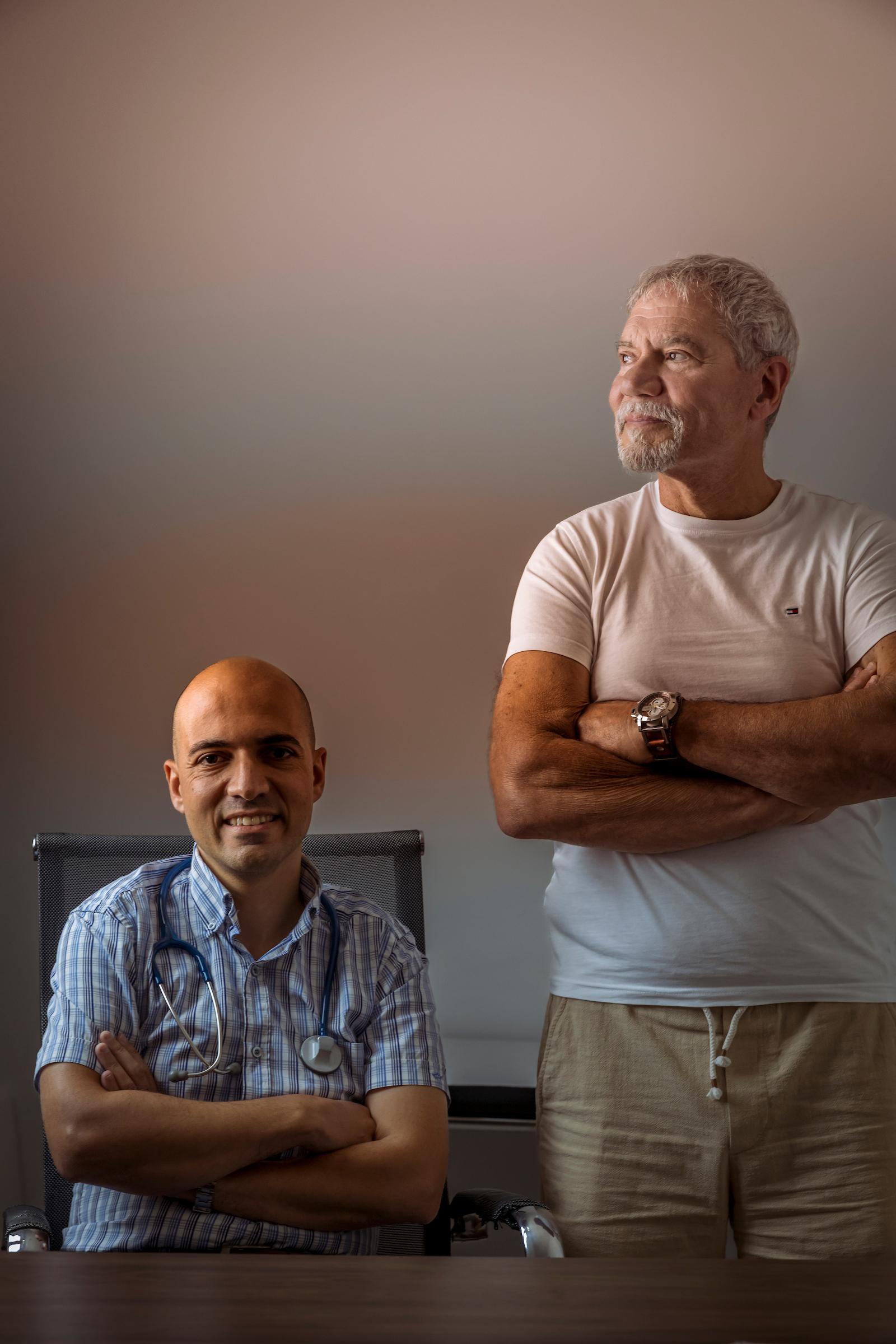 Doctors Jean Paul Camilleri and Joseph Tonna. Photo: Darrin Zammit Lupi
During a brief interview held in his clinic, Camilleri confirms his mentor’s observations about the “very common” occurrence of patients with respiratory issues.
When asked to describe any additional stressors that his local patients experience, Camilleri notes that environmental issues take a toll.
“People notice these things more when they’re already sick. They’ll be at home and there will be ongoing construction work nearby, so they’ll cough more, for example. If you look at Triq is-Sur, which oversees the dockyard, you just know it’ll impact people who live there. Even when I arrive and park in that area and draw my first breath, the air feels heavier,” Camilleri says.
Rebecca Cremona of ATAL is one of the activists who have been working to raise awareness of pollution in Cottonera for years.
After witnessing chronic inaction from local institutions seeking to curry favour and sponsorships from big maritime-based companies active in their area, as well as general complacency from a neighbourhood that simply got used to a shipyard in their backyard, she drily notes that the group has “given up” on authorities.
“...we gave up on them, not on the campaign. The Ombudsman’s report and its conclusions say it all: nobody knows who’s responsible for it all, everybody keeps pointing at others and delaying - even the Ombudsman was forced to say how ridiculous and dysfunctional this is,” she says.
 Rebecca Cremona from Azzjoni: Tuna Artna Lura speaks to residents. Photo: Darrin Zammit Lupi
A couple living together in Bormla agrees with Cremona’s assessment, arguing that the authorities have no coherent strategy to address these issues. They requested anonymity to speak candidly.
“They do the least they can to get the votes they need without thinking of the public good,” Michael* says during a conversation about the government’s €50 million shore-to-ship investment, pointing out that it is a limited system that can only connect to modern ships, which have the right equipment to plug into Malta’s electricity grid.
In fact, an investigation published by Amphora Media in October confirmed that cruise ships connected to the shore-to-ship system just 9% of the time during the first year in which the system was used.
Floriana’s mayor is one of the few to consistently buck the political trend of major parties giving powerful business lobbies an easy ride.
Though he confidently asserts that local councils remain a crucial focal point for day-to-day issues in their towns, he laments the slow population decline in Floriana, the pressures felt by the locality on various fronts, and its relative dependency on the central government listening to its urgent concerns.
“We’re working on something which we hope will help change this dire situation. We’re under 2,000 people living here now. I think the Three Cities are getting close to that mark, too. We had a response from Senglea and Vittoriosa’s local councils, we met and talked about what we want to do…but Maltese politicians just don’t want to go against wealthy, powerful individuals,” Holland says.
In spite of his keen awareness of the way in which politicians use luxury industries that provide positive statistics about economic growth to generate political capital, Holland cheerfully dismisses the notion of giving up his lonely crusade to save Floriana’s residential neighbourhoods.
“I will go down fighting, as the British would say,” he says with a chuckle.
Responses
Out of all the relevant stakeholders we reached out to for comment for this investigative project, we received two responses - a response from ERA’s spokesperson and a response from Valletta mayor Olaf McKay.
ERA’s spokesperson noted that Malta’s legally binding standards are set by the EU Ambient Air Quality Directive. That directive's standards are far less stringent than the guidelines published by the WHO.
“These standards set the EU limit values which constitute the official basis for compliance across all Member States including Malta. All official assessments and compliance reporting follow such EU standards,” the spokesperson noted.
“In this regard, the regulated pollutants are in line with EU standards during the period in question for all pollutants, with the exception of particulate matter of size 10 micrometres or less (PM10) at Msida station in 2018 and 2023, where the number of exceedances of the daily limit value exceeded that of the EU, and ozone which was exceeded in our Għarb station* in 2021, 2022, 2023,” the spokesperson added.
ERA also explained that ozone is known as a “transboundary pollutant”, which means that it is not just generated locally but also carried over from other countries, making it impossible to control except through “global action and efforts from other countries”.Earlier this year, ERA published an air quality plan, which the spokesperson says is meant to target road transport as the main source of air pollution and “includes a set of measures aiming to reduce traffic congestion, focusing on the inner harbour area.”
The spokesperson cited proposals including collective transportation, cleaner distribution services, grants and schemes for cleaner vehicles and incentives to surrender vehicles.
“These measures build on a series of initiatives that the government has implemented over the years, which have already contributed to significant emission reductions,” the spokesperson claimed, in spite of a lack of evidence which suggests that Malta has managed to reduce its emissions “significantly”.
“These include the reform of the power generation sector, the introduction of free public and school transport, the provision of free ferry services in the inner harbour area, and the fast-ferry link between Malta and Gozo,” the spokesperson added.
The spokesperson also stated that the mobile monitoring station in Senglea was set up to collect samples for a study on “any impact shipping in the Grand Harbour may have on air quality”, noting that the exercise was completed and that the station was removed afterwards.
The regulator did not share the results of its study nor did it explain whether its study was impacted by the poor quality of the data that was collected through the mobile station.
As for Valletta’s mayor, who was elected on the Labour Party’s ticket, his comment was largely about ongoing cooperation with the government to form a master plan for the capital city.
“I have always believed that a “one-size-fits-all” approach cannot be applied in all cases. Valletta needs its own dedicated action plan so that, together with the relevant entities, we can develop a model that truly addresses the needs of both residents and commercial establishments in the City,” McKay says.
Valletta’s mayor also stated that the council is collaborating with the office of the deputy prime minister on a pilot project that will design “measures tailored for a capital city that attracts high-quality tourism.”
“Through this initiative, we will be able to tackle issues such as waste management, public order, and the regulation of tourist accommodations. I thank the Government for its support in helping us present our proposals and the residents' suggestions, and implement our ideas so that we may achieve a balanced approach that meets the needs of residents, commercial activity, and tourism,” McKay adds.
The health ministry, the transport ministry, and the culture ministry did not respond to a request for comment.
This is part one in a three-part series. Parts two and three will be published in the coming weeks.
The Save our Shores project is an initiative created and implemented by Friends of the Earth Malta and funded by The Minor Foundation for Major Challenges.
The author used ChatGPT 5.1 for analytical support, multi-stage data processing, comparison against WHO air quality guidelines, and the interpretation of pollutant trends across Malta’s monitoring stations (2020–2024).