Saved treasures of Gaza in Paris
The exhibition at the Institut du Monde Arabe (IMA) presents 130 artefacts brought to the venue from their refugee storage in Geneva
When signatures on the negotiated peace agreement in the Gaza Strip have not yet dried up, it is perhaps time to deliberate on one hidden consequence of what Gazans have suffered during the latest war.
Two years of constant brutal bombing did not only snuff out more than 67,000 Palestinian lives, including that of some 20,000 children, and caused immeasurable disabilities on innocent citizens of all ages, but, besides destroying 90 per cent of buildings, also jeopardised national heritage, which, in the normal order of priorities, its protection is hardly ever heeded in a war zone.
This missed focus on Gaza’s threatened legacy, however, has been superbly brought to attention by an impressive exhibition mounted in Paris at the Institut du Monde Arabe (IMA), whose chairperson, Jack Lang, ex-French culture minister, described as “the archaeological patrimony that irrigates contemporary Palestinians”.
History of Gazan archaeology
Archaeology in Gaza started in 1879, under the Ottomans, when a villager accidentally discovered a statue of Zeus – today exhibited at the archaeological museum in Istanbul – on top of a sandy hill at Nuseirat.
Excavations of the Bronze and Iron periods by British Egyptologists based in Cairo proceeded during the British mandate (1922-1948). Unfortunately, after 1948 when Israel was created, most excavations came to a stop, until 1967 when Israeli-occupied Gazan excavations resumed, this time of the Canaan period from the 14th and 13th centuries before our era in Deir al Balah. More than 50 anthropoid sarcophagi from this site are exhibited in Israel.
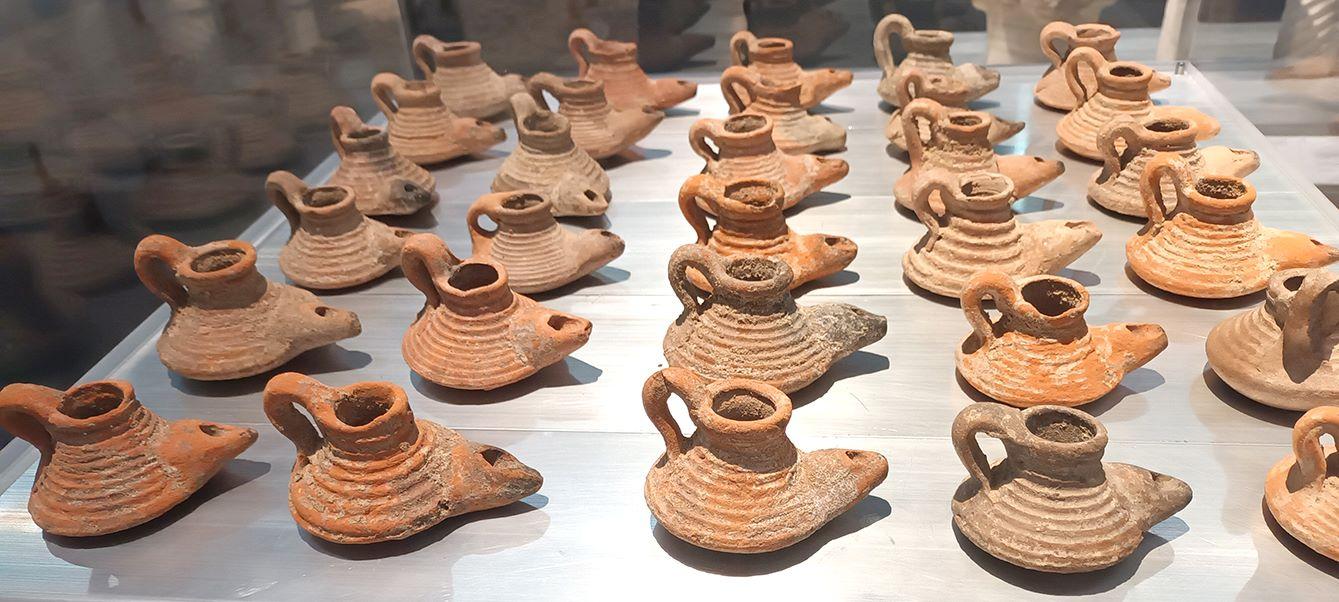 A set of 30 Byzantine lamps found in Gaza on show at the Paris exhibition. Photo: Charles Xuereb
One remarkable treasure consisting of a Byzantine mosaic floor, discovered in Gaza by the Australian army in 1917 at Ayn Salalah, is in Melbourne. Since 1995, upon its creation, the office of antiquities in Gaza started to supervise new excavations with the cooperation of the eminent École Biblique et Archéologique Française de Jérusalem (EBAF), founded in 1890.
After the Hamas win of the Gazan legislative elections in 2006, and the ensuing higher security measures in the country, often in conflict with Israel, the plan to house hundreds of objects from the Bronze Age to the Ottomans in the Archaeological Museum of Gaza was abandoned. A total of 529 objects belonging to the Palestine National Authority had instead to be stored in Geneva at the Museum of Art and History.
Wedding gift to Cleopatra
The current Paris exhibition, reflecting major finds during these recent excavations, displays artefacts that throw light on Gaza, which has been for a long time at the crossroads of power mongering between East and West.
In the fourth century CE, Gaza became a busy commercial and agricultural hub. Following Pharaoh Pompey’s defeat by Julius Caesar in 48 CE, with Palestine falling in Roman hands, Gaza became the wedding gift of Mark Antony to Cleopatra.
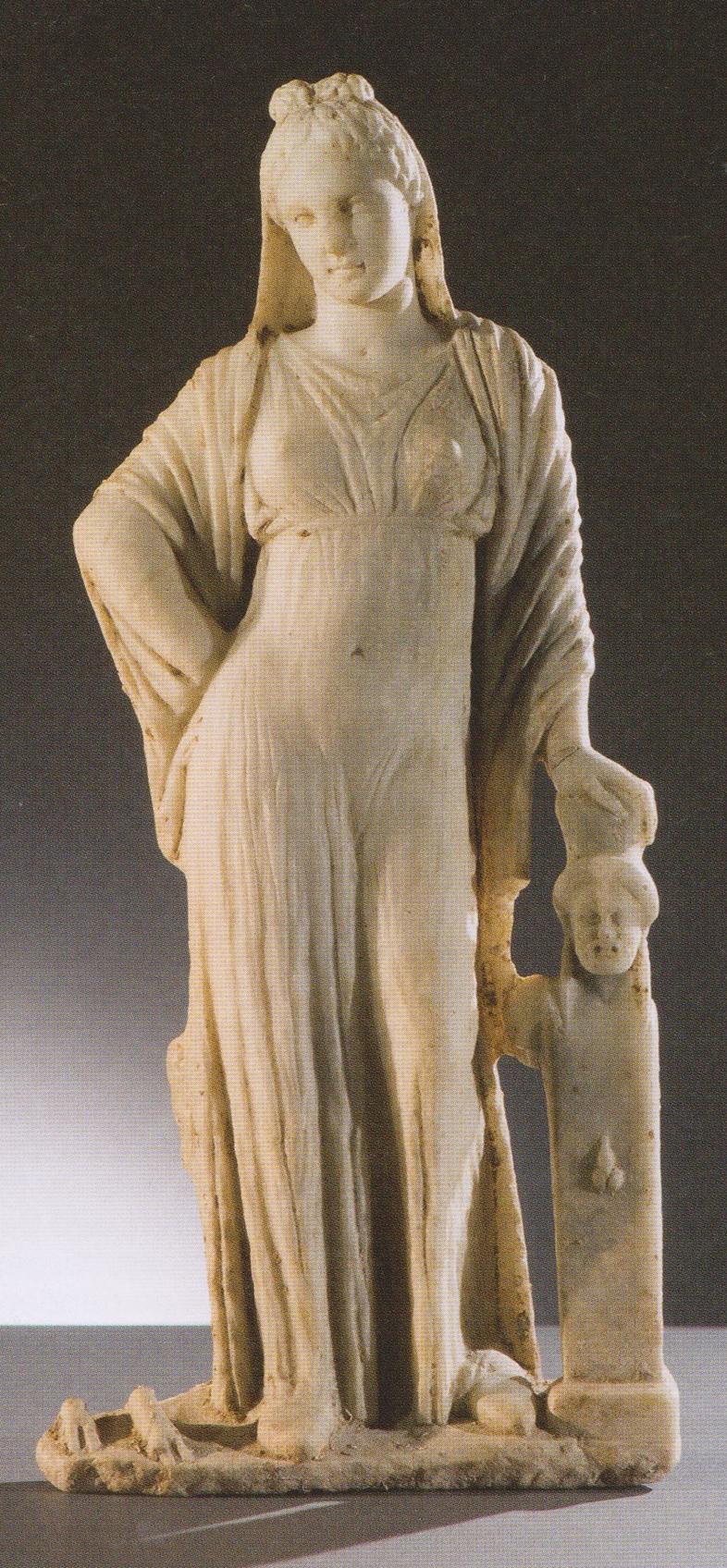 One of the main attractions in the exhibition showing Aphrodite with the infant Pan from the Hellenistic or Roman period. Photo: Courtesy of IMA
The Arab armies took Gaza in 637, followed by a Christianised crucial period during the Crusades until Saladin’s final victory, ushering in a very long period of stability, until the middle of the 20th century.
UNESCO has been running a preliminary evaluation of the damage caused to Gaza’s cultural wealth by the war from a distance, mostly through satellite surveillance. However, since the end of March, UNESCO could only audit 150 out of 345 sites in the Strip.
Saving the Gazan patrimony
On a recent rainy Sunday morning in Paris, queuing up at the IMA bore huge satisfaction, when I toured this inspiring exhibition presenting 130 artefacts brought to the IMA from their refugee storage in Geneva. Exhibited objects, saved with courage often under attack, help visitors appreciate the density of the opulent Gazan past.
Most of the merit to save Gazan patrimony goes to Première Urgence Internationale (PUI) and its Intiqal initiative. The latter is run by a non-profit, youth apolitical and secular international NGO constituted in 2007 supported by PUI. This innovative socio-economic development programme strives to protect cultural heritage.
What was to be a normal day of fresh excavations for a group of young Gazan archaeologists, early on the morning of October 7, 2023, was abruptly abandoned to the sound of dreadful blasts of rockets and bombs, due to the Hamas tragic attack on Israel. From the next day, Israeli Defence Forces embarked on the two-year long invasion of Gaza, now fragilely paused after President Donald Trump’s recent positive peace plan.
Acknowledgements due to Élodie Bouffard and René Elter, publication directors and contributors to the exhibition catalogue.