Scandal, gout, and legacy: The final years of Grand Master Verdalle
Giovanni Bonello delves into the fame and infamy surrounding the Order of Malta’s Verdalle Knights
Of the long sequence of 27 knights who became grand masters and ruled over the Order of St John and the Maltese islands, only one achieved the dignity of cardinal – Fra Hugues Loubenx de Verdalle. Throughout history, several cardinals had professed in the Hospitaller Order, but, before Verdalle, the only grand master who was also made cardinal had been Fra Pierre D’ Aubusson in 1498 when the Order ruled over Rhodes, not Malta. For the first and only time in its history, Malta was governed by a cardinal.
Verdalle’s 13 years’ reign (1582 – 1595), following the turbulent times of his predecessor La Cassière, proved less calamitous but only slightly so. Throughout his rule, Verdalle faced crippling internal problems, struggles to keep together different national loyalties relentlessly at each other’s throats, personal ambitions of knights with inflated egos, some brutal exuberance from Bishop Gargallo, and pitiless natural crisis, like a major famine and one of the most devastating onsets of the plague in 1592.
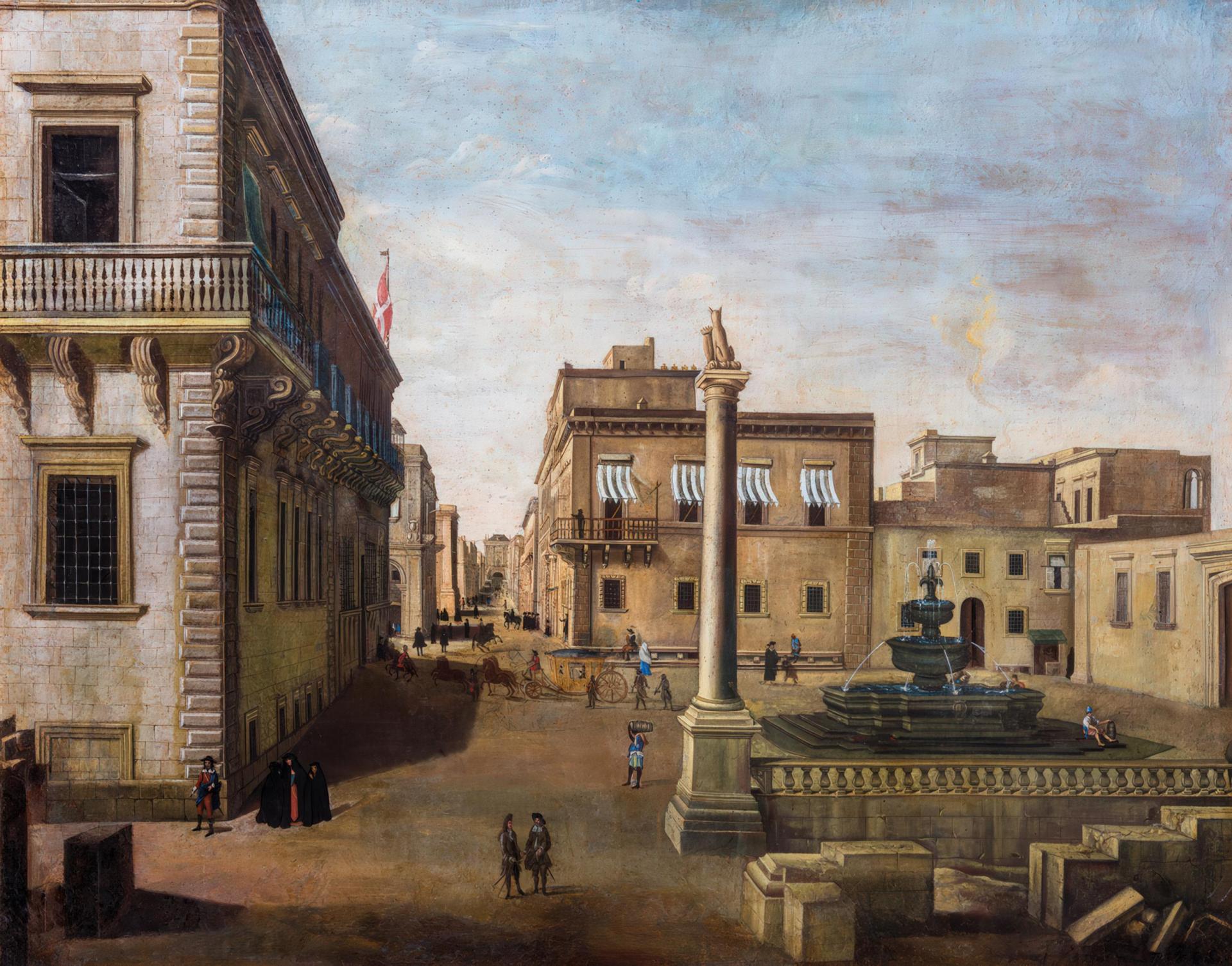 Il Negretto, St George’s Square, Valletta, showing the wolf of Verdala squatting over a column. Photo: Daniel Cilia, courtesy MUŻA.
Before old age wafted better wisdom and moderation over his head, Verdalle’s career as a knight had proved rather colourful. More than once, he figures in the criminal records of the Order. In 1577, Verdalle found himself embroiled in a violent brawl with another knight, Fra Pierre de Vintimille, and they both ended clapped in irons. Vintimille faced trial and the Council of the Order locked him up in prison for one year.. Only two months later, the council again formally appointed commissioners to investigate Verdalle, this time charged with seditious speech uttered in the Grand Master’s Palace.
His reputation must have plummeted rather noticeably – when, in 1579, he requested the council’s permission to visit his commanderies abroad, he faced a blunt refusal. These blots on the criminal conduct of a future grand master still feature in the records loud and clear – no accommodating ‘right to be forgotten’ sanitised your wrongdoing in those unenlightened times.
Verdalle’s name does not only appear in the lay criminal records of the island. The Roman Inquisition also took an interest in him. In 1563, Inquisitor Domenico Cubelles put Verdalle’s name down as one of the knights to be charged with heresy. Excellent seminary for a future cardinal of Holy Mother Church.
Controversy over his appointment
The solemn raising of the grand master to the high status of cardinal in 1587 had at least one hilarious aftershock. Several cardinals had disagreed with the pope – they believed Verdalle did not have the qualifications to justify that honour. His elevation came to be seen as coarse political horse-trading. Pope Sixtus V needed the Order’s navy to strengthen his planned campaign against the Ottomans and Verdalle required a prestige boost to reassert his waning authority over the Order.
 Portrait of Cardinal Grand Master Verdalle with the Floriana Capuchin complex as backdrop. Photo: Daniel Cilia
The greatest opponents of the novel prince of the Roman church were the Colonnas: Cardinal Marco Antonio, the dean of the college, and his brother Cardinal Prospero. There had been a history of bad blood between them and Verdalle. Age-old protocol dictated that the dean should greet a new cardinal with a lavish formal banquet in which all the other cardinals present in Rome would participate. A wolf, loup in French, was Loubenx de Verdalle’s heraldic symbol.
Cardinal Colonna organised the protocol dinner, during which he had a wolf cub placed next to his chair and he ostentatiously kept his foot on it throughout the duration of the banquet. Everyone understood the silent affront and what indignity it conveyed. That Roman dinner turned into Verdalle’s searing public humiliation. All the grand master could do was to plot commensurate vendetta.
The Colonna’s heraldic symbol was … a column. Back in Malta in 1588, Verdalle ordered the erection of a monument in St George’s Square, opposite the Palace – a column with a wolf defecating on it. This came to be known as the Colonna della Fama, (fama standing for infamy, as in libello famoso). Verdalle, not wanting the memory of his revenge ever to fade over time, on his deathbed left a sum of money specifically to fund the maintenance and repairs of his pooing wolf.
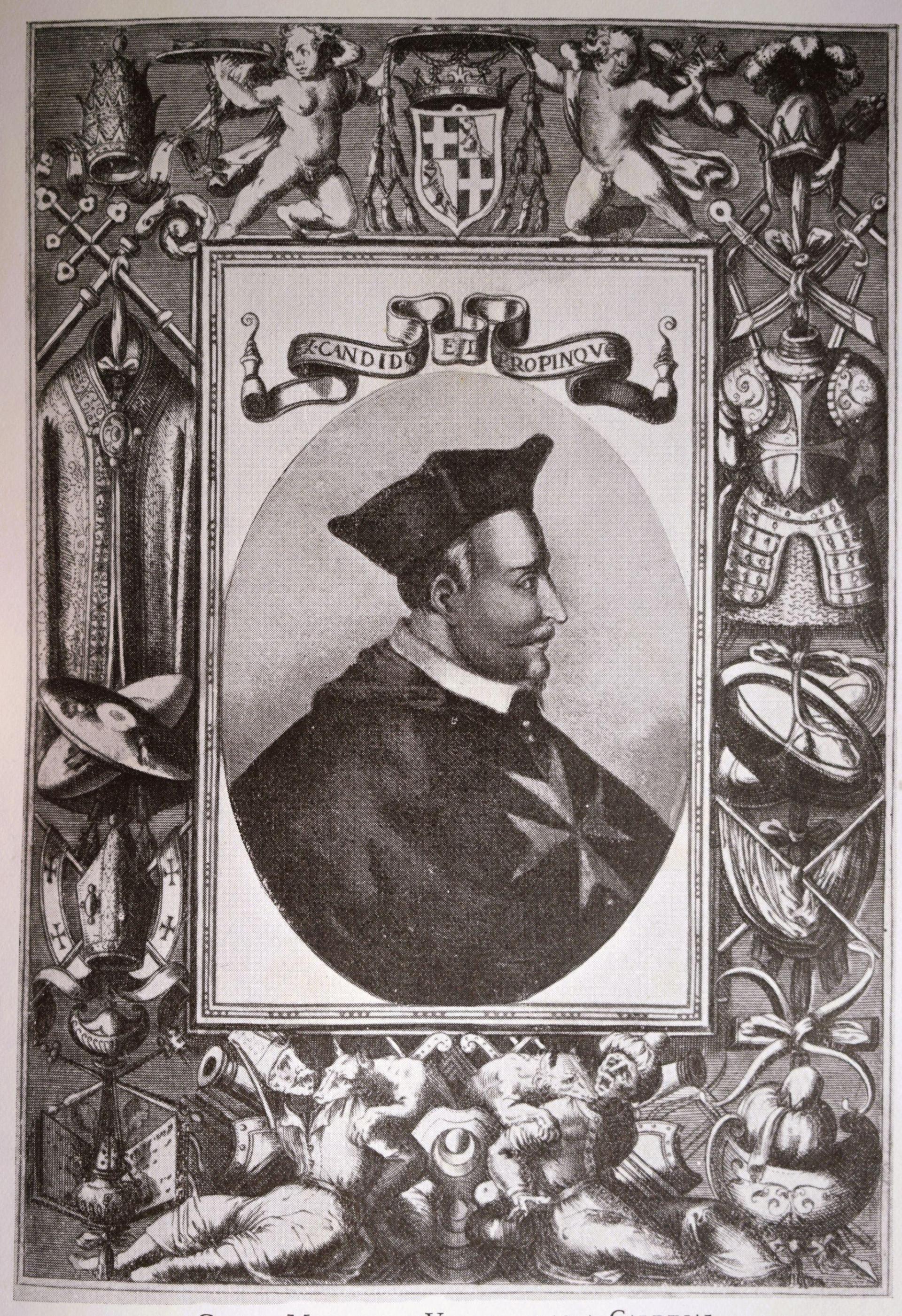 An engraved portrait of Grand Master Verdalle
Eventually, the monument, in local soft limestone, had to be renewed twice but was finally dismantled over a century-and-a-half later, when it became unstable and dangerous. The Venetian ambassador to Malta, Giacomo Capello, in his secret and very gossipy 1716 memoirs of Malta, makes a meal out of this story. If true, for many years Valletta would have been the only city in Europe to sport a public memorial to crapping.
Verdalle’s name does not only appear in the lay criminal records of the island
Verdalle’s term as grand master resulted almost as plagued by discontent, rebellion, indiscipline and treachery as that of his predecessor La Cassière. To top it, the repeated private misbehaviour and sexual excesses by some knights, often garnished with extreme violence, turned into a constant headache for the gentle disciplinarian. Random examples would be the gang rapes of 1582 by eight knights.
Among them Fra Antoine de Symon, Fra Francois de Rogier, Fra Robert Ceres (but de Very) and Fra Gaspard d’ Acton, who were expelled from the Order on the spot, in the company of another four knights, registered only by their nicknames: Fra Bottigliera (Fabritio? An Italian with seven Frenchmen? Unlikely), Fra Berton, Fra Boubordan and Fra de Boys who were jailed for two years.
The four expelled rapists appealed on a technicality and Verdalle formally quashed the sentence. He used his discretion to detain de Very in prison for two years and reserved judgement on the other three.
Did their time in jail teach the horny delinquents anything at all? Not much. After their release, both Fra Antoine de Symon and Fra Gaspard D’ Acton in 1585, separately, found themselves again accused of rape with violence of married women. For a second time, Verdalle advertised his compassion, or was it his weakness? He readmitted the rapist de Symon to the Order, locking him up for a few months in the tower. The rapist D’ Acton was again defrocked, but, after showing enormously fake contrition, Verdalle later readmitted him, jailing the relapser ‘during the grand master’s pleasure’.
The serial wrongdoings of knights with, or against, women punctuated Verdalle’s rule. In February 1582, the novel grand master had to deal with a huge brawl in which a number of hospitallers wounded some women at night and later, with the assault by Fra Anna de Very and his friends on Francesca Lampadina, whose door they broke down and whose lintel they smeared with excrement, to leave no one in doubt about their chivalric finesse.
The barber Egidio surprised his wife romping with Fra Onofrio Mestre magno cum scandalo and the knight found himself in detention. Fra Pierre de Glandes, called Carpentras, suffered the quarantena for ‘outraging’ the spouse of Brandano Cassar. Giovanni Rigal’s wife, Margherita Mattiola, sent Fra Nichoas le Duc and Fra Andre de Saint Marceau to jail for molesting her.
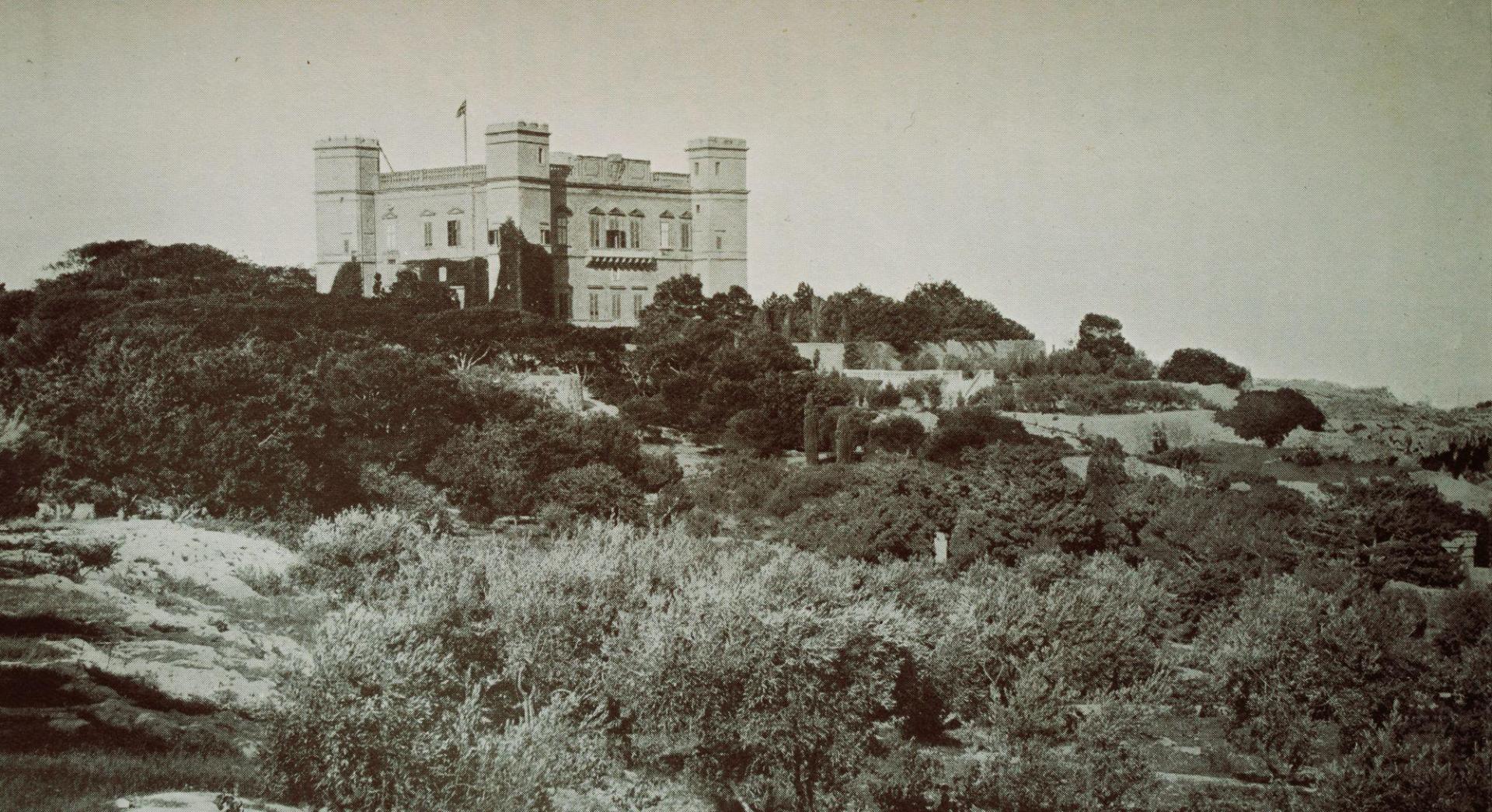 The summer palace built by Vedalle in Boschetto, 1920s. Photo: Richard Ellis
In 1593, the knights Andrea Marchetto and Antonio d’ Amico ended criminally prosecuted for ensuring the successful flight from her marital home of Francesca, wife of Antonio Ramella. Shortly later, Verdalle had to deal with Fra Cesare Sarsale, accused of having used violence on Cornelia Maravella. The following year, Valletta was shocked when a powerful bomb detonated on the doorstep of the pharmacist of the Order, the notoriously shameless Caterina Vitale. Followed by Fra Matteo Germano, imprisoned for indiscreetly flaunting his mistresses.
Not to mention a string of homosexual offenders, like Fra Giovanni Tomaso Carafa, no less, expelled from the Order for ‘the unmentionable crime’, sodomy, and locked in jail on bread and water. Another Italian knight, Fra Antonio Piccione, caused scandal in January 1595 for being nabbed indulging in the same proclivity. Not one of these knights ever won medals for self-discipline, but, to make up for this, they scored spectacularly on the testosterone scale.
Some disaffected knights reported Verdalle to Rome, accusing him of serious failings in his public duties and in his private life. Among other things, the pope heard how some hospitallers, instead of attending holy functions at St John’s, spent time playing cards and gambling with the grand master, losing considerable bets. The disgruntled knights proposed to Rome that the collacchio – that enclosed part of the city accessible only to professed knights –should be revived, to make it more difficult for hospitallers to mingle “with women of the world and of ill-fame”.
Verdalle parried these charges with remarkable restraint and urbanity: it was quite true, he replied, that, because of his gout (podagra), his physicians had pressed on him the need to relax and had recommended games of cards. “But he did so privately, behind closed doors and in his own room, and not with dice, never touching them with his hands, only in honest company who behaved entirely without scandal or blasphemy or laughter or indecent greed, and never during (religious) festas or in the hours of divine office. The most barbarous infidels in the world would never dream of slandering him that way”.
A nephew's arrest
One of the worst afflictions Verdalle would have suffered in his troubled rule could have been the arrest and indictment of his nephew and namesake, Fra Hughes Loubenx de Verdalle Junior, on June 12, 1589.
The public prosecutor of the Order filed formal charges against him for “leading a scandalous life, in defiance of the statutes of our sacred Order”, later explained as “being guilty of a licentious life”.
Verdalle Junior had been assigned a rich commenda in France, of which he was entitled to enjoy the rents and income. But he did far more than that. Clandestinely, he sold or enfeoffed 11 of the properties and diverted the funds to his own pocket.
The Order somehow came to know of this misappropriation and was anything but amused. It set in motion criminal proceedings against the grand master’s nephew, appointing two elders to compile the evidence and prepare a report. It took Fra Diego de Serralta and Fra Amedeo Chacherani almost a year to gather the evidence, but on June 15, 1590, they signed a scathing report, still preserved in the archives of the Order.
They confirmed all the delinquencies of Verdalle’s nephew and recommended that he be despoiled of what was left of his commenda, with a firm proposal that, in future, he should never again be entrusted with any of the Order’s property.
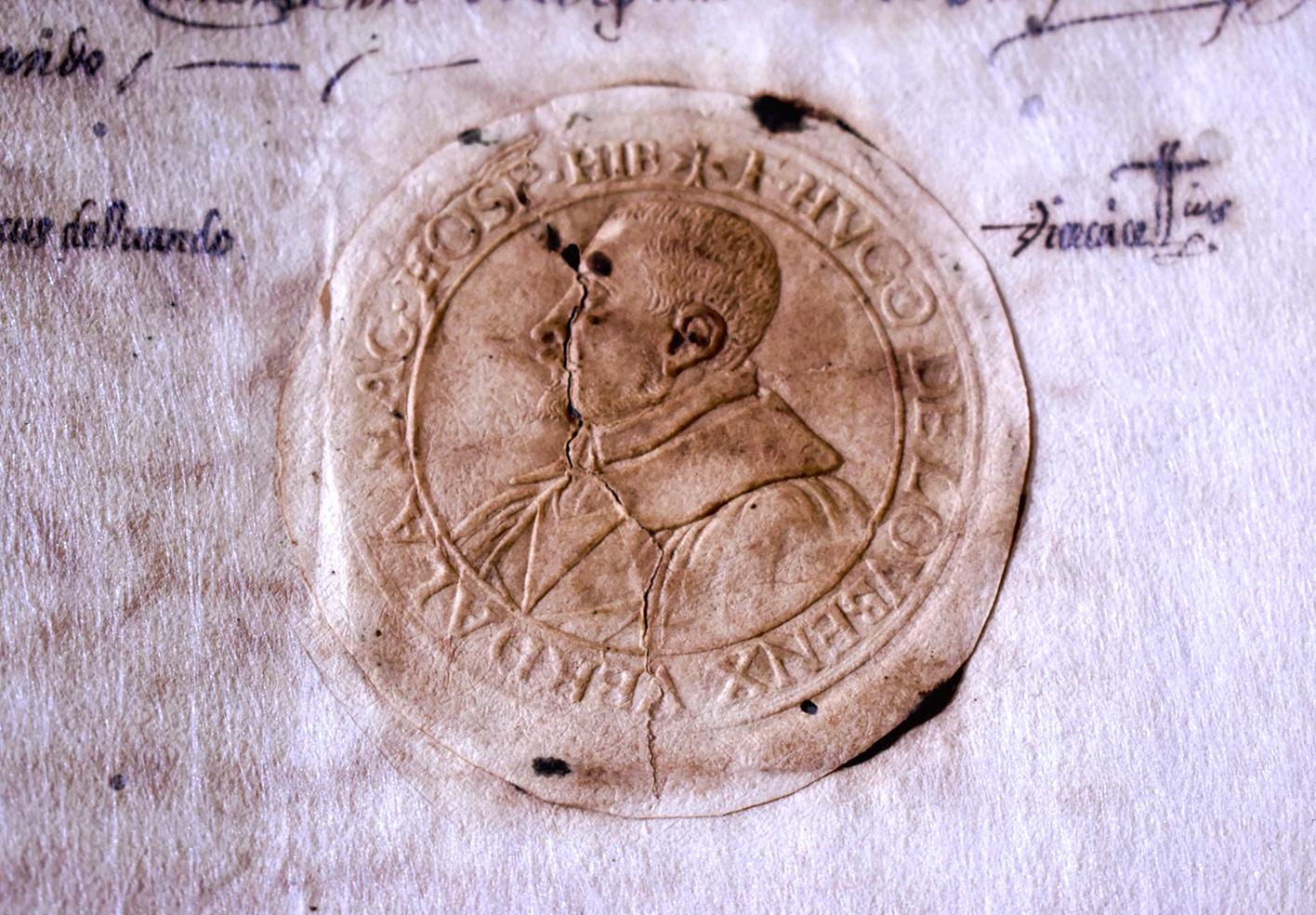 The seal used by Grand Master Verdalle.
They also believed that the council should declare void and inexistent all the fraudulent contracts signed by Verdalle Junior. These were the experts’ recommendations. Curiously, the records contain no follow-up of the criminal proceedings. Is it unfair to suspect that someone powerful intervened to paralyse the prosecution?
Verdalle’s name links to a bizarre feature in the Grand Masters Palace, Valletta – the extremely low steps of the main staircase, built by him, as evidenced by the repetition of the wolf’s head as decoration. Romantic (and grossly uninformed) legends have mushroomed around these steps – they are so low as the grand masters used to climb up and down on horseback, or be carried in sedan chairs, or because the knights, wearing their ponderous steel armour, could navigate them with greater ease.
The real reason proves much more pedestrian, and the Order’s historian records in some detail how this came about. In his later years, an extremely painful gout crippled Verdalle and he barely dragged his feet while walking. He gave the architect precise instructions as to the elevation of the new steps – the lowest possible. Verdalle’s gout turned so excruciating that a sedan chair on spherical bearings that rotated in every direction, had to be constructed to enable him to move at all.
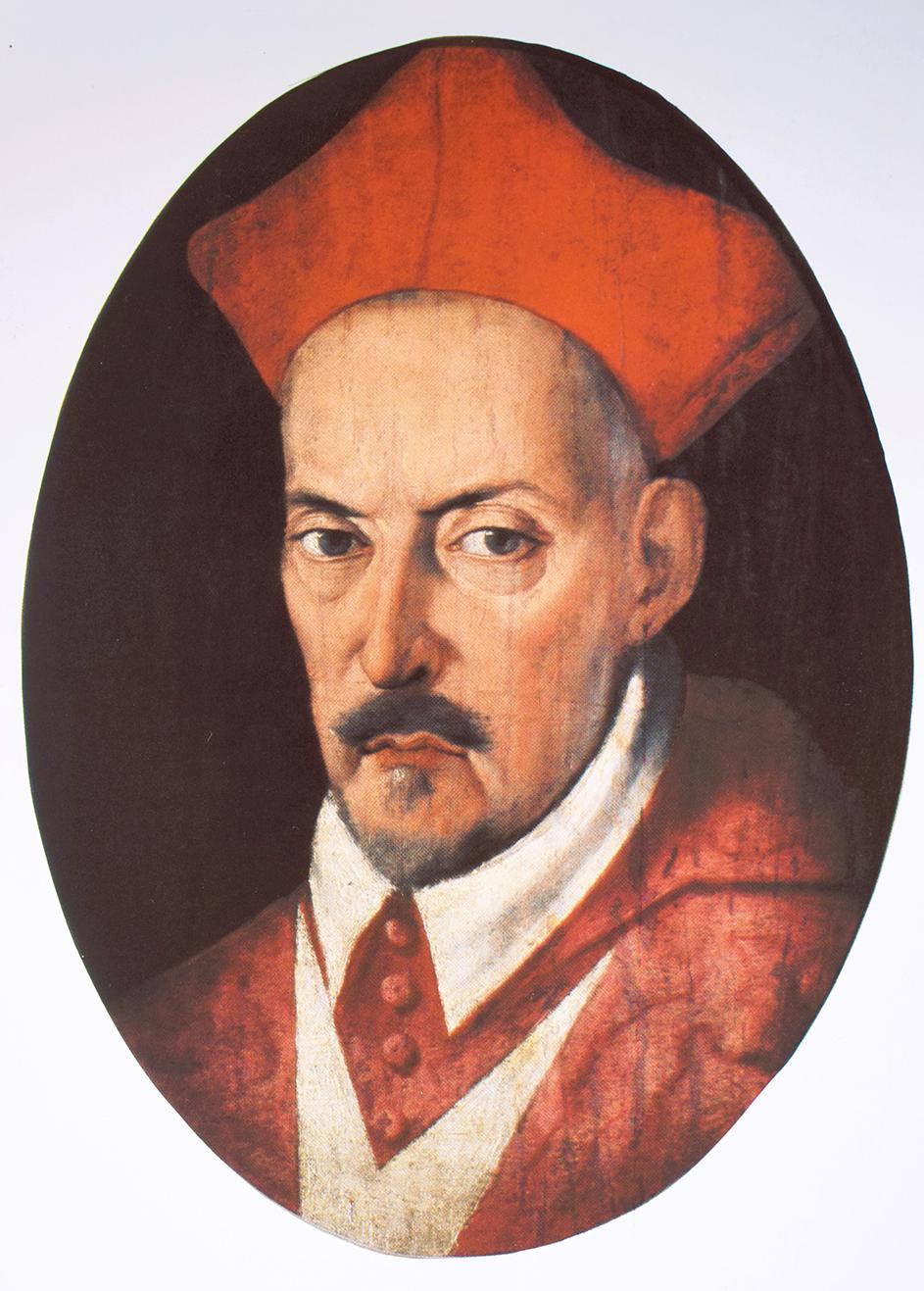 An oval portrait of Grand Master Verdalle. Photo: MUŻA
Extreme ill-health dogged the cardinal grand master. On Maundy Thursday, March 23, 1595, afflicted over many years by gout in his feet, hands and fingers (dolorosi chiodi di podagra e chiragra), he became emotionally disturbed, reflecting on the dire resistance of the knights to his authority and the parlous state of his Order. He still spent that morning presiding the solemn and protracted Maundy Thursday rituals at St John’s. Returning exhausted to the Palace, he threw himself on his bed and received the last sacraments.
With his breath failing, he addressed the senior knights gathered around him. Someone transcribed his long speech verbatim. The statutes of the Order laid down stringent rules about the inheritances of knights after their death: all their estate devolved on the Order, but they could, if they so wished, dispose freely of not more than one-fifth (the standard quinto) as they desired, usually in favour of their families.
In 1587, Pope Sixtus V had suspended this rigorous rule especially for Verdalle – he authorised the grand master to dispose of his entire estate, in any manner he desired. On his deathbed, Verdalle renounced his right to do as he wanted with his private wealth and left virtually everything he owned to his Order.
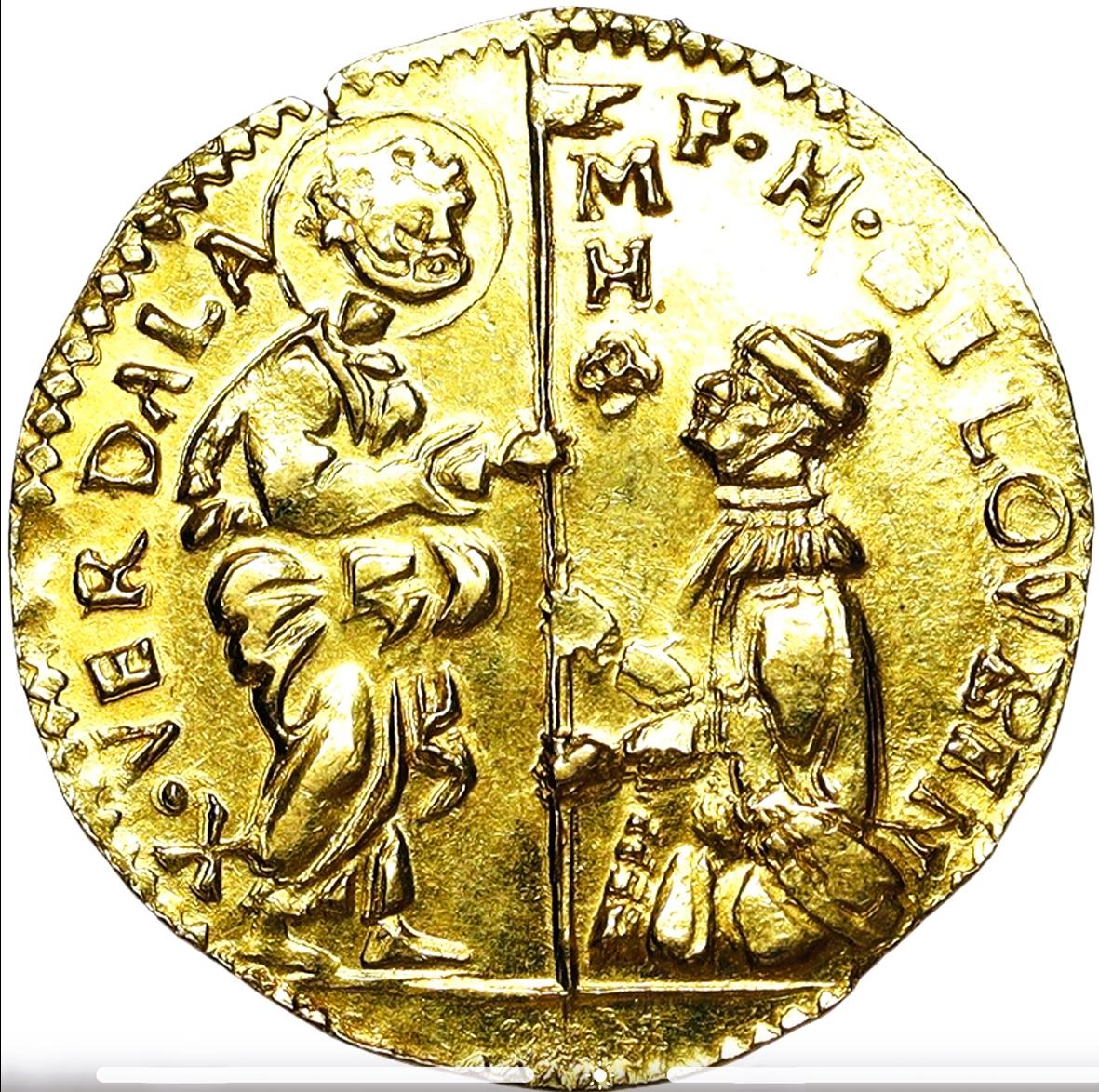 A gold zecchino issued by Grand Master Verdalle.
And what an estate it proved to be! Worth more than a million gold scudi, the inquisitor reported, of which 144,000 in cash, together with the remission of the 150,000 scudi he had loaned the ailing Treasury from his own purse, besides 650 slaves, his personal private fleet, and his enviable collection of objects d’ art.
“This is my testament” he shamed his detractors “wealth amassed by my own industry. Not to enrich myself, but for you!”
The news of Verdalle’s impending death set in motion a frenzy of activities; on March 11, Fra Pierre de Montauban Voguedemar, a prominent hospitaller, took over as caretaker of the Order, sede vacante. The council ordered the gates of the cities, the mouths of the harbours and the prisons of the slaves to be securely guarded, and for a supply of wheat to be sent to Gozo forthwith. To avoid conspiracies and turmoil, the elders prohibited all meetings of the Langues.
The dying grand master granted a general amnesty to all delinquents but signalled out the Bellardita brothers as exceptions, who were to remain in prison. The two Bellardita siblings, Fra Antonio and Fra Crispino, had, on July 29, 1594, been defrocked and slammed in jail for murdering a priest, Fr Pietro de Aldisi.
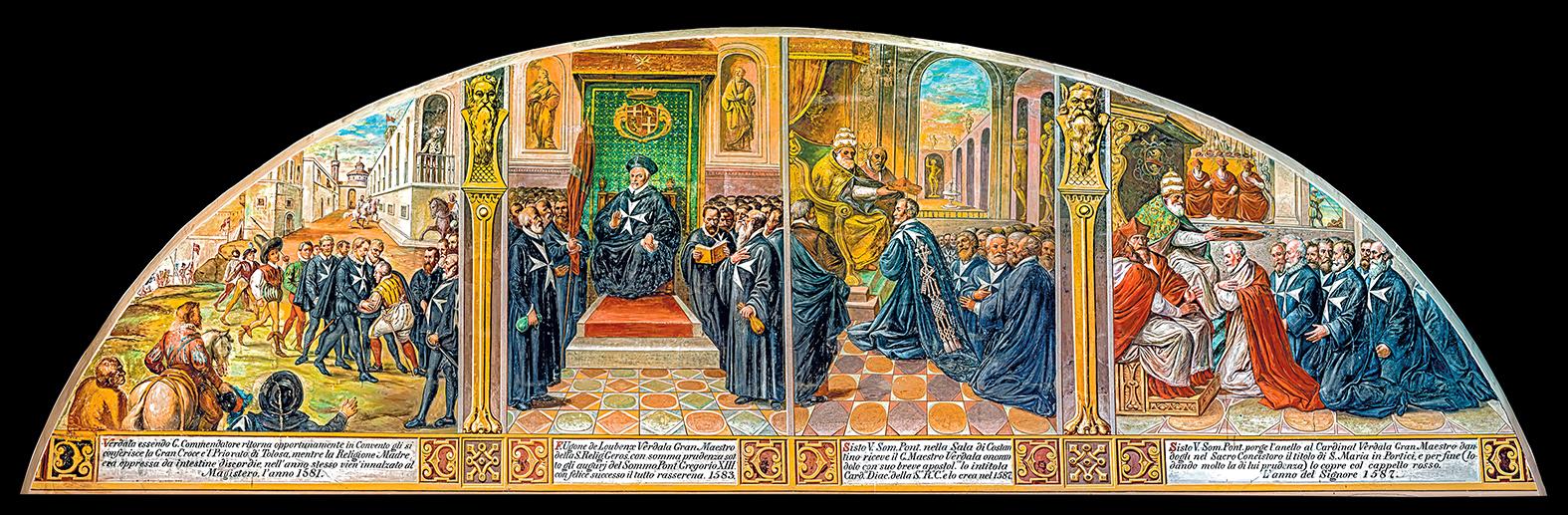 Filippo Paladini, Episodes in the life of Verdalle, Verdala Palace. Photo: Daniel Cilia/Courtesy Heritage Malta
The grand master handed over his personal seals for safe keeping and readmitted to the Order three delinquent knights who had recently been expelled for serious crimes: Fra Giulio Gattinara, Fra Ferdinando Sanazzaro and Fra Ferdinando Vice Conte.
By April 29, his birthday, he signed a letter in Italian to the Holy See, to update it about what he believed to be an improvement of his health and instructed the Admiral of the Order, Fra Pietro Rocca, to deliver it. But, immediately after, a violent stroke floored him. He asked for the chaplain of the Palace and some Capuchins – his darling Order – to be present and to assist him. They administered the last sacraments. He died on May 4 aged only 64 – the youngest grand master of Malta to pass. His entourage ordered his silver and iron seals to be shattered, and the fragments given to the vice-chancellor.
The surgeons opened (eviscerated?) and embalmed the body, and laid it, dressed in cardinal’s vestments, at the centre of the major council hall of the Palace for public homage by the members of the Order and by the people. 170 knights swarmed to kiss his hand, followed by interminable queues “of all classes of the population”.
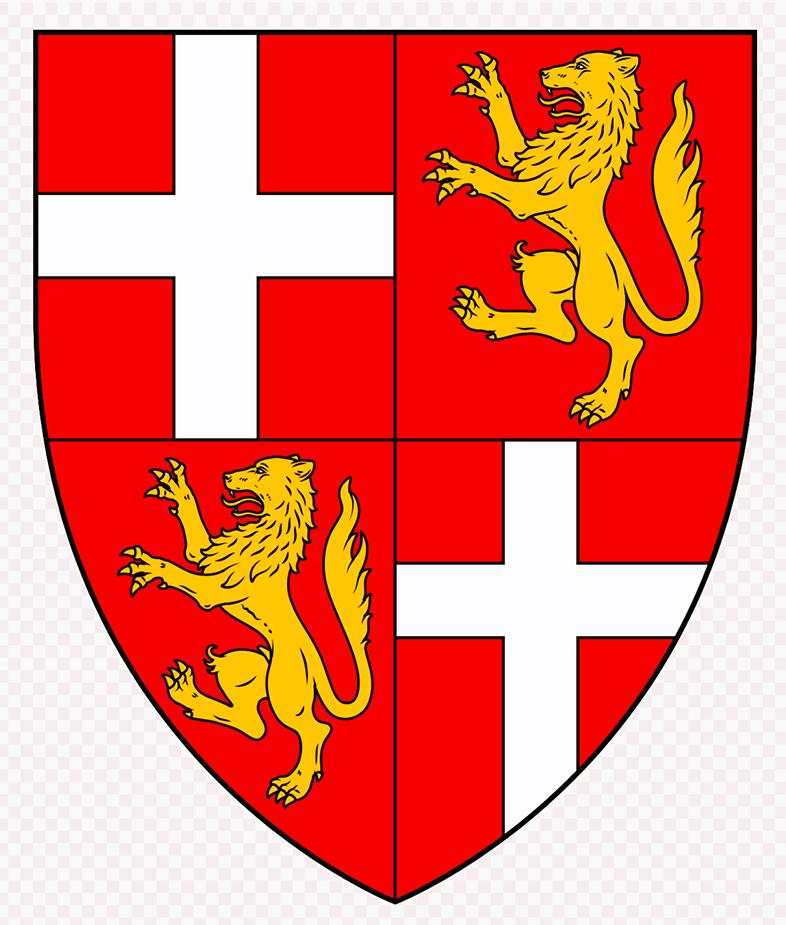 The Verdalle coat of arms
Contemporary records describe the elaborate, almost baroque, pomp of Verdalle’s funeral ceremonies and burial. The Order had a standard protocol for the last rituals due to grand masters about to be buried but with Verdalle’s corpse, they were dealing with a grand master who also doubled as a cardinal, so the scenography had to be upped several notches. It was.
They looked back to replicate the funeral of Cardinal Grand Master D’ Aubusson in July 1503 in Rhodes. The panoply of funerary gala, the props, the chants, the vestments, the charities, the decorations, must have been sombrely dazzling. I was curious to learn what music then played in St John’s. Was it Palestrina? Gesualdo? Marenzio perhaps, or Gregorian plainchant? Sadly, the records, so lavish in others, overlook this detail. Just cantata la messa di requie dal Priore della chiesa (the requiem mass having been sung by the prior of the church).
The stage was well and truly set for the next grand master of the Order of St John and prince of the Maltese Islands, the Aragonese Fra Martin Garzes.
Acknowledgements
Carmel Cassar, Daniel Cilia and Jeremy Debono.