Smoking rates hit record lows in Malta, but it’s only the men
The smoking rate of women in Malta has remained virtually the same
Cigarette smoking rates have fallen to record lows, but Malta’s 20-year progress against tobacco use is entirely attributed to men, new research shows.
The percentage of male smokers has plummeted from 2001 to 2023, while for women it has remained virtually unchanged over the same period, the General Population Survey on Alcohol, Tobacco, and Drug Use in Malta, shows.
Researchers conducted a survey through phone calls with 3,500 people across different age groups and regions in 2023. Data provided comes with a margin of error of +/-1.65% at a 95% confidence level.
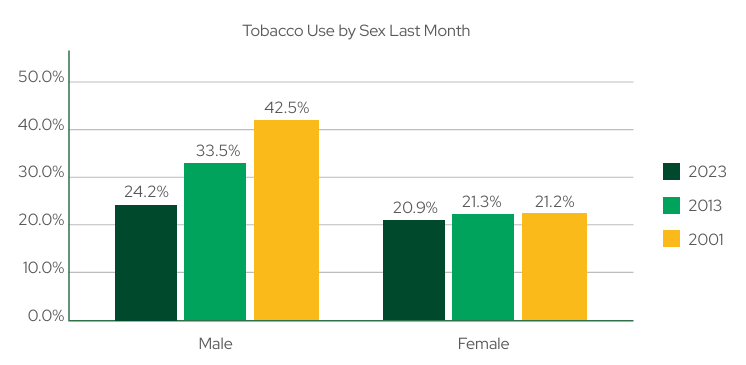 The graph shows that the percentage of men who smoked in the past month decreased drastically, while for women, this remained relatively unchanged. Photo: Social Policy Ministry
Results show that in 2001, 42.5 per cent of male participants said they smoked in the past month, but this dropped to 24.2 per cent in 2023. Meanwhile, in 2001, 21.2 per cent of female participants reported smoking in the past month. Twenty-two years later, that rate remains steady at 20.9 per cent.
For recent tobacco users, defined as anyone who smoked in the past year, women actually reported a slight increase. Male rates dropped from 44.5 per cent in 2001 to 28.4 per cent, while women went from 22.5 per cent to 23.3 per cent over the same period.
Anti-smoking campaigns generally target men
Speaking to Times of Malta, gender studies professor Marceline Naudi said that one possible explanation for the results is that, generally speaking, men smoke more than women, meaning anti-smoking campaigns are more often targeted at men.
“This can be compared to AIDS epidemic campaigns that originally mainly targeted gay men. While infection rates among gay men declined, they remained largely unchanged among other groups,” she said.
Malta’s overall smoking rate stands at 22 per cent (roughly 54,000 people), which places it in the middle of the EU pack. But while smoking is declining rapidly in absolute terms, the country’s failure to make a dent in female smoking rates means it is actually drifting down the EU ranking table.
Ireland and Belgium, which used to have higher overall smoking rates than Malta’s, now rank better.
Had Maltese women quit smoking at even half the rate of men, Malta would rank among the top five European countries for low smoking rates. Instead, it ranks 13th out of 27 countries.
The figures reveal an odd irony at the heart of Malta’s battle against tobacco: twenty years ago, Maltese women were less likely to light up than their EU peers, and Malta’s rate was around the average due to men’s high smoking rate. Today, the inverse is true.
Why aren’t women quitting?
Malta is not alone in its struggle to get women off cigarettes, though it is doing worse than its peers. Austria, Sweden and the UK, for instance, have dramatically cut female smoking rates over the past 20 years.
Still, Europe has the world’s largest number of female smokers and is reducing tobacco use among them more slowly, World Health Organisation data shows.
Brain imaging research has shown that women’s brains register significantly higher cigarette cravings at certain moments in their menstrual cycle, and other studies have shown that nicotine patches – frequently used as a public health tool – are much less effective on women than on men.
That may be because women are more likely to smoke to manage their mood or for stress relief, other studies have suggested, as opposed to men, who are more likely to seek nicotine highs provided by cigarettes.
Are young people turning to vapes?
The study also shows that cigarette smoking is increasingly an older person’s game, as the rate of smokers between the ages of 18 and 29 has significantly dropped, while there has been negligible progress for older adults aged 45 to 65.
However, the reduction in cigarette smoking among younger adults may be at least in part due to a shift from cigarettes to vapes, as 18- to 29-year-olds are the most frequent vape users, with over a third vaping daily.
The study does not touch on smokeless nicotine products, but earlier this year, Times of Malta reported on widely available nicotine pouches, as well as how smokeless tobacco products could be the key to help Malta quit cigarettes.